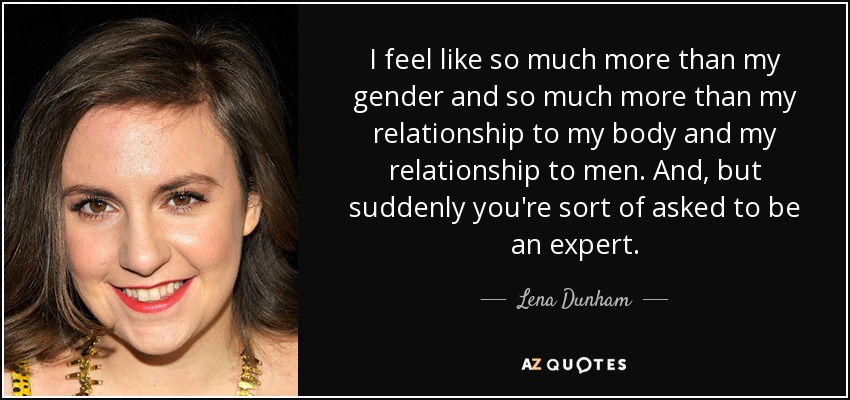
I feel like so much more than my gender and so much more than my relationship to my body and my relationship to men. And, but suddenly you're sort of asked to be an expert.
To me, my version of feminism, it's co-extensive with human rights and democracy. It's just part of the same fight for everyone being free, and having autonomy and dignity. It's not pitting one gender against another, it's not saying anything is better, it's just clearing away injustice.
I think gender inequality is a problem that goes back a long, long time. In human society, as a whole, women have tended to have a kind of inferior position - very often combined with playing up women as great role [models].
Gender inequality is not one problem, it's a collection of problems.
Education makes us the human beings we are. It has major impacts on economic development, on social equity, gender equity. In all kinds of ways, our lives are transformed by education and security. Even if it had not one iota of effect [on] security, it would still remain in my judgment the biggest priority in the world.
Education could be a great vehicle for gender equity. It allows people to see what your rights are by reading. Quite often women, for example, may have rights that they are not in the position to actually make use of.
What drives me is a sense of urgency. We live in frightening times. Progress towards gender equality and vital battles to end discrimination on grounds such as race, age, sexuality and disability are stalling and in some places, reversing. This is happening because of the collapse of trust in nearly all public institutions, and in particular in politics and media, and the inescapable feeling that the current system isn't working for most people.
While gender stereotypes can have negative impacts on men as well, the vast majority of structural gender inequality: socially, politically, professionally and economically, as well as the overwhelming burden of sexual violence is disproportionately borne by women.
The idea that feminism is a 'battle of the sexes' about blaming all men and setting up a 'gender war' is a handy, controversial media hook. But it doesn't reflect reality.
It's true that the gender pay gap is complicated. It's true that it is very slowly getting smaller. But that doesn't mean it doesn't exist. It would have to be a pretty HUGE conspiracy for every reputable major news outlet to report on it annually if it was a massive feminist lie.
Issues of the economy are profoundly affected by how you live out sexual orientation and gender identity.
In women's shelters the kind of clothes that women are given to go to job interviews are all girl clothes: little heels, little skirt. If you're gender nonconforming, you're a lesbian, you're not going to put those clothes on to go to a job interview.
I don't think that the forms of feminism that are prevailing on campus are left wing. It's a conservative form of feminism in gender politics and there [isn't] anything particularly progressive about it. That's what is baffling. You've got conservatives acting like liberals touting free speech and due process.
All of great leaders evidence four basic qualities that are central to their ability to lead: adaptive capacity, the ability to engage others through shared meaning, a distinctive voice, and unshakeable integrity. These four qualities mark all exemplary leaders, whatever their age, gender, ethnicity, or race.
I think the Resurrection continues to be a pivotal issue, a pivotal question for people. I think a lot of other issues have been raised in interim years, about the nature of truth, of course gender issues, issues involving social matters like abortion and euthanasia and so forth, those swirl about and change from time to time, but I think the fundamental question of whether or not Christianity is true ultimately goes back to the Resurrection.
That, to me, is what I feel like is the future. If I have a daughter, if you have a daughter, becoming that ideal where it's not about your gender; it's about us being human, being in this together.
There was no real gender definition in the sense of how you treat people in those days with gender differences. You avoided them. My parents always told me that you do not make fun of anybody, and so I didn't see anything funny about it.
I grew up with a sense of tolerance. I don't know that there was any talk about gender differences. It was respect for people. So when I became a professional and saw that there were a lot of differences in the sense of how people lived their lives, I became respectful of their territory, of their thoughts and their ideas, and it was never a problem for me to feel that this is my sister, this is my brother.
No matter whether one feels one's gendered and sexed reality to be firmly fixed or less so, every person should have the right to determine the legal and linguistic terms of their embodied lives. So whether one wants to be free to live out a "hard-wired" sense of sex or a more fluid sense of gender, is less important than the right to be free to live it out, without discrimination, harassment, injury, pathologization or criminalization - and with full institutional and community support.
I did not mean to argue that gender is fluid and changeable (mine certainly is not). I only meant to say that we should all have greater freedoms to define and pursue our lives without pathologization, de-realization, harassment, threats of violence, violence, and criminalization. I join in the struggle to realize such a world.
The fact that I'm a woman is as important to my work as a poet as the fact that Ahmad Shāmlu was a man was important to his work as a poet. Basically, gender shouldn't be viewed as an advantage in art. If a poem or a piece of writing is good, what difference does it make whether it's by a woman or a man? And, if it's bad, why should its writer's gender make it good?
Human beings make mistakes, so we all make mistakes and wrong decisions. Being able to make a decision and act upon it is not gender specific.
I once asked Myung Mi Kim where gender is located in her work, and she said simply, "it's everywhere," resisting the notion that gender needs to be overly inscribed into the text with some kind of message. Hers is the kind of work that has most influenced how I make poetry - the idea that we don't need to enclose or nail down gender or race, for that matter.
When it comes to gender, marriage, family, work, and religion - we once thought of them as being fixed, but they're incredibly fluid. The same is true for love. Love was not something that was originally built between two equal partners in a relationship. It's something that's been hard-earned over time.
We need to humanize women instead of making the idea of a woman be so stigmatized. That's what's interesting to me as a writer and a director - being able to tell stories that represent women as human beings and don't relate specifically to their gender. I want to just allow them to have their journeys.
Follow AzQuotes on Facebook, Twitter and Google+. Every day we present the best quotes! Improve yourself, find your inspiration, share with friends
or simply: