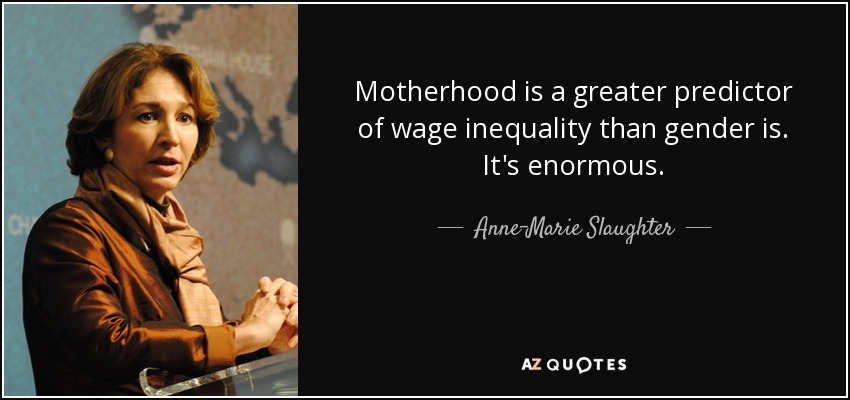
Motherhood is a greater predictor of wage inequality than gender is. It's enormous.
When we talk about gender pay gaps in the United States, and if you look at women without children, they earn 96 cents for every dollar that a man is earning, while for mothers it is about 76 cents. That's nearly 25 percent less. For single mothers, the situation is even worse. One third of them are living in poverty or just on the edge of poverty. This is an unacceptable situation.
The two most important forms of diversity when it comes to innovation are visible diversity (typically skin color, age, gender, etc.) and underrepresentation (anytime someone is less than 15% of the majority group). Other forms of diversity are also relevant but these are the ones that psychologically play the most role in how someone engages with the innovative process.
For years we've been treating men and women as though the only differences had to do with our sexual organs. The field of Gender-Specific Medicine was launched by cardiologist Marianne J. Legato, M.D. in 1997 when she recognized that a gender-neutral approach could be harmful to both men and women.
It was long assumed that heart disease manifested the same in men and women. But Dr. Legato found that men may experience the classic symptoms of chest pain that radiates down the left arm. Women often have symptoms including shortness of breath, nausea or vomiting, and back or jaw pain. A gender-neutral approach left many women under-diagnosed and under-treated and as a result many women died needlessly.
Looking at health through a gender lens is the first step to a more helpful and personalized approach to healing.
So the aim for the press was a mixture of things: to publish under-represented writing, which is an intersection of original language, style, content, and often its author's gender. To publish it properly, in a way that makes it clear that this is art, not anthropology. To spotlight the importance of translation in making cultures less dully homogenous.
Khairani Barokka is a writer, spoken-word poet, visual artist and performer whose work has a strong vein of activism, particularly around disability, but also how this intersects with, for example, issues of gender - she's campaigned for reproductive rights in her native Indonesian, and is currently studying for a PhD in disability and visual cultures at Goldsmiths. She's written a feminist, environmentalist, anti-colonialist narrative poem, with tactile artwork and a Braille translation. How could I not publish that?
The gender gap looks at this point like it's going to favor the president, particularly among white suburban women. I certainly think it's going to be an issue. But I think the single most important thing in this election will be turnout.
I'm excited about representing my gender, but at the same time it doesn't matter. I wouldn't say my gender has been a disadvantage.
I think that's my hope for a lot of the feminist movement is that the gender thing sort of stops being the selling point, if that makes any sense. We're just people making art, and that's how this process has felt to me.
I think we're at a really rich and fertile time in the zeitgeist about paying attention to diversity of all kinds - racial diversity, gender diversity, making room for a continuum that is more inclusive.
I've always been interested in writing from other people's perspectives and other gender perspectives.
Gender relations are a sad story of men talking trash about women all over the world.
Depression as one example is an illness that has a chemical basis, but also is deeply embedded in cultural norms about gender, social class, race.
There's going to be biological differences between the genders. There's going to be biological differences between two women or two men. There's biological differences between all of us. My concern is, why are we so concerned about it?
Intimate justice touches on ideas of gender inequity, violence, bodily integrity, physical and mental health. I don't expect a 15-year-old girl to have that figured out; it's hard enough to have it figured out when you're 50.
It's not gender-specific, but I do think it's women who tend to start having that sort of little whispering voice of "I want more here" and "I want more for my family."
The fact is that most husbands, regardless of religion - it's an old-fashioned gender divide where the husband wants to stay home and the wife is the one who drags herself and her children to whatever spiritual center they're going to.
If you watch [The] Search for Signs of Intelligent Life [in the Universe], or The Incredible Shrinking Woman, or 9 to 5, there is a lot of gender politics at the forefront of Lily Tomlin work, which was kind of thrilling for me to be watching as a 10-, 11-, 12-year-old kid.
On the most recent battles on health insurance reform, the women led the battle to end gender discrimination by the insurance companies [where] women paid more and got less of a benefit, and also the whole issue of prevention.
I feel nowadays that both women and men are embracing their individuality rather than being defined by gender roles.
I believe in gender equality and I love that I can represent strong modern-day women.
I hate to get gender essentialist, but I'm starting to think that a lot of married men have some sort of heterosexually induced dentistry aversion.
I'm really lucky because my sister is a real activist soul and also hyper-intellectualized in this way that's really allowed me to wrap my mind around some of the bigger intellectual concepts and really understand the language around identity in the gender nonconforming community.
Follow AzQuotes on Facebook, Twitter and Google+. Every day we present the best quotes! Improve yourself, find your inspiration, share with friends
or simply: