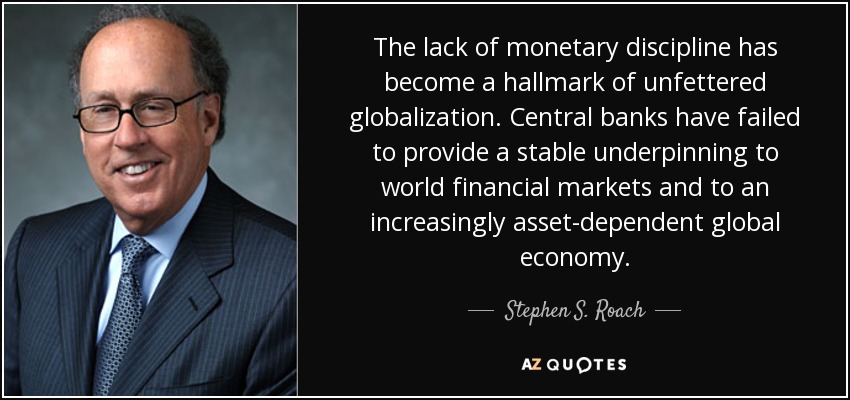
The lack of monetary discipline has become a hallmark of unfettered globalization. Central banks have failed to provide a stable underpinning to world financial markets and to an increasingly asset-dependent global economy.
To globalize for the sake of globalizing-as a matter of ego-is perilous. Expanding internationally is hard, risky work. Globalization is not just about putting up a plant. It's not about making an acquisition. It's much, much more.
Where do people earn the Per Capita Income? More than one poor starving soul would like to know. In our countries, numbers live better than people. How many people prosper in times of prosperity? How many people find their lives developed by development?
I think the twenty-first century happened, basically. That this century started on 9/11. And basically, it's been a century of counter reaction to globalization and the meritocracy. And a good century for 72 nations have gotten more authoritarian. We've had Brexit. We have Le Pen rising in France. We've just got a lot of these types all around the world. And the people who are suffering from globalization and the meritocracy are saying, "No more. You know, we get a voice too."
The religious rightwingism is directly linked to globalization and to privatization. When India is talking about selling its entire power sector to foreign multinationals, when the political climate gets too hot and uncomfortable, the government will immediately start saying, should we build a Hindu temple on the site of the Babri mosque? Everyone will go baying off in that direction. It's a game.
People are really excited by Obama abroad because he seems to be the first American presidential candidate who has ambition to go out of the country. In a sense, with the power of globalization, you are kind of electing the leader of the Western world to an extent.
I'm trying to see if I can speak about our society today, but I cannot speak about the theme, because it's a bit difficult. I'm just starting to work on that. Because we live in a kind of world which has drastically changed in the last years. We speak about globalization, and how it's become the reason for everything. It has a kind of deep meaning. To be everywhere and to be nowhere at the same time. You think to globalize, you think, the Earth, it's your country. No, it's not your country. It's not easy to catch it in a cinema. It's too huge.
For Russians in the '90s, there was that sense of not knowing what the future held at all. And coming off a long period of when people actually were robbed of the ability to plan their future - that's very much a part of totalitarian control - that exacerbated it. In this country, we are not coming off a long period like that. But I think that for a lot of Americans, as a result of globalization, as a result of the housing crisis, the future is just too uncertain. And their place in the world is too uncertain.
An active propaganda machinery controlled bv the world's largest corporations constantly reassures us that consumerism is the path to happiness, governmental restraint of market excess is the cause our distress, and economic globalization is both a historical inevitability and a boon to the human species.
Now that the most interesting matter of identity is not what place someone was born in, but what point in time they are from - where they sit in relation to time. Age has become much more divisive than place. With the Internet and globalization, a twenty-year-old in New York has far more cultural references in common with a twenty-year-old in Nebraska than they do with a thirty-year-old who lives next door. National identity is what they trick you with when they want your feet in their army boots or your taxes in their bailouts.
The central base of world political power is right here in America, and it is our corrupt political establishment that is the greatest power behind the efforts at radical globalization and the disenfranchisement of working people.
There are some very difficult things to understand that globalization is providing, that people really think are just here but really are a function of some of that. There are some very difficult arguments.
The governments are seen to be less effective than they used to be. The private sector is perceived as being so much more efficient, and so globalization implies a transfer of power to the private sector.
Indian intellectuals today feel radical when they condemn fundamentalism, but not many people are talking about the links between privatization, globalization, and fundamentalism.
When Mrs. Clinton ran for office, she promised economic growth across New York state, to bring in more than 200,000 jobs, ... She has not. We have lost jobs to outsourcing and globalization and to sending our jobs and industries to foreign countries.
Especially now, the immigrant problem is very dramatic around the world. Because we don't know what to do with them. They're in economic crisis, and there are more and more. There will be more and more. We speak about globalization of economy, but it's also globalization for immigration. Millions of people, they're willing to have a better life. A better life, they cannot have it where they live, so they move.
We have to think about what the future is going to look like for people. People are afraid of robotization; they're afraid of globalization; they're afraid of all these things. And Trump's solution to that is: shut the borders; America first; everything's got to be made here, which is of course, not realistic - in his own companies everything's not made here at all - but I think we have to engage in issues that do cross these demographic boundaries.
I don't live in Ireland, I live in London with my girlfriend; and it's because of the globalization of our planet, it's not necessary to live in Los Angeles to be a successful and any country is just an airplane ride away. If there's a director who wants to meet me or if there's something I have to do, I can just hop on an airplane - the world's small now.
I think of what's happening in Detroit as part of something that's much bigger. Most people think of the decline of the city as having to do with African-Americans and being in debt, and all the issues like crime and bad housing. But what happened is that when globalization took place, following World War II, Detroit's role as the center and the symbol of industrialization was destroyed. It wasn't because we had black citizens mainly or a black mayor; it was because the world was changing.
The standardization and specialization of industrialization was being undermined by globalization. When people in Bangladesh could produce things much more cheaply than anybody could produce them in Detroit, we no longer were the world capital of industrialization.
I think we have to understand that the nation-state became powerful in the wake of the French Revolution, whereas the nation-state has become powerless in light of globalization.
I think we will become disenchanted with the glamour of globalization.
The idea of protest organizing, as summarized by community organizer Saul Alinsky, is that if we put enough pressure on the government, it will do things to help people. We don't realize that that kind of organizing worked only when the government was very strong, when the West ruled the world, relatively speaking. But with globalization and the weakening of the nation-state, that kind of organizing doesn't work.
Despite all the boosterish talk of globalization breaking down barriers, most writers in Anglo-America are still working within the nationalist assumptions of their traditionally powerful societies.
Today what we see is tribes moving into the 21st century and facing real 21st century problems of globalization, of multi-national, national resource development, of jobs, tribes have elected leaderships. They're elected to do a lot of things.
Follow AzQuotes on Facebook, Twitter and Google+. Every day we present the best quotes! Improve yourself, find your inspiration, share with friends
or simply: