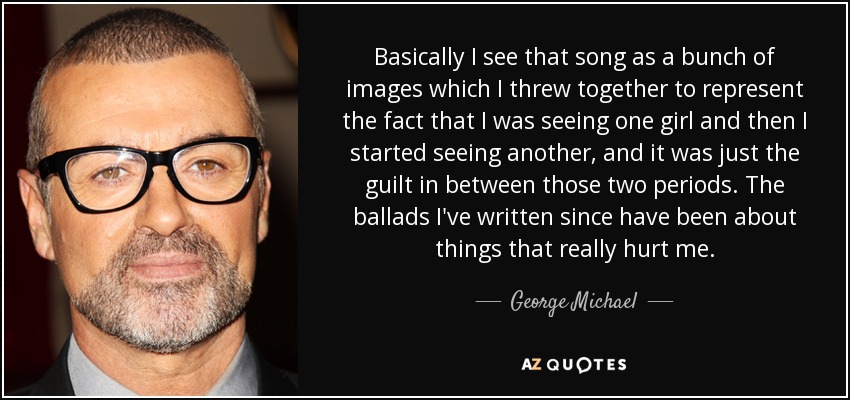
Basically I see that song as a bunch of images which I threw together to represent the fact that I was seeing one girl and then I started seeing another, and it was just the guilt in between those two periods. The ballads I've written since have been about things that really hurt me.
A different kind of pleasure surfaced in the aftermath, the pleasure of seeing the towers fall time and again, the experience of being entranced by the visual spectacle, and then also the very graphic forms of public mourning for exemplary citizens (taking place at the same time as the refusal to mourn the undocumented, the foreign, gay and lesbian lives lost there, for example). I am not sure that the guilt over the pleasure re-installed the good citizen.
I do not believe in collective guilt.
Like every working mother, there's guilt involved in deciding how you're going to balance family and work.
I have Type-1 diabetes, so Team 1 Diabetes is one thing I've been a part of for a while, empowering kids who have diabetes to know they can do anything they want to do. It's amazing, how much guilt and sadness comes with a kid when they find out they're diagnosed with diabetes.
Sex is where you find it. I say take it and enjoy it. Give and receive freely, without fear, without guilt and without contractual obligations.
I think once a Catholic, always a Catholic. You never escape. I still have Catholic guilt. It is in its basis a really powerful religion and a really strong set of beliefs. They permeate my work in many ways.
Kafka had the sense of guilt. I don't think I have because I don't believe in free will. Because what I have done has been done, well, for me or through me. But I haven't done it really. But I don't believe in free will, I can't feel guilty.
Some people are guilty when they win. Some people, "Ah, you know, it's so unfortunate, some people had to lose." I mean, even some modern-day competitors, athletes have a guilt complex about winning. They think it isn't fair. That's not how you win. You don't feel guilty when you wine, and you don't feel sorry for anybody about it.
I didn't wake up one day and say, I have to tell O.J.'s Simpson story. But what drew me to it wasn't what people have focused on over the last 20 years - meaning, the question of innocence or guilt, nor the spectacle of the trial. I was more interested in the history that led up to that point in time in 1994, which would help explain what exactly went into making the trial as fascinating as it was.
"It is finished" means that Jesus had accomplished all that God's mission had sent him to do. It did not merely mean that his life was over like, "I'm finished". It was a statement of achievement of purpose - God's purpose to deal with sin and guilt, to defeat all the powers of evil, to bring about the reconciliation of enemies, to defeat death itself, and to accomplish the reconciliation and liberation of the whole creation.
I grew up outside of Seattle, and have lived here my whole life, and I think that there is a culture of questioning, and guilt. Almost an "anti-ambition." Like, an awareness, and then a subsequent guilt. But sometimes that progressive, liberal guilt is really obnoxious, too - in some ways, I think it's better to just own it. It's weird, that actually, the acknowledgement of privilege or the enactment of guilt can be as obnoxious as anything else. It's a never-ending rabbit hole. We're really in a rabbit hole right now, with this conversation. We're just spiraling down into the void.
The amount of guilt you deal with as a parent is pretty profound. It's a constant balancing act. I'm an ambitious person, but when I became a father, ambition had a different hold on me. Providing for my kids was important, but the superficial ambition drifted away.
Malibu history is interesting to me. My mom's family was one of the early families in California, so there's history going back to the 1840s or '50s. They came over in the Gold Rush, actually. I have all this guilt about raising my daughter in the East. Coco's very anti-California. It's her way of rebelling.
Maybe it's the Calvinist guilt about capitalism or mercantilism. But, I like the idea of doing things that only exist for as long as they exist, which are not archives, which are not sold or prepared even. It's funny though, because a lot of my unreliable tours were inspired by the docents at the Japan Society, who are mostly these volunteers from the Upper East Side. They basically find positive messages in really nihilist, perverse videos. So they were my inspiration.
We've been taught that the Christian life is a life of peace, and when we don't have peace, we assume the problem lies within us. Not only do we feel anxious, but we also feel guilty about our anxiety! The result is a downward spiral of worry, guilt, worry, guilt.
Our aim - our only aim - is to be at home in Christ. He's not a roadside park or hotel room. He's our permanent mailing address. Christ is our home. He's our place of refuge and security. We're comfortable in his presence, free to be our authentic selves. We know our way around in him. We know his heart and his ways. We rest in him, find our nourishment in him. His roof of grace protects us from storms of guilt. His walls of providence secure us from destructive winds. His fireplace warms us during the lonely winters of life. We linger in the abode of Christ and never leave.
I see a lot of people who have amazing stories but have been told that their work, their lives, and their stories and not the stuff of literature. Or they're first-generation college student, first-generation American, and their family just doesn't understand the art world. They have a lot of guilt. "We came all the way from [wherever] so you could do this?" Those people may not be showing the moxie, but that's because they don't even know what's possible. So I want to jump in and say, "Actually, your story is amazing, and I believe in you.".
Never feel guilty. Don't hold yourself back by guilt or fear. No other species in the entire world deals with guilt. Guilt is a bizarre emotion that makes you feel bad about decisions that you make.
Global warming people ignore nature; they ignore water vapor; they ignore sunspot cycles and sun activity. It's typical liberal guilt and politics wanting to blame western societies and lifestyles for causing all these problems because it leads to government and United Nations solutions, and that's where liberals like power vested. And of course when people come along and don't agree, they gotta be shut up.
I have a great female support system. We encourage each other because we all face some of the same difficulties. We all experience mommy guilt. It's always great to have an uplifting support system.
People grow up learning to be silent about their sexuality, so where are they going to learn to talk about it when they are in a relationship? Shame, guilt, ignorance, reservation, prudishness, all kinds of different cultural systems and social stereotypes shroud sexuality in secrecy and in silence. And there's the romantic notion. "If I say in the beginning, that I am missing something, you are instantly going to think that means you are not enough."
If guilt tells us that we've done something wrong, then shame tells us that we are something wrong. So many people feel isolated, not good enough, defined by the labels they wear rather than the identity they have in Christ. The love of Christ tells us that we're accepted; that we belong.
You feel guilt when you're not necessarily in the best mood and you say to your fans "No, I don't want to take a photo," or you're not as happy or bubbly as they probably thought you would be. I've had to remind myself that's okay. No one's forcing me or any other celebrity to take time out of their day to say hi to these fans or do these things. There is a sense of guilt that you can feel sometimes for not meeting their expectations, but that's kind of wrong for me to think that way, because I am a person.
If you discuss the beliefs of Christianity with the village diviner, the medicine man, he will say the white man must be extremely stupid. The white man must be profoundly troubled - probably torn by a huge guilt connected to how he treated the ancestors - to think that villagers would buy the idea that someone died on the cross for us. They would say these beliefs are evidence that the white people killed someone of great importance, probably a diviner and a healer. If you kill a healer, you must make amends by appeasing the healer's spirit.
Follow AzQuotes on Facebook, Twitter and Google+. Every day we present the best quotes! Improve yourself, find your inspiration, share with friends
or simply: