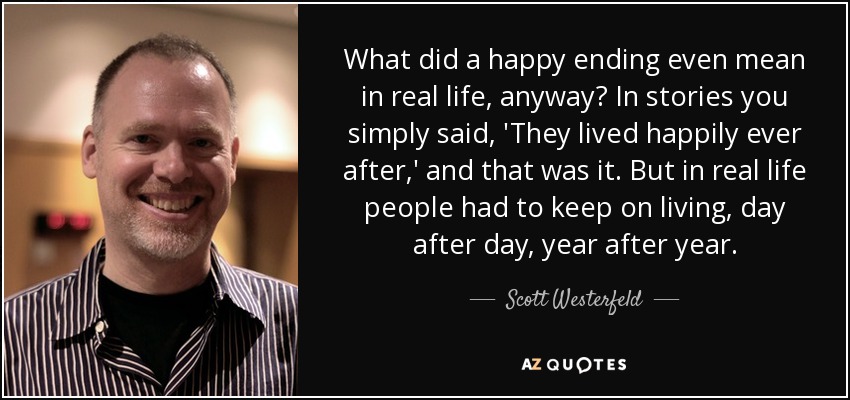
What did a happy ending even mean in real life, anyway? In stories you simply said, 'They lived happily ever after,' and that was it. But in real life people had to keep on living, day after day, year after year.
You can write something that has continuity, but it makes happy endings all the more ridiculous.
I think it makes people frustrated when they have to live their actual lives commercial free and they can't just magically wind up at the part with the happy ending.
All analyses end badly. Each 'termination' leaves the participants with the taste of ashes in their mouths; each is absurd; each is a small, pointless death. Psychoanalysis cannot tolerate happy endings; it casts them off the way the body's immunological system casts off transplanted organs.
Alcoholism plus criminality plus whatever caused both in the first place form a combination that is very nearly happy-ending-proof.
I was the original Cinderella girl, looking for the happy ending in the fairy story. But my fantasy prince never came.
In America there's a tendency to write the same book over and over because that's what sells. So in a way, my success in America has come at the expense of what I do. I haven't sold out, and I haven't taken the popular road to writing a best-selling book. I've really bucked the system. So it was necessary for me not to go and find the easy fans, the ones who want something digestible and fast with a happy ending that they can read over and over again no matter how many different books it is. I had to find fans who really wanted to think. Worldwide they all have that in common.
Whether histories have a happy ending or not depends on when the chronicler ends the tale.
The side of fairytales I don't like is that they always have happy endings, that there's just good and evil, and things are perfect. But life is a little more complicated, and that's what I try to teach my kids.
Fantasy-based ideologies invariably have neat happy endings where all the bad people and all the bad behavior goes away when the volume is turned up and enough force is applied.
The making of miracles to edification was as ardently admired by pious Victorians as it was sternly discouraged by Jesus of Nazareth. Not that the Victorians were unique in this respect. Modern writers also indulge in edifying miracles though they generally prefer to use them to procure unhappy endings, by which piece of thaumaturgy they win the title of realists.
At the center of the religious life is a peculiar kind of joy, the prospect of a happy ending that blossoms from necessarily painful ordeals, the promise of human difficulties embraced and overcome.
The happy ending is hardly important, though we may be glad its there. The real joy is knowing that if you felt the trouble in the story, your kingdom isnt dead.
Not everything has a happy ending, and not everything has an ending. Some things just kind of dribble away or cut off abruptly.
For me, a happy ending is not everything works out just right and there is a big bow, it's more coming to a place where a person has a clear vision of his or her own life in a way that enables them to kind of throw down their crutches and walk.
Socialist writers are made of sterner stuff than those who only let their characters steeplechase through trouble in order to comeout first in the happy ending of moral uplift.
At the happy ending of the Tempest, Prospero brings the kind back togeter with his son, and finds Miranda's true love and punishes the bad duke and frees Ariel and becomes a duke himself again. Everyone - except Caliban - is happy, and everyone is forgiven, and everyone is fine, and they all sail away on calm seas. Happy endings. That's how it is in Shakespeare. But Shakespeare was wrong. Sometimes there isn't a Prospero to make everything fine again. And sometimes the quality of mercy is strained.
The bourgeoisie is very fond of so-called practical types and novels with happy endings, since they soothe it with the idea that one can both accumulate capital and preserve innocence, be a beast and at the same time be happy...
Every day is an opportunity to make a new happy ending. May you live all the days of your life.
In this deeply nuanced portrait of an American family, Bret Anthony Johnston fearlessly explores the truth behind a mythic happy ending. In Remember Me Like This, Johnston presents an incisive dismantling of an all-too-comforting fallacy: that in being found we are no longer lost.
The happy ending of the fairy tale, the myth, and the divine comedy of the soul, is to be read, not as a contradiction, but as a transcendence of the universal tragedy of man. The objective world remains what it was, but, because of a shift of emphasis within the subject, is beheld as though transformed. Where formerly life and death contended, now enduring being is made manifest-as indifferent to the accidents of time as water boiling in a pot is to the destiny of a bubble, or as the cosmos to the appearance and disappearance of a galaxy of stars.
The older you get, the more you live with ghosts.
The older you get, the more you learn.
This is where the story starts, in this threadbare room. The walls are exploding. The windows have turned into telescopes. Moon and stars are magnified in this room. The sun hangs over the mantelpiece. I stretch out my hand and reach the corners of the world. The world is bundled up in this room. Beyond the door, where the river is, where the roads are, we shall be. We can take the world with us when we go and sling the sun under your arm. Hurry now, it's getting late. I don't know if this is a happy ending but here we are let loose in open fields.
I'm under strict instructions to write a happy ending. Rule number ninety-seven: You're not allowed to make a dragon cry." "Right," Said Sophie, starting the engine. "Tears might quench their fire.
Follow AzQuotes on Facebook, Twitter and Google+. Every day we present the best quotes! Improve yourself, find your inspiration, share with friends
or simply: