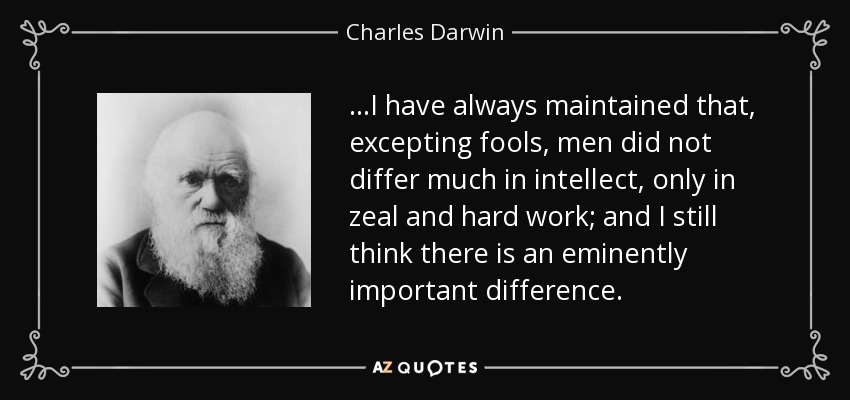
...I have always maintained that, excepting fools, men did not differ much in intellect, only in zeal and hard work; and I still think there is an eminently important difference.
Science is one land, having the ability to accommodate even more people, as more residents gather in it; it is a treasure that is the greater the more it is shared. Because of that, each of us can do his work in his own way, and the common ground does not mean conformity.
Honesty is a principle. Service is a principle. Love is a principle. Hard work is a principle. Respect, gratitude, moderation, fairness, integrity, loyalty, and responsibility are principles. There are dozens and dozens more. They are not hard to identify. Just as a compass always points to true north, your heart will recognize true principles.
A mathematician's work is mostly a tangle of guesswork, analogy, wishful thinking and frustration, and proof, far from being the core of discovery, is more often than not a way of making sure that our minds are not playing tricks.
According to Gandhi, the seven sins are wealth without works, pleasure without conscience, knowledge without character, commerce without morality, science without humanity, worship without sacrifice, and politics without principle. Well, Hubert Humphrey may have sinned in the eyes of God, as we all do, but according to those definitions of Gandhi's, it was Hubert Humphrey without sin.
Accurate and minute measurement seems to the non-scientific imagination, a less lofty and dignified work than looking for something new. But nearly all the grandest discoveries of science have been but the rewards of accurate measurement and patient long-continued labour in the minute sifting of numerical results.
After five years' work I allowed myself to speculate on the subject, and drew up some short notes; these I enlarged in 1844 into a sketch of the conclusions, which then seemed to me probable: from that period to the present day I have steadily pursued the same object. I hope that I may be excused for entering on these personal details, as I give them to show that I have not been hasty in coming to a decision.
All that we can hope from these inspirations, which are the fruits of unconscious work, is to obtain points of departure for such calculations. As for the calculations themselves, they must be made in the second period of conscious work which follows the inspiration, and in which the results of the inspiration are verified and the consequences deduced.
Anything worth doing is worth doing to excess.
Arts and sciences in one and the same century have arrived at great perfection; and no wonder, since every age has a kind of universal genius, which inclines those that live in it to some particular studies; the work then, being pushed on by many hands, must go forward.
Do the day's work. If it be to protect the rights of the weak, whoever objects, do it. If it be to help a powerful corporation better to serve the people, whatever the opposition, do that. Expect to be called a stand-patter, but don't be a stand-patter. Expect to be called a demagogue, but don't be a demagogue. Don't hesitate to be as revolutionary as science. Don't hesitate to be as reactionary as the multiplication table. Don't expect to build up the weak by pulling down the strong. Don't hurry to legislate. Give administration a chance to catch up with legislation.
Every work of science great enough to be well remembered for a few generations affords some exemplification of the defective state of the art of reasoning of the time when it was written; and each chief step in science has been a lesson in logic.
Good work is no done by "humble" men. It is one of the first duties of a professor, for example, in any subject, to exaggerate a little both the importance of his subject and his own importance in it. A man who is always asking "Is what I do worth while?" and "Am I the right person to do it?" will always be ineffective himself and a discouragement to others. He must shut his eyes a little and think a little more of his subject and himself than they deserve. This is not too difficult: it is harder not to make his subject and himself ridiculous by shutting his eyes too tightly.
Heat energy of uniform temperature [is] the ultimate fate of all energy. The power of sunlight and coal, electric power, water power, winds and tides do the work of the world, and in the end all unite to hasten the merry molecular dance.
I can say, if I like, that social insects behave like the working parts of an immense central nervous system: the termite colony is an enormous brain on millions of legs; the individual termite is a mobile neurone.
I cannot face with comfort the idea of life without work; work and the free play of the imagination are for me the same thing, I take no pleasure in anything else.
I find I'm luckier when I work harder.
I have lived much of my life among molecules. They are good company. I tell my students to try to know molecules, so well that when they have some question involving molecules, they can ask themselves, What would I do if I were that molecule? I tell them, Try to feel like a molecule; and if you work hard, who knows? Some day you may get to feel like a big molecule!
I think work is a privilege. ... It keeps you alive, spiritually.
I would visualize things coming to me. It would just make me feel better. Visualization works if you work hard. That's the thing. You can't just visualize and go eat a sandwich.
If science has no country, the scientist should have one, and ascribe to it the influence which his works may have in this world.
If there is no solace in the fruits of our research, there is at least some consolation in the research itself. Men and women are not content to comfort themselves with tales of gods and giants, or to confine their thoughts to the daily affairs of life; they also build telescopes and satellites and accelerators and sit at their desks for endless hours working out the meaning of the data they gather.
If we do not learn to eliminate waste and to be more productive and more efficient in the ways we use energy, then we will fall short of this goal [for the Nation to derive 20 percent of all the energy we use from the Sun, by 2000]. But if we use our technological imagination, if we can work together to harness the light of the Sun, the power of the wind, and the strength of rushing streams, then we will succeed.
If you do not feel equal to the headaches that psychiatry induces, you are in the wrong business. It is work - work the like of which I do not know.
In my understanding of God I start with certain firm beliefs. One is that the laws of nature are not broken. We do not, of course, know all these laws yet, but I believe that such laws exist. I do not, therefore, believe in the literal truth of some miracles which are featured in the Christian Scriptures, such as the Virgin Birth or water into wine. ... God works, I believe, within natural laws, and, according to natural laws, these things happen.
Follow AzQuotes on Facebook, Twitter and Google+. Every day we present the best quotes! Improve yourself, find your inspiration, share with friends
or simply: