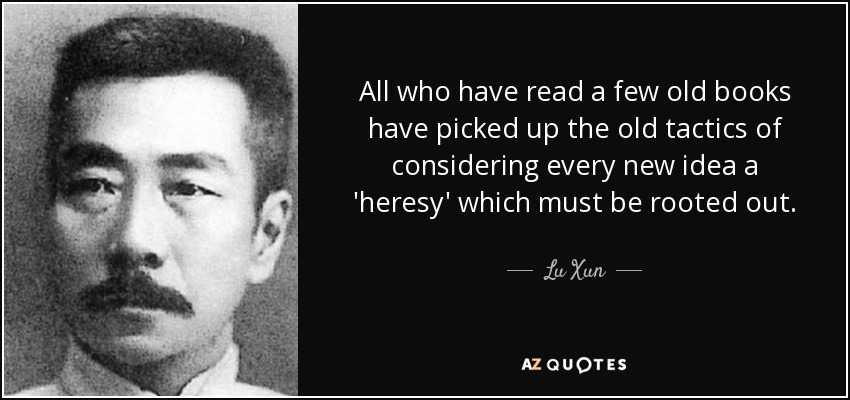
All who have read a few old books have picked up the old tactics of considering every new idea a 'heresy' which must be rooted out.
And so many of the people in the arena here, you know, were underprivileged anyway, so this is working very well for them.
Every heresy has been an effort to narrow the Church.
"Heresy," by the way, simply means "choice." It came to mean "thoughtcrime," implying it was blasphemy to presume to choose your own belief instead of swallowing what the bishops spoonfed you.
It follows from the assumption of a universally valid ideology, just as night follows day, that other positions are heresy.
A delusion held by one person is a mental illness, held by a few is a cult, held by many is a religion.
The testament of science is so continually in a flux that the heresy of yesterday is the gospel of today and the fundamentalism of tomorrow.
The greatest heresy in the American Evangelical and Protestant church is that if you pray and ask Jesus Christ to come into your heart, He will definitely come in!
The testimony of scripture is so plain that to add anything were superfluous, were it not that the world is almost now come to that blindness, that whatsoever pleases not the princes and the multitude, the same is rejected as doctrine newly forged, and is condemned for heresy.
When I read the documents relative to the Modernism, as it was defined by Saint Pius X, and when I compare them to the documents of the II Vatican Council, I cannot help being bewildered. For what was condemned as heresy in 1906 was proclaimed as what is and should be from now on the doctrine and method of the Church. In other words, the modernists of 1906 were, somewhat, precursors to me. My masters were part of them. My parents taught me Modernism. How could Saint Pius X reject those that now seem to be my precursors?
After Galileo was convicted (for heresy by the Spanish Inquisition) for his theory that the Earth revolved around the sun, ... he replied, `Still, the Earth is moving.'
[The 4 spiritual laws and sinner's prayer] is not the gospel of Jesus Christ, and that methodology and envangelism has done more to hurt this country than every heresy introduced by every cult combined. Millions of people in this country whose lives have never been changed believed themselves born again because we have so reduced the gospel of Jesus Christ that it means now nothing more than simple decision that will only take five minutes of your time.
The great modern heresy in poetry is to confuse the use we make of words in a poem with modalities of speech...For true poetry is never speech but always a song.
Fundamentalism in most of its forms is the active creation of antibodies to some threatening [god] virus. As long as threatening religions or mutations [heresies] are present, fundamentalism will churn out antibodies to keep the population under control and prevent mutations from getting out of hand.
But there is yet another form of this hidden heresy, and, paradoxically, it can affect those who are proudest of their long-standing and unimpeachable orthodoxy; heresy in the form of indifference.
We must nevertheless present all possible interpretations for each observation, so that competing theories can be formulated and defended. In science, as elsewhere, intellectual inertia, the fashions of the moment, the weight of institutions, and authoritarianism are always to be feared. Heresies play an essential role by keeping our minds argumentative and alert.
Let us pray for the Catholic Church; for the Churches throughout the whole world; that is, for their truth, unity, and stability; that in all charity may flourish, and truth may live. For our own Church, that what is lacking in it may be supplied; what is unsound, corrected; that all Heresies, Schisms, Scandals, as well public as private, may be removed. Correct the wandering, convert the unbelieving, increase the faith of the Church, destroy Heresies, discover the crafty enemies, crush the violent.
"Cynicism," like "heresy" and "heterodoxy" and "atheism" and "agnosticism" and "paganism" and "heathenism," is above all else a way for organized orthodoxy's caste of official censors to encyst and segregate and thus neutralize all contrarian forms of seeing and thinking, all (necessarily implicitly) prohibited and repressed ways of exercising disruptive and iconoclastic intuition and intellection (for to analyze and explain these things too openly is to give them publicity and potential cogency when the point is to asphyxiate them).
Give any orthodox church the power, and to-day they would punish heresy with whip, and chain, and fire. As long as a church deems a certain belief essential to salvation, just so long it will kill and burn if it has the power.
What is in reality cowardice and faithlessness, we call charity, and consider it the part of benevolence sometimes to forgive men's evil practice for the sake of their accurate faith, and sometimes to forgive their confessed heresy for the sake of their admirable practice.
Why did the consensus of Christian churches not only accept these astonishing views but establish them as the only true form of Christian doctrine? . . . these religious debates - questions of the nature of God, or of Christ - simultaneously bear social and political implications that are crucial to the development of Christianity as an institutional religion. In simplest terms, ideas which bear implications contrary to that development come to be labeled as 'heresy'; ideas which implicitly support it become 'orthodox.'
Christianity persecuted, tortured, and burned. Like a hound it tracked the very scent of heresy. It kindled wars, and nursed furious hatreds and ambitions. It sanctified, quite like Mohammedism, extermination and tyranny. All this would have been impossible if, like Buddhism, it had looked only for peace and the liberation of souls. It looked beyond; it dreamt of infinite blisses and crowns it should be crowned with before an electrified universe and an applauding God... Buddhism had tried to quiet a sick world with anesthetics; Christianity sought to purge it with fire.
Heresy is the lifeblood of religions. It is faith that begets heresies. There are no heresies in a dead religion.
We ought to be very cautious and circumspect in the prosecution of magic and heresy. The attempt to put down these two crimes may be extremely perilous to liberty.
Heresy makes for progress.
Follow AzQuotes on Facebook, Twitter and Google+. Every day we present the best quotes! Improve yourself, find your inspiration, share with friends
or simply: