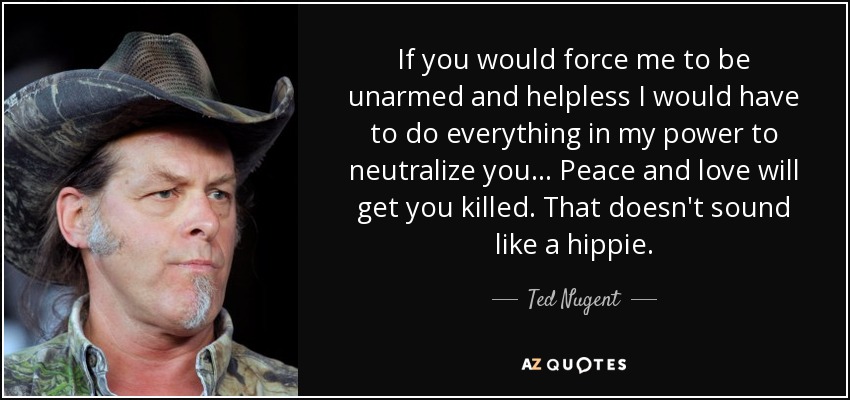
If you would force me to be unarmed and helpless I would have to do everything in my power to neutralize you... Peace and love will get you killed. That doesn't sound like a hippie.
I was lucky enough to go to college for four years. At what was supposedly a hippie school with no tests and no grades, blah blah blah, I wasn't learning that. I was taking photography classes. That stuff just wasn't talked about. It was like, "Does this picture have the right about of grey in it?" It wasn't even an art school. It was a state-run school.
So dogma, doctrine, unexamined assumptions, that's what it is to be sharing that, the hippies shadow, no way of grounding it to reality. It's where we're just cut off from reality unless we can argue, we can substantiate, we can justify, we can convince each other.
The hippie is the scion of surplus value. The dropout can only claim sanctity in a society which offers something to be dropped out of--career, ambition, conspicuous consumption. The effects of hippie sanctimony can only be felt in the context of others who plunder his lifestyle for what they find good or profitable, a process known as rip-off by the hippie, who will not see how savagely he has pillaged intricate and demanding civilizations for his own parodic lifestyle.
If you purposefully look to shock people, it isn't funny. That's what 50 million dollar Hollywood comedies do; try to be shocking and dirty. They aren't really. It isn't enough to shock. It's easy to shock. Real surprise is what I'm after. Those early movies, we had drugs, which you weren't supposed to show. You weren't supposed to shoot up. We would make fun of hippies. I think that we were punk before there was punk.
I come from a visual background, and I grew up around a lot of hippies and artists. My mom and my brother and I moved around a lot. We basically moved every couple of years, and I went to a lot of different schools. But creativity, for us, was always a way of life. It was never a job. Being an artist was a passion and a way of life.
People are going to say, "I was a lesbian back in the 90s" just like people say, "I was a hippie in the 60s". I see them struggling. Rich girls struggling with their heterosexuality.
His hair has the long jesuschrist look. He is wearing the costume clothes. But most of all, he now has a very tolerant and therefore withering attitude toward all those who are still struggling in the old activist political ways...while he, with the help of psychedelic chemicals, is exploring the infinite regions of human consciousness.
Obscenity is a moral concept in the verbal arsenal of the Establishment, which abuses the term by applying it, not to expressions of its own morality but to those of another. Pbscene is not the picture of a naked woman who exposes her pubic hair but that of a fully clad general who exposes his medals rewarded in a war of aggression; obscene is not the ritual of the Hippies but the declaration of a high dignitary of the Church that war is necessary for peace.
People didn't relate to me as being Chinese or white, just being a hippie, a long-haired hippie.
Stonehenge had an aura but it was also just stone. Then in the sixties, it became a great hedonistic, hippie, druid, rock-n-roll party site. There are amazing pictures of people up on the stones going wild and that's the image I recreated for my model of the project: full access to everyone. I even invented a Stonehenge soccer team that uses spaces between the stones as goals.
As I got into my teens, I started reading better books, beginning with the Beats and then the hippie writers, people like Wallace Stegner up in Northern California, and all the political New Journalism stuff, the Boys on the Bus dudes and Ken Kesey.
I'm a real conservative. I never became a hippie, or a groupie. I never wore flowers in my hair.
From the time I was a kid, I'd never joined groups. I hated high school groups. I hung out with hippies, musical people. I hung out with whomever I found compelling and interesting and smart. And I continued to do that throughout my life.
When I was in high school, it was the beginning of hippies and free love and sleeping with people was a sign of your liberation and your freedom. Then we [had to worry about] AIDS, so they started lecturing my kids in elementary school about safe sex. Sex turned from something joyful into something kind of dangerous, and it was hard to avoid that sense that it was a different world.
I’m too young and ridiculous a person to speak for my generation, but I’d be happy to talk about my own experiences as a generation Y writer. I was raised by a generation of hippies. Throughout my childhood, teachers urged me to fight the establishment. My English teacher assigned Ginsberg and Kerouac and declared Bob Dylan “a genius.” My science teacher told me that television was “the new opiate of the masses” and bragged about never having owned one. My drama teacher made us perform Beckett.
I kind of grew up in a commune, but it wasn't a hippie commune necessarily, but it was a big house with a lot of families, we all lived together and it was the 70s, whatever that means.
One time we stayed at a B&B, and there were a couple of hippies who had this nice little area and they let us sleep in their beds that they had in the back.Then the woman suggested we go out and lie on some cushions and look up at the stars and look for UFOs and she said, "You know, I do this all the time," and I was like, "Okay..." So there we are, lying there next to this amazing loch, and we're looking up in the stars and I don't really know what I was expecting, but to see some sort of metallic object.
I am a product of the "Hippie" theater movement of the '60s.
I was influenced by the hippie movement in San Francisco and by the feminist movement, which had arrived in Paris.
I was brought up in a kind of, you know, very hippie, liberal family. And it was just always automatically assumed that men and women were equal and indeed superior.
Literature is about getting in touch. It sounds so hippie, but it really is about sharing stuff. We are a community that doesn't seem to be important for the rest of society, but we are people who want to get in touch - really in touch. We want to be thinking together.
I was certainly a child of the '60s, and I came out of that era, and as a young actor, I got cast as a lot of counterculture hippie types.
[T]he Nixon campaign in 1968, and the Nixon White House after that, had two enemies: the antiwar Left, and black people. You understand what I'm saying? We knew we couldn't make it illegal to be either against the war or black. But by getting the public to associate the hippies with marijuana and blacks with heroin, and then criminalizing both heavily, we could disrupt those communities. We could arrest their leaders, raid their homes, break up their meetings, and vilify them night after night on the evening news. Did we know we were lying about the drugs? Of course we did.
When I was a kid... I don't know which was more embarrassing, when I was really into The Beatles or when I was a hippie.
Follow AzQuotes on Facebook, Twitter and Google+. Every day we present the best quotes! Improve yourself, find your inspiration, share with friends
or simply: