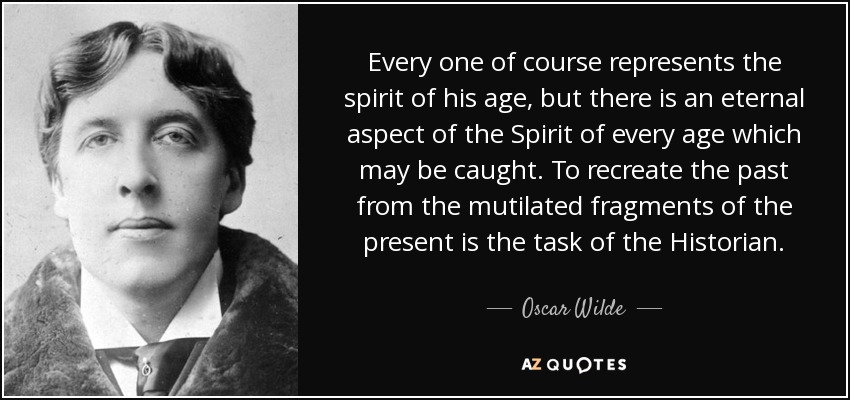
Every one of course represents the spirit of his age, but there is an eternal aspect of the Spirit of every age which may be caught. To recreate the past from the mutilated fragments of the present is the task of the Historian.
An emperor knows how to govern when poets are free to make verses, people to act plays, historians to tell the truth, ministers to give advice, the poor to grumble at taxes, students to learn lessons aloud, workmen to praise their skill and seek work, people to speak of anything, and old men to find fault with everything.
All I am in private life is a literary critic and historian, that's my job...And I'm prepared to say on that basis if anyone thinks the Gospels are either legends or novels, then that person is simply showing his incompetence as a literary critic. I've read a great many novels and I know a fair amount about the legends that grew up among early people, and I know perfectly well the Gospels are not that kind of stuff.
If there were even one spark of evidence from antiquity that Jesus even may have gotten married, then as a historian, I would have to weigh this evidence against the total absence of such information in either Scripture or the early church traditions. But there is no such spark-not a scintilla of evidence-anywhere in historical sources. Even where one might expect to find such claims in the bizarre, second-century, apocryphal gospels...there is no reference that Jesus ever got married.
I don't think that boxing historians have been able to find a case in which a great fighter, or a fighter presumed to be a great fighter, came to such an ignominious end.
You're making a movie, not a documentary. If you made a film like the historians would like you to make, you're not going to go and see it. I'd rather see paint dry.
I was under the librarians' protection. Civil servants and servants of civility, they had my back. The would be whatever they needed to be that day: information professionals, teachers, police, community organizers, computer technicians, historians, confidantes, clerks, social workers, storytellers, or, in this case, guardians of my peace.
A delusion that encourages belief where there is no evidence is asking for trouble. Disagreements between incompatible beliefs cannot be settled by reasoned argument because reasoned argument is drummed out of those trained in religion from the cradle. Instead, disagreements are settled by other means which, in extreme cases, inevitably become violent. Scientists disagree among themselves but they never fight over their disagreements. They argue about evidence or go out and seek new evidence. Much the same is true of philosophers, historians and literary critics.
It is remarkable that Lord Esher should be so much astray...We must conclude that an uncontrollable fondness for fiction forbade him to forsake it for fact. Such constancy is a defect in an historian.
The early Christians' opponents all accepted that Jesus existed, taught, had disciples, worked miracles, and was put to death on a Roman cross. As in our day, debate and disagreement centred largely not on the story but on the significance of Jesus. Today nearly all historians, whether Christians or not, accept that Jesus existed and that the gospels contain plenty of valuable evidence which has to be weighed and assessed critically.
Today nearly all historians, whether Christians or not, accept that Jesus existed.
Today nearly all historians, whether Christians or not, accept that Jesus existed and that the Gospels contain plenty of valuable evidence which has to be weighed and assessed critically.
Too rigid specialization is almost as bad for a historian's mind, and for his ultimate reputation, as too early an indulgence in broad generalization and synthesis.
Historians of literature like to regard a century as a series of ten faces, each grimacing in a different way.
The middle sort of historians (of which the most part are) spoil all; they will chew our meat for us.
It's interesting - an actor's research is different to just historian's research. I'm looking for things that I can actually physically use in the movie.
History is the open Bible: we historians are not priests to expound it infallibly: our function is to teach people to read it and to reflect upon it for themselves.
It has become too easy to see that the luckless men of the past lived by mistakes, even absurd beliefs, so we may well fail in a decent respect for them, and forget that historians of the future will point out that we too lived by myths.
The amazing thing since so many variables enter into historical judgments, is not that historians disagree but that they agree as often as they do.
[T]he historian lays humanity on the couch.
A mind devoid of prepossessions is likely to be devoid of all mental furniture. And the historian who thinks that he can clean his mind as he would a slate with a wet sponge, is ignorant of the simplest facts of mental life.
History, when rightly written, is but a record of providence; and he who would read history rightly, must read it with his eyes constantly fixed on the hand of God. This statement of a nineteenth-century historian sums up the responsibility of the Christian teacher of history, for he who would teach history or any subject matter rightly, must teach it with his eyes constantly fixed on the hand of God.
Science will...produce the data..., but never the full meaning. For perceiving real significance, we shall need...most of all the brains of poets, [and] also those of artists, musicians, philosophers, historians, writers in general.
The good tidings which the historian of the past brings with throbbing heart may be lost in a void the very moment he opens his mouth.
I don't really have a historical overview of my work at all. I'm not an art historian. I don't see that there's this period and that period.
Follow AzQuotes on Facebook, Twitter and Google+. Every day we present the best quotes! Improve yourself, find your inspiration, share with friends
or simply: