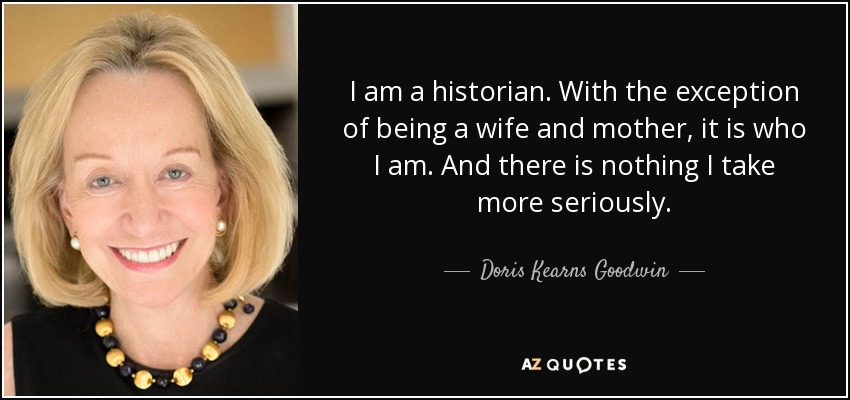
I am a historian. With the exception of being a wife and mother, it is who I am. And there is nothing I take more seriously.
So with truth - there is a certain moment when one can say, this is the truth and here I put a dot, a stop, and I go to another thing. A judge has to put an end to a deliberation. But for a historian, theres never an end to the past. It can go on and on and on.
The ordinary routines of life are never chronicled by the historian, but they make up almost the whole of experience.
The amazing thing since so many variables enter into historical judgments, is not that historians disagree but that they agree as often as they do.
The historian's distortion is more than technical, it is ideological; it is released into a world of contending interest, where any chosen emphasis supports some kind of interest, whether economic or political or racial, or national or sexual.
Historians constantly rewrite history, reinterpreting (reorganizing) the records of the past. So, too, when the brain's coherent responses become part of a memory, they are organized anew as part of the structure of consciousness. What makes them memories is that they become part of that structure and thus form part of the sense of self; my sense of self derives from a certainty that my experiences refer back to me, the individual who is having them. Hence the sense of the past, of history, of memory, is in part the creation of the self.
Among German historians, there's really not much debate about whether or not Hitler was a social Darwinist. He clearly was drawing on Darwinian ideas.
As political theorist Michael Parenti points out, historians often overlook Fascism's economic agenda--the partnership between Big Capital and Big Government--in their analysis of its authoritarian social program. Indeed, according to Bertram Gross in his startlingly prescient Friendly Fascism (1980), it is possible to achieve fascist goals within an ostensibly democratic society.
Susan Campbell has brought Isabella's fascinating forgotten story back to life with the deep research of a born historian and the vibrant readable prose style of a veteran journalist.
The selection process has been powerful enough to produce one indisputable outcome: the family is a universal human institution. . . . In virtually every society into which historians or anthropologists have inquired, one finds people living together on the basis of kinship ties and having responsibility for raising children. . . . Even in societies where men and women have relatively unrestricted sexual access to one another beginning at an early age, marriage is still the basis for family formation. It is desired by the partners and expected by society.
As a historian, he felt it his duty to respect everything that had ever been respected, except for the occasional statesman.
We're not going to waste our valuable space or your precious energy by giving equal time to stories of tragedy, failure, and tumult. They get far more that their fair share of attention everywhere else. Future historians might even conclude that our age suffered from a collective obsessive-compulsive disorder: the pathological need to repetitively seek out reasons for how bad life is.
The main duty of the historian of mathematics, as well as his fondest privilege, is to explain the humanity of mathematics, to illustrate its greatness, beauty and dignity, and to describe how the incessant efforts and accumulated genius of many generations have built up that magnificent monument, the object of our most legitimate pride as men, and of our wonder, humility and thankfulness, as individuals. The study of the history of mathematics will not make better mathematicians but gentler ones, it will enrich their minds, mellow their hearts, and bring out their finer qualities.
When historians look back on our century, they may remember it most, not for space travel or the release of nuclear energy, but as the time when the peoples of the world first came to take one another seriously.
The connoisseur might be defined as a laconic art historian, and the art historian as a loquacious connoisseur.
I have a hard time with historians because they idolize the truth. The truth is not uplifting; it destroys. I could tell most of the secretaries in the church office building that they are ugly and fat. That would be the truth, but it would hurt and destroy them. Historians should tell only that part of the truth that is inspiring and uplifting.
The anarch knows the rules. He has studied them as a historian and goes along with them as a contemporary. Wherever possible, he plays his own game within their framework; this makes the fewest waves.
No Christian and, indeed, no historian could accept the epigram which defines religion as 'what a man does with his solitude.'
Historians will consider this a dark age. Science historians can read Galileos technical correspondence from the 1590s but not Marvin Minskys from the 1960s.
It is not without fear and trembling that a historian of religion approaches the problem of myth. This is not only because of that preliminary embarrassing question: what is intended by myth? It is also because the answers given depend for the most part on the documents selected.
Change from below, the formulation of demands from the populace to end unacceptable injustice, supported by direct action, has played a far larger part in shaping British democracy than most constitutional lawyers, political commentators, historians or statesmen have ever cared to admit. Direct action in a democratic society is fundamentally an educational exercise.
The gods have fled, I know. My sense is the gods have always been essentially absent. I do not believe human beings have played games or sports from the beginning merely to summon or to please or to appease the gods. If anthropologists and historians believe that, it is because they believe whatever they have been able to recover about what humankind told the gods humankind was doing. I believe we have played games, and watched games, to imitate the gods, to become godlike in our worship of eachother and, through those moments of transmutation, to know for an instant what the gods know.
I learned early on that war forms its own culture. The rush of battle is a potent and often lethal addiction, for war is a drug, one I ingested for many years. It is peddled by mythmakers- historians, war correspondents, filmmakers, novelists, and the state- all of whom endow it with qualities it often does possess: excitement, exoticism, power, chances to rise above our small stations in life, and a bizarre and fantastic universe that has a grotesque and dark beauty.
Incredibly deep research combines with the talents of a fine historian and writer to produce superb narrative history. The true character and relationship of these two iconic westerners emerge to suppress myth and correct more than a century of tomes laden with bad history.
Today nearly all historians, whether Christians or not, accept that Jesus existed and that the Gospels contain plenty of valuable evidence which has to be weighed and assessed critically.
Follow AzQuotes on Facebook, Twitter and Google+. Every day we present the best quotes! Improve yourself, find your inspiration, share with friends
or simply: