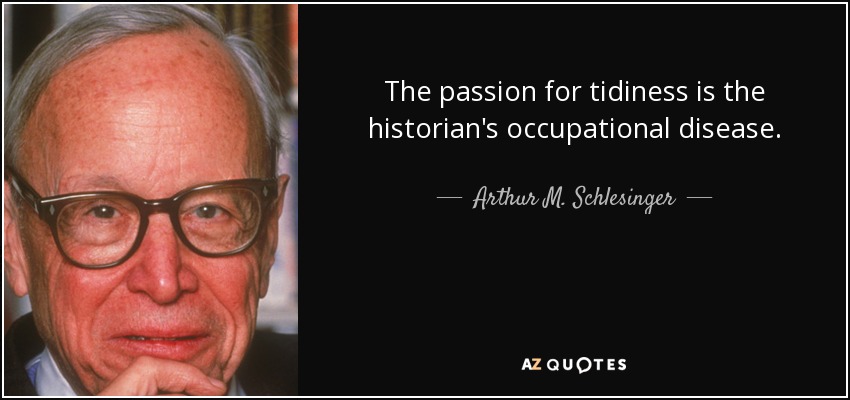
The passion for tidiness is the historian's occupational disease.
The history of thought, and therefore all history, is the re-enactment of past thought in the historian's own mind.
Problems cannot all be solved, for, as they are solved, new aspects are continually revealed: the historian opens the way, he does not close it.
What distinguishes the historian from the collector of historical facts is generalization.
The past in the hands of historians is not what it was.
Chronology, so the saying goes, is the last refuge of the feeble-minded and the only resort for historians.
An historian should yield himself to his subject, become immersed in the place and period of his choice, standing apart from it now and then for a fresh view.
That historians should give their own country a break, I grant you; but not so as to state things contrary to fact. For there are plenty of mistakes made by writers out of ignorance, and which any man finds it difficult to avoid. But if we knowingly write what is false, whether for the sake of our country or our friends or just to be pleasant, what difference is there between us and hack writers? Readers should be very attentive to and critical of historians, and they in turn should be constantly on their guard.
The historian does simply not come in to replenish the gaps of memory. He constantly challenges even those memories that have survived intact.
The historian ought to be an educated person, writing for other educated people about something which they don't know about, but wish to know about in a way that they can understand.
Civilization is a stream with banks. The stream is sometimes filled with blood from people killing, stealing, shouting and doing the things historians usually record, while on the banks, unnoticed, people build homes, make love, raise children, sing songs, write poetry and even whittle statues. The story of civilization is what happened on the banks.
History is always written wrong, and so always needs to be rewritten. ...What is interesting is brought forward as if it had been central and efficacious in the march of events, and harmonies are turned into causes. Kings and generals are endowed with motives appropriate to what the historian values in their actions; plans are imputed to them prophetic of their actual achievements, while the thoughts that really preoccupied them remain buried in absolute oblivion.
The gravest of the ecclesiastical historians, Eusebius himself, indirectly confesses that he has related whatever might redound to the glory, and that he has suppressed all that could tend to the disgrace, of religion.
It is difficult to find a reputable American historian who will acknowledge the crude fact that a Franklin Roosevelt, say, wanted to be President merely to wield power, to be famed and to be feared. To learn this simple fact one must wade through a sea of evasions: history as sociology, leaders as teachers, bland benevolence as a motive force, when, finally, power is an end to itself, and the instinctive urge to prevail the most important single human trait, the necessary force without which no city was built, no city destroyed.
Luke [the gospel writer] screws up his dating by tactlessly mentioning events that historians are capable of independently checking. There was indeed a census under Governor Quirinius - a local census, not one decreed by Caesar Augustus for the Empire as a whole - but it happened too late in 6 AD, long after Herod's death.
Historians of a generation ago were often shocked by the violence with which scientists rejected the history of their own subject as irrelevant; they could not understand how the members of any academic profession could fail to be intrigued by the study of their own cultural heritage. What these historians did not grasp was that scientists will welcome the history of science only when it has been demonstrated that this discipline can add to our understanding of science itself and thus help to produce, in some sense, better scientists.
The novelist must look on humanity without partiality or prejudice. His sympathy, like that of the historian, must be unbounded, and untainted by sect or party.
We find few historians who have been diligent enough in their search for truth; it is their common method to take on trust what they help distribute to the public; by which means a falsehood once received from a famed writer becomes traditional to posterity.
No historian should be trusted implicitly.
The historian of science may be tempted to claim that when paradigms change, the world itself changes with them. Led by a new paradigm, scientists adopt new instruments and look in new places. even more important, during revolutions, scientists see new and different things when looking with familiar instruments in places they have looked before. It is rather as if the professional community had been suddenly transported to another planet where familiar objects are seen in a different light and are joined by unfamiliar ones as well.
The older I get the more I'm convinced that it's the purpose of politicians and journalists to say the world is very simple, whereas it's the purpose of historians to say, 'No! It's very complicated.' The job of the historian is to help give people a sense of existence in time, without which we are really not fully human.
I think the fault is more with historicists who have stubbornly failed to develop a good theory of historicity. By simply resting on the feeble laurels of prima facie plausibility ('Jesus existed because everyone said so') and subjective notions of absurdity ('I can't believe Jesus didn't exist!'), the existence of Jesus has largely been taken for granted, even by competent historians who explicitly try to argue for it.
Environmental history... refer[s] to the past contact of man with his total habitat. . . . The environmental historian like the ecologist [s]hould think in terms of wholes, of communities, of interrelationships, and of balances.
So many of the things we are doing right now as a country are things that lead to loss of a country. I leave you with this thought and challenge any historian, no mater who you are where you are. You show me a country that ever met its demise while as a nation it was honoring the one true God. You won't find it. Let's keep this country alive.
The first law for the historian is that he shall never dare utter an untruth. The second is that he shall suppress nothing that is true. Moreover, there shall be no suspicion of partiality in his writing, or of malice.
Follow AzQuotes on Facebook, Twitter and Google+. Every day we present the best quotes! Improve yourself, find your inspiration, share with friends
or simply: