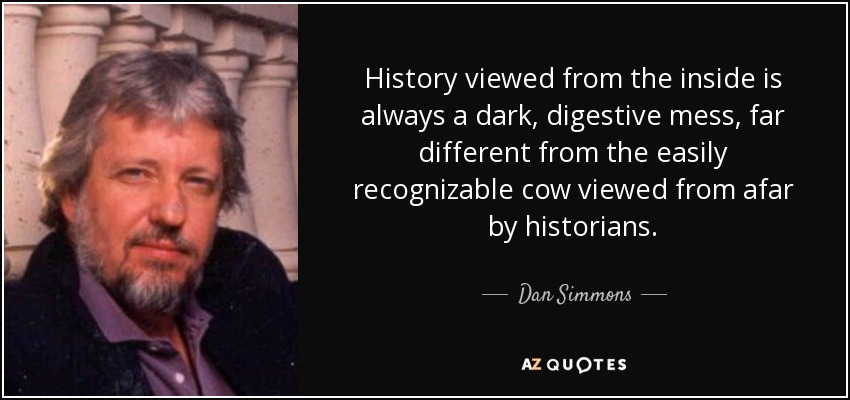
History viewed from the inside is always a dark, digestive mess, far different from the easily recognizable cow viewed from afar by historians.
How something important happens is the business of historians and newspapers, the effect it has is the business of philosophers and writers and especially poets.
Historians still often see the end of the war as meaning nothing more for Germany than lost territories, lost participation in colonization, and lost assets for the state and individuals. They frequently overlook the most serious loss that Germany suffered.
I foresee the time when the painter will paint that scene, no longer going to Rome for a subject; the poet will sing it; the historian record it; and, with the Landing of the Pilgrims and the Declaration of Independence, it will be the ornament of some future national gallery, when at least the present form of slavery shall be no more here. We shall then be at liberty to weep for Captain Brown. Then, and not till then, we will take our revenge.
I am not a representative of anything. When art historians or critics or the public put somebody in a drawer like this, it has a tranquilizing, paralyzing effect. Artists are individuals. They have ideas, and the conventions for one's self as an individual are not for a group. There are always those who follow the group, but they belong in the margins. I refuse to be placed within, or added to, one particular school.
It is difficult to find a reputable American historian who will acknowledge the crude fact that a Franklin Roosevelt, say, wanted to be President merely to wield power, to be famed and to be feared. To learn this simple fact one must wade through a sea of evasions: history as sociology, leaders as teachers, bland benevolence as a motive force, when, finally, power is an end to itself, and the instinctive urge to prevail the most important single human trait, the necessary force without which no city was built, no city destroyed.
Historians of a generation ago were often shocked by the violence with which scientists rejected the history of their own subject as irrelevant; they could not understand how the members of any academic profession could fail to be intrigued by the study of their own cultural heritage. What these historians did not grasp was that scientists will welcome the history of science only when it has been demonstrated that this discipline can add to our understanding of science itself and thus help to produce, in some sense, better scientists.
The novelist must look on humanity without partiality or prejudice. His sympathy, like that of the historian, must be unbounded, and untainted by sect or party.
The historian is terribly responsible to what he can discern are the facts of the case, but he's nothing if he doesn't make out a case.
As a scholar who regularly surveys archival material, I think that, a century from now, cultural historians will find David Horowitz's spiritual and political odyssey paradigmatic for our time.
I can find my way from 500 A.D. through to 1066 pretty well as an amateur historian.
I learned more from my mother than from all the art historians and curators who have informed me about technical aspects of art history and art appreciation over the years.
A couple years ago, the novelist Russell Banks told me he was reading the ancient Greek historian Herodotus. I asked why. He said, 'Because I've always wanted to and am tired of having my reading assigned.' I thought it was a marvelous declaration of independence.
Every historian discloses a new horizon.
The historian is a prophet looking backward.
What the British seem to like are television historians and naturalists, not public intellectuals. You can't help feeling that's because one supplies narrative and the other supplies facts, and the British are traditionally empiricists so they/we have a resistance to theory and to theoreticians playing too prominent a role in public life.
I think that a movie can only be an adjunct or only a supplement to books, to different points of view, to scholars, historians and your own teachers.
I am not trying to be a historian and a dramatist; I'm a dramatist, a dramatic historian, or one who does a dramatic interpretation of history.
I'm a historian in my own mind.
[talking about the Holocaust] 'But to put something in context is a step towards saying it can be understood and that it can be explained. And if it can be explained that it can be explained away.' 'But this is History. Distance yourselves. Our perspective on the past alters. Looking back, immediately in front of us is dead ground. We don't see it, and because we don't see it this means that there is no period so remote as the recent past. And one of the historian's jobs is to anticipate what our perspective of that period will be... even on the Holocaust.
I knew that a historian (or a journalist, or anyone telling a story) was forced to choose, out of an infinite number of facts, what to present, what to omit. And that decision inevitably would reflect, whether consciously or not, the interests of the historian.
That historians should give their own country a break, I grant you; but not so as to state things contrary to fact. For there are plenty of mistakes made by writers out of ignorance, and which any man finds it difficult to avoid. But if we knowingly write what is false, whether for the sake of our country or our friends or just to be pleasant, what difference is there between us and hack writers? Readers should be very attentive to and critical of historians, and they in turn should be constantly on their guard.
The historian ought to be an educated person, writing for other educated people about something which they don't know about, but wish to know about in a way that they can understand.
Civilization is a stream with banks. The stream is sometimes filled with blood from people killing, stealing, shouting and doing the things historians usually record, while on the banks, unnoticed, people build homes, make love, raise children, sing songs, write poetry and even whittle statues. The story of civilization is what happened on the banks.
Caution in handling generally accepted opinions that claim to explain whole trends of history is especially important for the historian of modern times, because the last century has produced an abundance of ideologies that pretend to be keys to history but are actually nothing but desperate efforts to escape responsibility.
Follow AzQuotes on Facebook, Twitter and Google+. Every day we present the best quotes! Improve yourself, find your inspiration, share with friends
or simply: