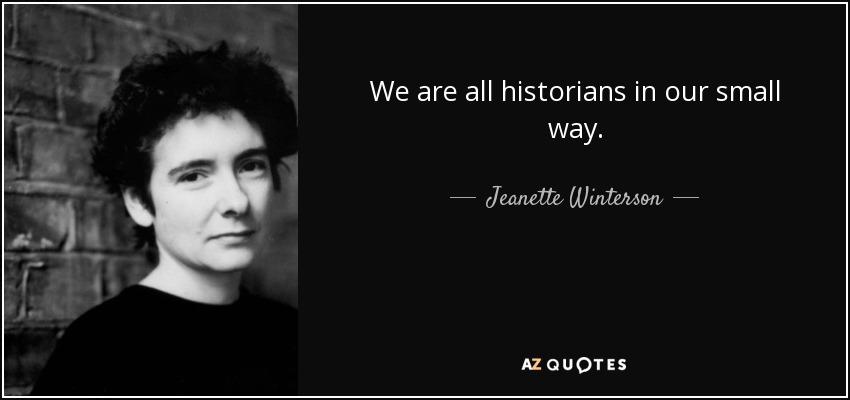
We are all historians in our small way.
The contemporary historian never writes such a true history as the historian of a later generation.
Of all studies, the most delightful and the most useful is biography. The seeds of great events lie near the surface; historians delve too deep for them. No history was ever true. Lives I have read which, if they were not, had the appearance, the interest, and the utility of truth.
Sallust is indisputably one of the best historians among the Romans, both for the purity of his language and the elegance of his style.
The long historian of my country's woes.
Anyone, however, who has had dealings with dates knows that they are worse than elusive, they are perverse. Events do not happen at the right time, nor in their proper sequence. That sense of harmony with place and season which is so strong in the historian--if he be a readable historian--is lamentably lacking in history, which takes no pains to verify his most convincing statements.
The true historian, therefore, seeking to compose a true picture of the thing acted, must collect facts and combine facts. Methods will differ, styles will differ. Nobody ever does anything like anybody else; but the end in view is generally the same, and the historian's end is truthful narration. Maxims he will have, if he is wise, never a one; and as for a moral, if he tell his story well, it will need none; if he tell it ill, it will deserve none.
Ah, there's nothing like tea in the afternoon. When the British Empire collapses, historians will find that it had made but two invaluable contributions to civilization - this tea ritual and the detective novel.
History is made by masses of people. One man, or ten men, don't start the earthquakes and don't stop them either. Only hero worshipers and ignorant historians think they do.
Historians differ on when the consumer culture came to dominate American culture. Some say it was in the twenties, when advertising became a major industry and the middle class bought radios to hear the ads and cars to get to the stores. ... But there is no question that the consumer culture had begun to crowd out all other cultural possibilities by the years following World War II.
The only difference between the narrator of contemporary affairs and the ordinary historian is that moral judgments about the present provoke fiercer reactions and have more immediately practical implications than moral judgments about the past.
His [Jesus'] historians, having brought him into the world in a supernatural manner, were obliged to take him out again in the same manner, or the first part of the story must have fallen to the ground.
To be a really good historian is perhaps the rarest of intellectual distinctions.
In the West the past is like a dead animal. It is a carcass picked at by the flies that call themselves historians and biographers. But in my culture the past lives. My people feel this way in part because death does not separate us from our ancestors.
The poets have familiarized more people with history than have the historians.
A nation does not create the historians it deserves; the historians are far more likely to create the nation.
History, in spite of the occasional protest of historians, will always be used in a general way as a collection of political and moral precedents.
The selective winnowing of time leaves only a few recognizable individuals behind for the historian to light on. Thus the historian who finds the human being more interesting than what the human being has done must inevitably endow the comparatively few individuals he can identify with too great an importance in relation to their time. Even so, I prefer this overestimate to the opposite method which treats developments as though they were the massive anonymous waves of an unhuman sea or pulverizes the fallible surviving records of human life into the grey dust of statistics.
I have no doubt that historians will conclude that we of the twentieth century had intelligence enough to create a great civilization but not the moral wisdom to preserve it.
In the closing years of the nineteenth century, African-American historians began to look at their people's history from their vantage point and their point of view.
Poets, if they're genuine, must keep repeating "I don't know." Each poem marks an effort to answer this statement, but as soon as the final period hits the page, the poet begins to hesitate, starts to realize that this particular answer was pure makeshift that's absolutely inadequate to boot. So the poets keep on trying, and sooner or later the consecutive results of their self-dissatisfaction are clipped together with a giant paperclip by literary historians and called their oeuvre.
The Reverend Douglas Wilson may not be a professional historian, as his detractors say, but he has a strong grasp of the essentials of the history of slavery and its relation to Christian doctrine. Indeed, sad to say, his grasp is a great deal stronger than that of most professors of American history, whose distortions and trivializations disgrace our college classrooms. And the Reverend Mr. Wilson is a fighter, especially effective in defense of Christianity against those who try to turn Jesus' way of salvation into pseudo-moralistic drivel.
I retained no records and I am not a good writer anyhow. So the best approach is for historians like you to extract the facts directly from people like me.
The Tudors was ground-breaking in the sense that it did ruffle the feathers of classical historians and alter the way people did period drama at the time.
Somebody said, "Well, you're going to write your definitive book about your life, biography." No, I'm not. I haven't done that. I wrote a book of letters which gives an insight into the real me as opposed to the public perceptions of me. But I'm convinced historians will figure out the things we got wrong and hopefully the things we got right.
Follow AzQuotes on Facebook, Twitter and Google+. Every day we present the best quotes! Improve yourself, find your inspiration, share with friends
or simply: