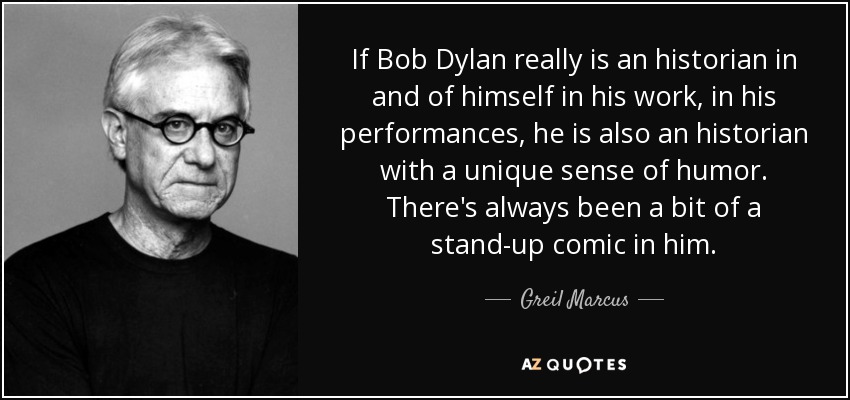
If Bob Dylan really is an historian in and of himself in his work, in his performances, he is also an historian with a unique sense of humor. There's always been a bit of a stand-up comic in him.
What kinds of problems, and what kinds of meanings, happen in the paint? Or as one historian puts it, 'What is thinking in painting, as opposed to thinking about painting?' These are important questions, and they are very hard to answer using the language of art history.
Women have their uses for historians.
The Rebecca Riots by David Williams is an unassuming book, but its significance is universal. The book and its author determined my life; they made me want to be a historian of Wales and of the world.
Acts themselves alone are history, and these are neither the exclusive property of Hume, Gibbon nor Voltaire, Echard, Rapin, Plutarch, nor Herodotus. Tell me the Acts, O historian, and leave me to reason upon them as I please; away with your reasoning and your rubbish. All that is not action is not worth reading.
Journalists who make mistakes get sued for libel; historians who make mistakes get to publish a revised edition.
Conservatives or better, pro-corporate apologists hijacked the vocabulary of Jeffersonian liberalism and turned words like "progress," "opportunity," and "individualism" into tools for making the plunder of America sound like divine right. This "degenerate and unlovely age," as one historian calls it, exists in the mind of Karl Rove the reputed brain of George W. Bush as the seminal age of inspiration for politics and governance of America today.
The historian is looked upon as objective when he measures the past by the popular opinions of his own time, as subjective when he does not take these opinions for models. That man is thought best fitted to depict a period of the past, who is not in the least affected by that period. But only he who has a share in building up the future can grasp what the past has been, and only when transformed into a work of art can history arouse or even sustain instincts.
No serious historian of nations and nationalism can be a committed political nationalist... Nationalism requires too much belief in what is patently not so.
My basic notion regarding the matter of historical recognition is basically, it's a matter that should be left to the good hands of historians and experts.
Generations from now, when historians write about these times, they might note that, in the early decades of the twenty-first century, the United States succeeded in its great and historic mission--it globalized the world. But along the way, they might write, it forgot to globalize itself.
What would become of history, had we not a dependence on the veracity of the historian, according to the experience, what we have had of mankind?
David Irving is not just a Fascist historian. He is also a great historian of Fascism.
The Messiah comes not only as the redeemer, he comes as the subduer of Antichrist. Only that historian will have the gift of fanning the spark of hope in the past who is firmly convinced that even the dead will not be safe from the enemy if he wins. And this enemy has not ceased to be victorious.
It would be most wholesome if for at least twenty years art historians were forbidden to refer to any derivations. If they were not allowed to account for a work of art mainly by tracing where it comes from, they would have to deal with it in and by itself--which is what they are most needed for.
The historian's one task is to tell the thing as it happened.
I realized how valuable the art and practice of writing letters are, and how important it is to remind people of what a treasure letters--handwritten letters--can be. In our throwaway era of quick phone calls, faxes, and email, it's all to easy never to find the time to write letters. That's a great pity--for historians and the rest of us.
If being an anti-art artist is difficult, being an anti-art art historian is a hard position indeed. His doctrinal revolutionism brings forth nothing new in art but reenacts upheavals on the symbolic plane of language. It provides the consoling belief that overthrows are occurring as in the past, that barriers to creation are being surmounted, and that art is pursuing a radical purpose, even if it is only the purpose of doing away with itself.
Not only were the minds of artists formed by the university; in the same mold were formed those of the art historians, the critics, the curators, and the collectors by whom their work was evaluated. With the rise of Conceptual art, the classroom announced its final triumph over the studio.
The first job of the historian and of the journalist is to find facts. Not the only job, perhaps not the most important, but the first. Facts are the cobblestones from which we build roads of analysis, mosaic tiles that we fit together to compose pictures of past and present. There will be disagreement about where the road leads and what reality or truth is revealed by the mosaic picture. The facts themselves must be checked against all the available evidence. But some are round and hard--and the most powerful leaders in the world can trip over them. So can writers, dissidents and saints.
I have a dreadful feeling in my bones that future historians may write of the May 2014 elections: "This was the wake-up call from which Europe failed to wake up."
I'm a historian by training and by conviction. And so the thing that has throughout informed my thinking about international relations is history. I think, for example, the reason that I was perhaps able to see sooner than some others that the Soviet Empire in Eastern Europe was decaying--if not disintegrating--was that I came to it through history and through Germany, rather than through Sovietology and through Moscow. And therefore the starting point was that no empire in history has lasted forever, and this one won't either.
The lucidity of the battle narratives, the vigor of the prose, the strong feeling for the men from generals to privates who did the fighting, are all controlled by a constant sense of how it happened and what it was all about. Foote has the novelist's feeling for character and situation, without losing the historian's scrupulous regard for recorded fact. The Civil War is likely to stand unequalled.
More attention to the History of Science is needed, as much by scientists as by historians, and especially by biologists, and this should mean a deliberate attempt to understand the thoughts of the great masters of the past, to see in what circumstances or intellectual milieu their ideas were formed, where they took the wrong turning or stopped short on the right track.
Fatal human malice is the staple of narrators, original sin the mother-fluid of historians. But it is a risky enterprise to have to write of virtue.
Follow AzQuotes on Facebook, Twitter and Google+. Every day we present the best quotes! Improve yourself, find your inspiration, share with friends
or simply: