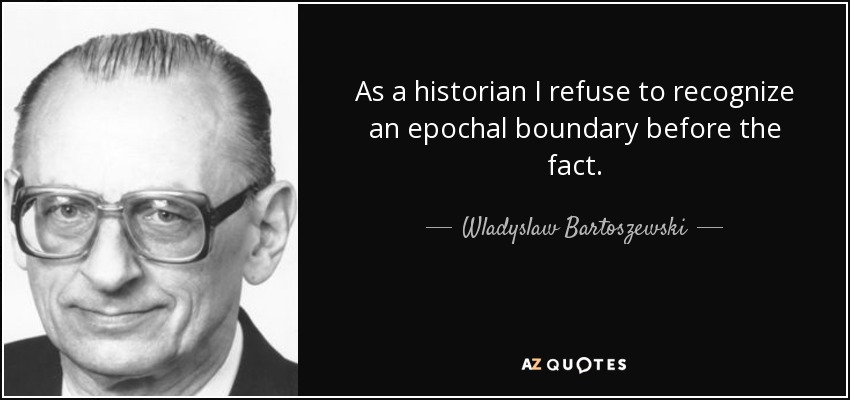
As a historian I refuse to recognize an epochal boundary before the fact.
Let's say that history is what happened. The record of what happened is how each individual happens to see those events. They've already been filtered. When the historian or biographer takes over, history is no longer exactly what happened, because there has been a process of selection going on; it's impossible to write about anyone, any event, in any period of time, without in some way imposing, even unconsciously, your own standards, your own values.
One of the challenges in writing the script Call Me by Your Name was that I had to find something concrete for the professor to do. In the book he is some kind of classics scholar. But I thought it would be interesting to make him into something of an art historian and archaeologist whose background was the classical world. It's always difficult when someone is supposed to be an intellectual. What do they do? You can't just film them sitting around and thinking all day. And that's what the business of the statues is all about.
We cannot be spun, or at least we'd like to think that we cannot be. And the presidents who are trying to - too overtly to try to say, here is what you historians and what you later Americans should think of my presidency, 30 or 40 years later, they look silly.
You know, I am not a particular Kennedy apologist or an awed fan - I was 12 when he was murdered - but I have discussed Kennedy with historians. For his incredibly short tenure, he was a very important president. Many put him in the second tier, below the big three and surrounded by Truman and Eisenhower. Kennedy moved our soul. Changed our thinking about service and governance. And won big in the greatest nuclear crisis of the Cold War.
The act of choosing what to place in your piece when you're a historian or a non-fiction writer already renders it into fiction for someone else. In some ways fiction comes a lot closer to reality. When you start talking about something as brutal as slavery and life in the American West, it's really important to take a non- judgmental stance. We romanticize a great deal about life in the American West, but I thank God I wasn't living during that time. No matter what color you were, it was rough, crude, tough living.
The spectator and historian of [Belisarius's] exploits has observed, that amidst the perils of war, he was daring without rashness, prudent without fear, slow or rapid according to the exigencies of the moment; that in the deepest distress he was animated by real or apparent hope, but that he was modest and humble in the most prosperous fortune.
History does not have sides, although historians do.
What the historian Elie Kedourie called "the Chatham House Version" - that toxic amalgam of smugness, moral relativism, and cherished feelings of guilt about the achievements of Western civilization - everywhere nurtured the catechism of established opinion.
Good historians, I suspect, whether they think about it or not, have the future in their bones. Besides the question: Why? the historian also asks the question: Whither?
Historical research to this day remains unorganized, and the historian is expected to make his own instruments or do without them; and so with wooden ploughs we continue to draw lonely furrows, most successfully when we strike sand.
I had studied history at Brown and didn't feel like doing anything with it. What does one do with a history degree besides become a historian? And the professors in school, it seemed like they were just writing books for other professors to comment on, and vice versa - it was the most self-referential, boring world you could ever imagine.
You don't believe that the Earth is round only if you're an astronaut. You don't believe Napoleon existed only if you're a historian. You believe these things because they're facts, proved by evidence.
It hurt the economic historians, the Marxists and the fabians, to admit that the Ten Hour Bill, the basic piece of 19th century legislation, came down from the top, out of aa nobleman's private feelings about the Gospel, or that the abolition of the slave trade was achieved, not through the operation of some "law" of profit and loss, but peurlet as the result of tyhe new humanitarianism of the Evangelicals.
The U.S. Army records alone for World War II weigh 17,000 tons, and even the best historians have not done more than just scratch the surface. The story is such that 500 years from now people will be writing and reading about it.
There are a number of World War II historians I admire: Cornelius Ryan, Mark Stoler, Antony Beevor, to name a few. As for generals, there are those I admire as combat leaders and others I admire because they're great fun to write about.
John Lewis Gaddis is not only the favorite historian of the Reagan administration, but he's regarded as the dean of Cold War scholarship, the leading figure in the American Cold War scholarship, a professor at Yale.
History is too important to be left to the historians.
To view current events as a historian is to account for all perspectives, even those of your enemy
A historian may be an artist too, and a novelist is a historian, the preserver, the keeper, the expounder, of human experience.
No passion is stronger in the breast of man than the desire to make others believe as he believes. Nothing so cuts at the root of his happiness and fills him with rage as the sense that another rates low what he prizes high. Whigs and Tories, Liberal party and Labour party - for what do they battle except their own prestige? It is not love of truth but desire to prevail that sets quarter against quarter and makes subserviency rather than the triumph of truth and the exaltation of virtue - but these moralities belong, and should be left to the historian, since they are as dull as ditch water.
I am not a chess historian - I myself am a piece of chess history, which no one can avoid. I will not write about myself, but I am sure that someone will write.
I am a lay historian by nature. I seek out an empirical reflection of what truth is. I sort of want dates and motivations and I want the whole story. But I've always felt, unconsciously, that all human history is that connection from person to person to person, event to event to event, and from idea to idea.
Land surveyors can spend as much time reading legislation, bylaws, and engineering documents as we spend in front of an instrument in the field or calculating coordinates for a subdivision. We are mathematicians, historians, project managers, advocates, engineers, and even chainsaw operators!
Traditionally art is to create and not to revive. To revive: leave that to the historians, who are looking backward.
Follow AzQuotes on Facebook, Twitter and Google+. Every day we present the best quotes! Improve yourself, find your inspiration, share with friends
or simply: