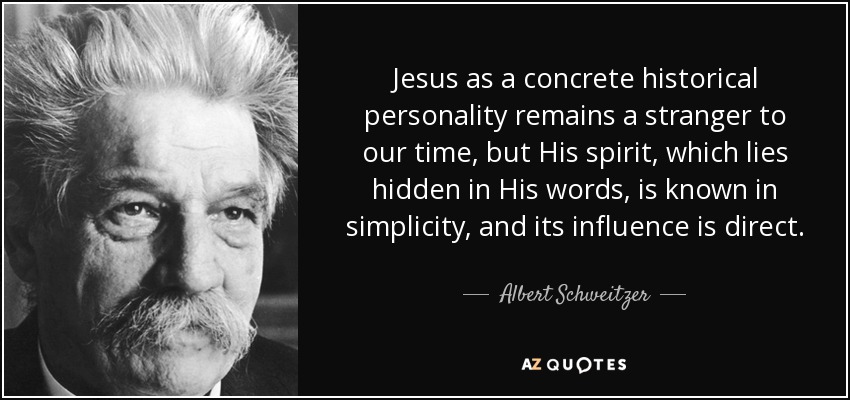
Jesus as a concrete historical personality remains a stranger to our time, but His spirit, which lies hidden in His words, is known in simplicity, and its influence is direct.
The use of expressive colors is felt to be one of the basic elements of the modern mentality, an historical necessity, beyond choice.
'Believing' cannot tip the scales in making a historical judgement about whether something really happened. I can choose to believe that George Washington threw a silver dollar across the Rappahannock, but my believing that he did it has nothing to do with whether or not he really did do it. So also with the story of Jesus walking on water: Believing that he did it has nothing to do with whether he really did do it. 'Belief' cannot be the basis for historical conclusions; it has no direct relevance.
And it also became clear that these conditions of inequality and historical injustice have given rise to a feeling of hate in the world - a deeply felt hate that cannot easily be overcome with a few good words.
Communist regimes were not some unfortunate aberration, some historical deviation from a socialist ideal. They were the ultimate expression, unconstrained by democratic and electoral pressures, of what socialism is all about. ... In short, the state [is] everything and the individual nothing.
As an historical novelist - there are few jobs more retrospective.
In historical and constitutional terms, the recent political status vote in Puerto Rico was a necessary but obviously not decisive step on the road of self-determination leading to full self-government.
I mean, Jesus was a white man too. He was a historical figure — that's a verifiable fact.
The historical mission of our times is to re-invent the human—at the species level, with critical reflection, within the community of life-systems, in a time-developmental context, by means of story and shared dream experience.
Just now one of the significant historical roles of the primal people of the world is not simply to sustain their own traditions, but call the entire civilized world back to a more authentic mode of being.
The Feminist Standpoint: Developing the Ground for a Specifically Feminist Historical Materialism
The power of the Marxian critique of class domination stands as an implicit suggestion that feminists should consider the advantages of adopting a historical materialist approach to understanding phallocratic domination.
When one group rules another, the relationship between the two is political. When such an arrangement is carried out over a long period of time it develops an ideology (feudalism, racism, etc.). All historical civilizations are patriarchies: their ideology is male supremacy.
I think one of the great historical contributions of science is to weaken the hold of religion. That's a good thing.
I am myself persuaded, on the basis of extensive study of the historical evidence, that... the severity of each of the contractions - 1920-21, 1929-33, and 1937-38 - is directly attributable to acts of commission and omission by the Reserve authorities and would not have occurred under earlier monetary and banking arrangements.
Nothing will stop us. The road to the stars is steep and dangerous. But we're not afraid . . . Space flights can't be stopped. This isn't the work of one man or even a group of men. It is a historical process which mankind is carrying out in accordance with the natural laws of human development.
When one historical period is replaced by another, there is always a group of people left over from the old society
That Krishna himself was a historical figure is indeed quite indubitable.
After all, the past is our only real guide to the future, and historical analogies are instruments for distilling and organizing the past and converting it to a map by which we can navigate.
The Genealogical Science is a wonderful account of how old-fashioned race science has come to be re-defined by resort to the most recent developments in genetics. But this book is not simply another story of the ideological uses to which science may be put. Nadia Abu El-Haj has provided the reader with a very detailed analysis of the historical entanglement between science and politics. Her study should be required reading for anyone interested in the sociology of science-and also for those dealing with Middle Eastern nationalisms. This is a work of outstanding value for scholarship.
However, the difficulties and pleasures of the writing itself are similar for a novel with a historical setting and a novel with a contemporary setting, as far as I'm concerned.
I have certainly amassed many historical research gathering skills.
Telling about our lives is important for those who come after as, for those who will see our experience as part of their own historical struggle.
A historical perspective can also help free us from the ever-present danger -- especially at danger in the social sciences -- of absolutizing a theory or method which is actually relative to the fact that we live at a given moment in time in the development of our particular culture.
Silences enter the process of historical production at four crucial moments: the moment of fact creation (the making of sources); the moment of fact assembly (the making of archives); the moment of fact retrieval (the making of narratives); and the moment of retrospective significance (the making of history in the final instance).
Follow AzQuotes on Facebook, Twitter and Google+. Every day we present the best quotes! Improve yourself, find your inspiration, share with friends
or simply: