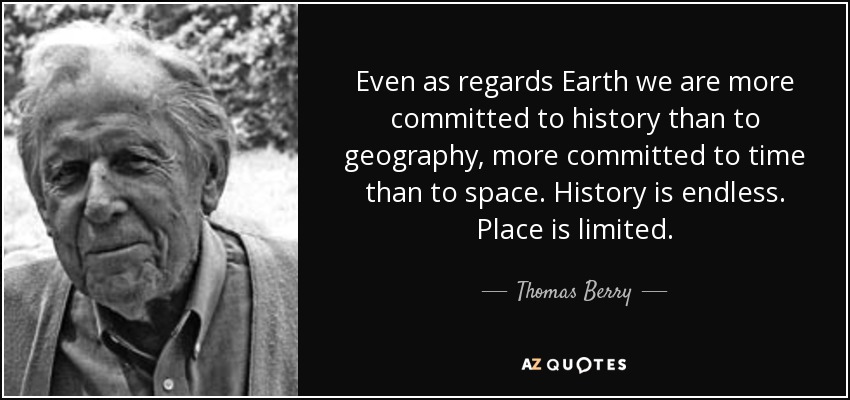
Even as regards Earth we are more committed to history than to geography, more committed to time than to space. History is endless. Place is limited.
The success or failure of any historical age is the extent to which those living at that time have fulfilled the special role that history has imposed upon them.
You have delivered up our holy German Fatherland to one of the greatest demagogues of all time. I solemnly prophesy that this accursed man will cast our Reich into the abyss and bring our nation to inconceivable misery. Future generations will damn you in your grave for what you have done.
No civilization can exist part free and part slave. ..We have never had any other kind of civilization. It has always been that way. There has always been a division of man. There has always been the conqueror and conquered-the master and slave-the ruler and the ruled-the oppressor and the oppressed. There has never been content nor unity. There has been only discontent and disunity.
There are reveries so deep, reveries which help us descend so deeply within ourselves that they rid us of our history. They liberate us from our name. These solitudes of today return us to the original solitudes.
History can tell us what happened in the past. But it cannot assert that it must happen again in the future.
The supremacy of public opinion determines not only the singular role that economics occupies in the complex of thought and knowledge. It determines the whole process of human history.
"For even the most childish intoxication with progress will soon be forced to recognize that writing and books have a function that is eternal. It will become evident that formulations in words and the handling on of these formulations through writing are not only important aids but actually the only means by which humanity can have a history and continuing consciousness of itself."
The fate of our times is characterized by rationalization and intellectualization and, above all, by the 'disenchantment of the world.' Precisely the ultimate and most sublime values have retreated from public life either into the transcendental realm of mystic life or into the brotherliness of direct and personal human relations. It is not accidental that our greatest art is intimate and not monumental.
The course of human history is determined, not by what happens in the skies, but what takes place in our hearts.
To write history is as important as to make history. It is an unchanging truth that if the writer does not remain true to the maker, then it takes on a quality that will confuse humanity.
It is best to erase all personal history because that would make us free from the encumbering thoughts of other people
Sometimes history knocks at the most ordinary door to see if anyone is home. Sometimes someone is.
History is rooted in the future
Jews, Germans, and Allies is an important historical document, especially in light of those revisionists who would impose a universal amnesia about the suffering and losses incurred during the Holocaust. The grim statistics that Ms. Grossmann presents in her carefully researched and well-organized book carry evidence of the terrible truth. But the testimony of the survivors she quotes contains the final, ineradicable facts of history.
The effect on human consciousness of the experience of the Presence of God is subjectively transformative and identical throughout human history. It leaves a timeless mark that is verifiable as a calibration of a recorded level of conciousness.
Do not let us speak of darker days, let us speak rather of sterner days. These are not dark days: these are great days-the greatest days our country has ever lived; and we must all thank God that we have been allowed, each of us according to our stations, to play a part in making these days memorable in the history of our race.
History unfolds itself by strange and unpredictable paths. We have little control over the future; and none at all over the past.
History's villains are more easily recognized in retrospect. In an article published in 1935 and reprinted in 1937, Winston Churchill expressed a curious ambivalence towards the German chancellor prior to the outbreak of war: We cannot tell whether Hitler will be the man who will once again let loose upon the world another war in which civilization will irretrievably succumb, or whether he will go down in history as the man who restored honour and peace of mind to the great Germanic nation. . . .
Those old credulities, to Nature dear, Shall they no longer bloom upon the stock Of history?
O my Bergson, you are a magician, and your book is a marvel, a real wonder in the history of philosophy . . . In finishing it I found . . . such a flavor of persistent euphony, as of a rich river that never foamed or ran thin, but steadily and firmly proceeded with its banks full to the brim.
As the British Constitution is the most subtle organism which has proceeded from progressive history, so the American Constitution is the most wonderful work ever struck off at a given time by the brain and purpose of man.
The academic mind can eat away the very basis of its own assurance ... produce contortions when it tries to bend over backward ... allow itself to be dismayed by the picture it has created of relentless historical process.
I cannot too often repeat that Democracy is a word the real gist of which still sleeps, quite unawakened, notwithstanding the resonance and the many angry tempests out of which its syllables have come, from pen or tongue. It is a great word, whose history, I suppose, remains unwritten because that history has yet to be enacted.
On the road, they join the bedraggled remnants of a column of exhausted Confederate soldiers evacuating burning Atlanta. Rhett makes her take note of the scene: "Take a good look, my dear. It's a historic moment. You can tell your grandchildren how you watched the Old South disappear one night."
Follow AzQuotes on Facebook, Twitter and Google+. Every day we present the best quotes! Improve yourself, find your inspiration, share with friends
or simply: