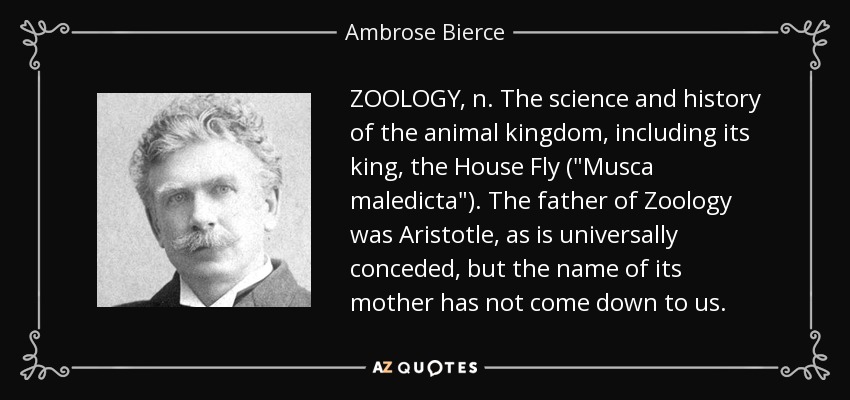
ZOOLOGY, n. The science and history of the animal kingdom, including its king, the House Fly ("Musca maledicta"). The father of Zoology was Aristotle, as is universally conceded, but the name of its mother has not come down to us.
I will not go so far as to say that to construct a history of thought without profound study of the mathematical ideas of successive epochs is like omitting Hamlet from the play which is named after him. That would be claiming too much. But it is certainly analogous to cutting out the part of Ophelia. This simile is singularly exact. For Ophelia is quite essential to the play, she is very charming . . . and a little mad.
I am not a pessimist but a pejorist (as George Eliot said she was not an optimist but a meliorist); and that philosophy is founded on my observation of the world, not on anything so trivial and irrelevant as personal history.
This generation, raised on "Eyewitness News," conditioned by the instant replay, and spared the illumination that comes from tedious historical study, tends to be even more ahistorical than most.
I think utopianism and eschatology are really two sides of the same coin. They both assume that some massively transformative event is going to happen that's going to completely change the nature of society. They only disagree on whether we get a happy ending or all die horribly. And so utopianism is on the wane right now because at the moment most of the plausible candidates for huge historical transformation look like they're going to kill us.
Russia is an ancient country with historical, profound traditions and a very powerful moral foundation. And this foundation is a love for the Motherland and patriotism. Patriotism in the best sense of that word. Incidentally, I think that to a certain extent, to a significant extent, this is also attributable to the American people.
I like to create imaginary characters and events around a real historical situation. I want readers to feel: OK, this probably didn't happen, but it might have.
Memory as an inversion of historical time is the essence of interiority.
Marxism must abhor nothing so much as the possibility that it becomes congealed in its current form. It is at its best when butting heads in self-criticism, and in historical thunder and lightning, it retains its strength.
Due to the fact that I experienced personally the situation of a political prisoner, I have an historical commitment to all those that were or are prisoners just because they expressed their views, their public opinion, their own opinions.
By the same right under which France took Flanders, Lorraine and Alsace, and will sooner or later take Belgium — by that same right Germany takes over Schleswig; it is the right of civilisation as against barbarism, of progress as against stability.
Killing Lincoln is a must-read historical thriller. Bill O'Reilly recounts the dramatic events of the spring of 1865 with such exhilarating immediacy that you will feel like you are walking the streets of Washington DC on the night that John Wilkes Booth shot Abraham Lincoln. This is a hugely entertaining, heart-stopping read.
As founder and co-chair of the upper Mississippi River Congressional task force, I have long sought to preserve the river's health and historical multiple uses, including as a natural waterway and a home to wildlife, for the benefit of future generations of Americans.
I will give you my definition of a nation, and you can add the adjective 'Jewish.' A Nation is, in my mind, an historical group of men of a recognizable cohesion held together by a common enemy. Then, if you add to that the word 'Jewish' you have what I understand to be the Jewish nation.
False history gets made all day, any day, the truth of the new is never on the news.
The corniest movie ever made about the white man's need to lose his identity and assuage racial, political, sexual and historical guilt.
For man as an historical creature has desires of indeterminate dimensions.
Beauty has never been absolute and immutable but has taken on different aspects depending on the historical period and the country
Millar Burrows of Yale observes: 'Archeology has in many cases refuted the views of modern critics. It has shown in a number of instances that these views rest on false assumptions and unreal, artificial schemes of historical development. This is a real contribution and not to be minimized.'
Homeopathy may be defined as a specious mode of doing nothing. While it waits on the natural progress of disease and the restorative tendence of nature on the one hand, or the injurious advance of disease on the other, it supplies the craving for activity, on the part of the patient and his friends, by the formal and regular administration of nominal medicine. Although homeopathy will, at some future time, be classed with historical delusions.
I think you just have to turn it around and say we are at this absolute historical moment. No generation has ever been as powerful as us. We have the future of our species in our hands. We could be the generation that people look back on and say, 'They bloody did it!', not 'They didn't bother.'
The idea of the paranoid style as a force in politics would have little contemporary relevance or historical value if it were applied only to men with profoundly disturbed minds. It is the use of paranoid modes of expression by more or less normal people that makes the phenomenon significant.
No degree of prosperity could justify the accumulation of large amounts of highly toxic substances which nobody knows how to make safe and which remain an incalculable danger to the whole of creation for historical or even geological ages. To do such a thing is a transgression against life itself, a transgression infinitely more serious than any crime perpetrated by man. The idea that a civilization could sustain itself on such a transgression is an ethical, spiritual, and metaphysical monstrosity. It means conducting the economical affairs of man as if people did not matter at all.
The traditional doctrine of man and not the measurement of skulls and footprints is the key for the understanding of that anthropos who, despite the rebellion of Promethean man against Heaven from the period of Renaissance and its aftermath, is still the inner man of every man, the reality which no human being can deny wherever and whenever he lives, the imprint of a theomorphic nature which no historical change and transformation can erase completely from the face of that creature called man.
All historical writing, even the most honest, is unconsciously subjective, since every age is bound, in spite of itself, to make the dead perform whatever tricks it finds necessary for its own peace of mind.
Follow AzQuotes on Facebook, Twitter and Google+. Every day we present the best quotes! Improve yourself, find your inspiration, share with friends
or simply: