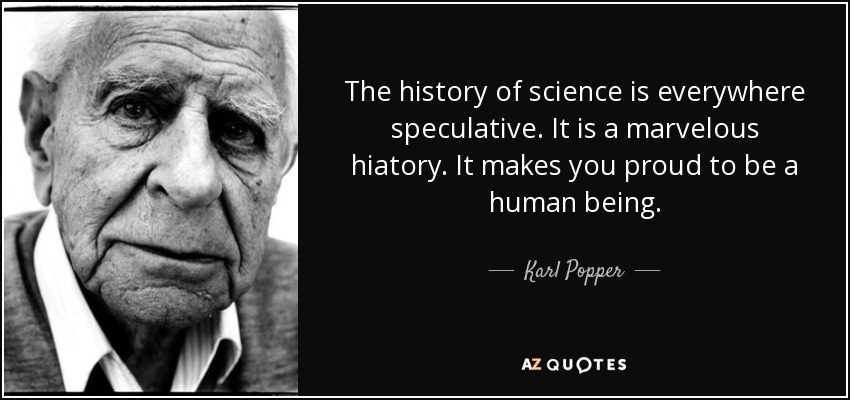
The history of science is everywhere speculative. It is a marvelous hiatory. It makes you proud to be a human being.
The history of art cannot be properly understood without some reference to the history of science. In both we are studying the symbols by which man affirms his mental scheme, and these symbols, be they pictorial or mathematical, a fable or formula, will reflect the same changes.
Just as science is more immediate and exciting than the history of science, so is insight more compelling than a history of insight.
Oddly, since by now I've written quite a lot on early modern philosophers, I didn't care for the history of philosophy, which I thought dull and obscure, until I got a minor job writing articles for a children's encyclopedia in the history of science and began to make connections between science and philosophy.
The natural history of science is the study of the unknown. If you fear it you're not going to study it and you're not going to make any progress.
The history of science is a record of the transformations of contempts amd amusements.
Under my definition, a scientific theory is a proposed explanation which focuses or points to physical, observable data and logical inferences. There are many things throughout the history of science which we now think to be incorrect which nonetheless would fit that which would fit that definition. Yes, astrology is in fact one.
It has never been in my power to study anything, mathematics, ethics, metaphysics, gravitation, thermodynamics, optics, chemistry, comparative anatomy, astronomy, psychology, phonetics, economics, the history of science, whist, men and women, wine, metrology, except as a study of semeiotic .
The history of science is the saga of nature defying common sense.
The history of science teaches only too plainly the lesson that no single method is absolutely to be relied upon, that sources of error lurk where they are least expected, and that they may escape the notice of the most experienced and conscientious worker.
The history of science fiction started in the caves 20,000 years ago. The ideas on the walls of the cave were problems to be solved. It's problem solving. Primitive scientific knowledge, primitive dreams, primitive blueprinting: to solve problems.
More attention to the History of Science is needed, as much by scientists as by historians, and especially by biologists, and this should mean a deliberate attempt to understand the thoughts of the great masters of the past, to see in what circumstances or intellectual milieu their ideas were formed, where they took the wrong turning or stopped short on the right track.
The chief requisite for the making of a good chicken pie is chicken; no amount of culinary legerdemain can make up for the lack of chicken. In the same way, the chief requisite for the history of science is intimate scientific knowledge; no amount of philosophic legerdemain can make up for its absence.
Tektology was the first attempt in the history of science to arrive at a systematic formulation of the principles of organization operating in living and nonliving systems.
In the history of science it has often happened that the majority was wrong and refused to listen to a minority that later turned out to be right.
You could write the entire history of science in the last 50 years in terms of papers rejected by Science or Nature.
The history of science is science itself; the history of the individual, the individual.
The history of science should not be an instrument to defend any kind of social or philosophic theory; it should be used only for its own purpose, to illustrate impartially the working of reason against unreason, the gradual unfolding of truth, in all its forms, whether pleasant or unpleasant, useful of useless, welcome or unwelcome.
Any scientist who tells you they know that GMOs are safe and not to worry about it, is either ignorant of the history of science or is deliberately lying. Nobody knows what the long-term effect will be.
We live in an enlightened age, however, an age that has learned to see and to value other living things as they are, not as we wish them to be. And the long and creditable history of science has taught us, if nothing else, to look carefully before we judge to judge, if we must, based on what we see, not what we would prefer to believe.
Philosophy of science without history of science is empty; history of science without philosophy of science is blind.
Historians of a generation ago were often shocked by the violence with which scientists rejected the history of their own subject as irrelevant; they could not understand how the members of any academic profession could fail to be intrigued by the study of their own cultural heritage. What these historians did not grasp was that scientists will welcome the history of science only when it has been demonstrated that this discipline can add to our understanding of science itself and thus help to produce, in some sense, better scientists.
The history of science, like the history of all human ideas, is a history of irresponsible dreams, of obstinacy, and of error. But science is one of the very few human activities-perhaps the only one-in which errors are systematically criticized and fairly often, in time, corrected. This is why we can say that, in science, we often learn from our mistakes, and why we can speak clearly and sensibly about making progress there. In most other fields of human endeavour there is change, but rarely progress ... And in most fields we do not even know how to evaluate change.
It is for Muslim scholars to study the whole history of Islamic science completely and not only the chapters and periods which influenced Western science. It is also for Muslim scholars to present the tradition of Islamic science from the point of view of Islam itself and not from the point of view of the scientism, rationalism and positivism which have dominated the history of science in the West since the establishment of the discipline in the early part of the 20th century in Europe and America.
Evolution is one of the most powerful and important ideas ever developed in the history of science. Every question it raises leads to new answers, new discoveries, and new smarter questions. The science of evolution is as expansive as nature itself. It is also the most meaningful creation story that humans have ever found.
Follow AzQuotes on Facebook, Twitter and Google+. Every day we present the best quotes! Improve yourself, find your inspiration, share with friends
or simply: