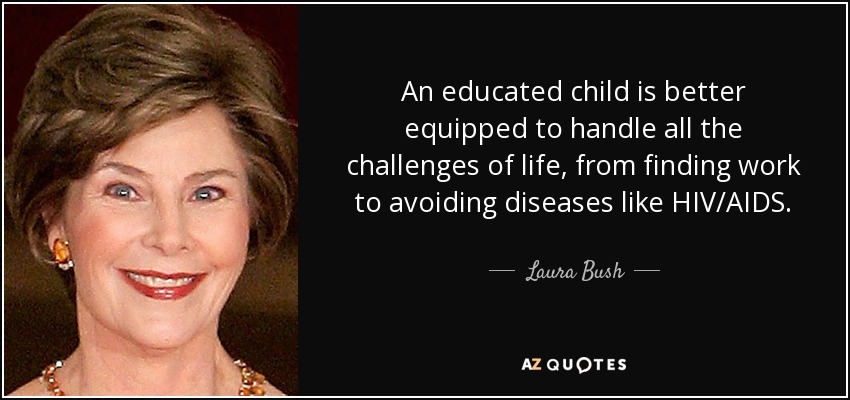
An educated child is better equipped to handle all the challenges of life, from finding work to avoiding diseases like HIV/AIDS.
I admire leaders in science, people who really figure things out like Richard Fineman or people who work on vaccines, tons of people working on [the] HIV vaccine. There's leaders in business, people like Warren Buffett, who've got a certain approach they take that are pretty amazing. There [are] product innovators like Steve Jobs was, where he gets behind a concept and does a fantastic job.
It starts with water. The kid who doesn't get to go to school because he's looking for water around his neck of the woods, that kid doesn't learn about HIV and then dies from AIDS. Or cholera or whatever. It all links back.
Is neither a cure for AIDS nor a way of preventing infection with HIV.
Some countries have good laws, laws which could stem the tide of HIV. The problem is that these laws are flouted. Because stigma gives unofficial license to treat people living with HIV or those at greatest risk unlike other citizens.
Where you criminalize people living with HIV or those at greatest risk, you fuel the epidemic.
When I first came up, the whole AIDS epidemic was starting, and the gay community that I experienced from the beginning of my career was mostly - and overwhelmingly - concerned with staying alive. And, also, I felt really aware of the preciousness of life and time. The gay community and people who were HIV-positive were treated so badly, and I was very disturbed by things. But I also saw a lot of love and connection in the gay community at that time.
The desire to move into a bigger house, to avoid living AIDS daily, and a dream to be accepted by a community and school, became possible and a reality with a movie about my life, The Ryan White Story.
Most recently my battle has been against AIDS and the discrimination surrounding it.
On December 17, 1984, I had surgery to remove two inches of my left lung due to pneumonia. After two hours of surgery the doctors told my mother I had AIDS.
The school I was going to said they had no guidelines for a person with AIDS.
The truth is that the 143 million orphaned children and the 11 million who starve to death or die from preventable diseases and the 8.5 million who work as child slaves, prostitutes, or under other horrific conditions and the 2.3 million who live with HIV add up to 164.8 million needy children. And though at first glance that looks like a big number, 2.1 billion people on this earth proclaim to be Christians. The truth is that if only 8 percent of the Christians would care for one more child, there would not be any statistics left.
To date, nearly 100,000 Hispanics have died with AIDS. Since Hispanics are the fastest growing minority group in the United States, our challenge is even greater.
Over the years, HIV/AIDS activists and their allies have been pioneers in creating new frontiers in the medical establishment. Through their efforts, the FDA drug approval procedures were reformed so promising new therapies could reach desperate patients quicker.
I don't know how many [South Africans] with HIV would want to take anti-retrovirals.
There is not substantial data that AZT stops the transmission of HIV from mother to child. There is too much conflicting data to make concrete policy.
AZT was never meant to treat HIV. It was meant to treat cancer and, when it was discovered to be toxic, the drug companies stopped clinic trials of the drug because it was so toxic. Is this drug really one we want to use?
An AIDS-free generation would mean that virtually no child is born with HIV; that, as those children grow up, their risk of becoming infected is far lower than it is today; and that those who become infected can access treatment to help prevent them from developing AIDS and from passing the virus on to others.
Drug warriors' staunch opposition to needle exchanges to prevent the spread of HIV in addicts delayed the programs' widespread introduction in most states for years. A federal ban on funding for these programs wasn't lifted until 2009. Contrast this with what happened in the U.K. At the peak of the AIDS epidemic in the mid-1990s, the HIV infection rate in IV drug users in the U.K. was about 1%. In New York City, the American epicenter, that figure was 50%. The British had introduced widespread needle exchange in 1986. That country had no heterosexual AIDS epidemic.
Do you know there is actually a blood test out there now to find out if your kid is gay or not? Yeah, it's an HIV test.
The United States has put more money on HIV, AIDS, malaria and tuberculosis than any country in the world and it's having an impact real quick.
My first understanding of HIV and AIDS was like everybody else from my generation. In the mid-'80s, we heard about this, and it was terrifying, because we knew nothing about how to respond to it appropriately, and we didn't really understand about how the virus is passed. There was a lot of misconception about that.
There's so much stigma around HIV/AIDS. It's a challenging issue, and the people that already have been tested and know their status find it very, very hard to disclose their status, to live with that virus, and to even seek out the kind of information they need. This experience of going to South Africa a decade ago really woke me up to the scale of the HIV/AIDS pandemic in sub-Saharan Africa, how it was affecting women and their children. I haven't been able to walk away from it.
HIV is no respecter of persons. Any of us could find ourselves with the disease, and then what? We tend to stigmatize as a way to deceive ourselves about our invincibility. But it is a delusion.
In This Body Mystery, even though it was written in the voice of people with HIV/AIDS, it's about how people come to accept their fate and their sickness. It's about accepting the way your life is.
Follow AzQuotes on Facebook, Twitter and Google+. Every day we present the best quotes! Improve yourself, find your inspiration, share with friends
or simply: