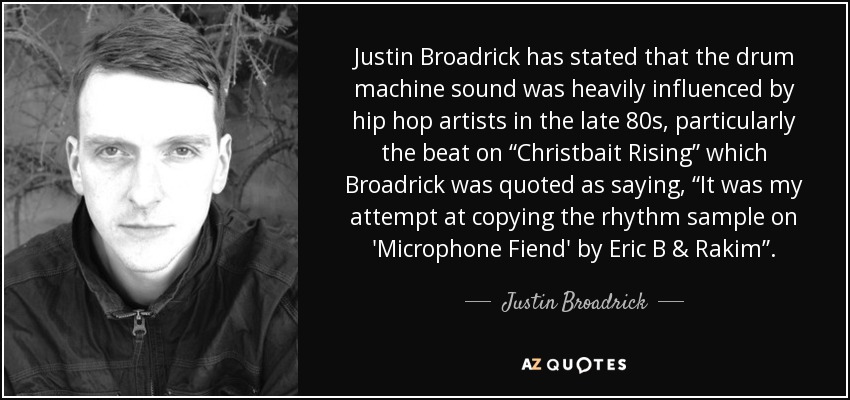
Justin Broadrick has stated that the drum machine sound was heavily influenced by hip hop artists in the late 80s, particularly the beat on “Christbait Rising” which Broadrick was quoted as saying, “It was my attempt at copying the rhythm sample on 'Microphone Fiend' by Eric B & Rakim”.
I park two blocks away from Nickelodeon studios and I hop on my skateboard and I skateboard the rest of the way to the studio.
I am a hip-hop fanatic, and rock fanatic.
It's not about what you get out but what you put into hip hop as a genre.
I like Nine Inch Nails, and I like hip-hop.
The earth has become small, and on it hops the last man, who makes everything small. His race can no more be exterminated than the flea can be. The last man lives the longest.
Hip-hop is rock & roll. What the hell is Wu-Tang but Motorhead?
I don't talk to media or anyone before games. I just put my headphones on, turn up some hip-hop, and get in the zone.
I'd always loved hip-hop.
I know a lot of mainstream hip-hop people, have been listening to things like Aphex Twin for years. When somebody first played me some of that album, I was just like, "Woah!"
With dance, it's about education. I'm teaching a lot. I teach the foundations of hip-hop.
It's odd to see a black person painting his nails in Miami, especially in the hip-hop community.
I'm not stuck strictly doing hip-hop. Songs from the dance/electronic scene are my favorite to make and remix, and I like that world.
When you think of blues, all you think about is crying guitar like B.B. King's guitar. You think about someone crying that their woman's gone. And how bad life is and all that. Why can't it be something happy with the blues? Why can't it have a hip-hop beat to which you can do the dances of today?
I've been able to be a part of every movement in music over the last several decades. The only one that I haven't been involved in so much is hip-hop, which I chose not to be involved in because it felt like I would be what they called "perpetrating." It felt like hip-hop was so much of its own culture and that I was not part of that culture.
I fell into hip-hop right from the beginning. I was a teenager in the '60s, so I was putting all my pocket money into buying LPs. I followed the ascent of the Rolling Stones, the Beatles, and Stevie Wonder. I followed popular music very closely, and I've never stopped.
In the early '80s, I was blown away when I began to hear some of the earliest hip-hop songs, and I'm fascinated by all the permutations the genre has gone through.
I think there is going to be a whole market and we'll start to see hip-hop jewelry regularly in jewelry auctions around the world. Therefore, anybody who gets on the train early can only do well financially in the long run.
Critics are always complaining about the materialism of hip-hop and accusing the artists of living way above their means. But this ostentatious sort of spending isn't strictly the province of hip-hop. It's almost like a continuation of the American Dream.
I think it's a tribute to the artistic importance of hip-hop culture and what hip-hop has brought into music and fashion and jewelry that it is being adapted or imitated or is inspiring variations or new types of art or new types of music.
What I feel with the best of hip-hop music and with the best of what has been produced by hip-hop culture is that it's going to be timeless, and it's going to last.
I think Hip Hop and Gospel are such strong distinct cultures that have problems, unspoken problems obviously, but problems with one another. On the hip hop side, it's the problems of "awe man I don't like the suits and ties," and on the Gospel side it's " awe man they need to pull their pants up." I just think those are minor, really small issues that we just need to get over and learn to help each other. We're all on the same , and in the same boat.
Maybe there's a different story when it comes to hip-hop or different genres, but as far as rock music goes, I think there is a sort of fear of saying things people might be apt to criticize. Our band is the opposite of that.
Hip-hop artist, especially the older ones, are the ones who new hip-hop was a worldwide phenomenon before the mainstream caught on, so hip-hop artists are forward thinkers. We want to stay with the new.
I noticed that difference early on, like if you were successful in rock 'n' roll, that was a really bad thing, you almost had to hide it. You had these guys selling 200 million records with dirty T-shirts on. I was like, 'Come on, man. Come on. We know you're successful.' Hip-hop is more about attaining wealth. People respect success. They respect big. They don't even have to like your music. If you're big enough, people are drawn to you.
Follow AzQuotes on Facebook, Twitter and Google+. Every day we present the best quotes! Improve yourself, find your inspiration, share with friends
or simply: