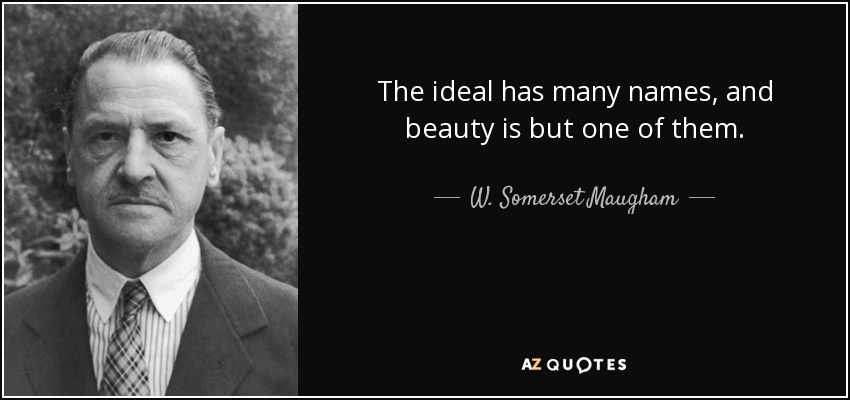
The ideal has many names, and beauty is but one of them.
Every time you stand up for an ideal, you send forth a tiny ripple of hope.
Set up as an ideal the facing of reality as honestly and as cheerfully as possible.
The worst effect of sin is within and is manifest not in poverty, and pain, and bodily defacement, but in the discrowned faculties, the unworthy love, the low ideal, the brutalized and enslaved spirit.
Yale is a crucible in American life for the accommodation of intellectual achievement, of wisdom, of refinement, with the democratic ideals of openness, of social justice and of equal opportunity.
My ideal is to achieve the ability to produce numberless prints from each negative, prints all significantly alive, yet indistinguishably alike, and to be able to circulate them at a price not higher than that of a popular magazine, or even a daily paper. To gain that ability there has been no choice but to follow the road I have chosen.
This is the most beautiful place on Earth. There are many such places. Every man, every woman, carries in heart and mind the image of the ideal place, the right place, the one true home, known or unknown, actual or visionary.
The function of an ideal is not to be realized but, like that of the North Star, to serve as a guiding point.
The ideal society can be described, quite simply, as that in which no man has the power of means to coerce others.
One can imagine a sane, healthy, cheerful human society based on no more than the principles of common sense, as validated each day by work, play, and living experience. But this remains the most utopian and fantastic of ideals.
There has never yet been a human society worthy of the name of civilization. Civilization remains a remote ideal.
The ideal kitchen-sink novel: Throw in everything but the kitchen sink. Then add the kitchen sink.
My theory on literature is an author who does not indulge in trashiness-writes about people you could introduce into your own home...he did not care to read a book or go to a play about people he would not care to meet at his own dinner table. I believe we should live by certain standards and ideals.
Politics, when it is an art and a service, not an exploitation, is about acting for an ideal through realities.
One might compare the relation of the ego to the id with that between a rider and his horse. The horse provides the locomotor energy, and the rider has the prerogative of determining the goal and of guiding the movements of his powerful mount towards it. But all too often in the relations between the ego and the id we find a picture of the less ideal situation in which the rider is obliged to guide his horse in the direction in which it itself wants to go.
Because the world is radically new, the ideal encyclopedia should be radical, too.
The further limits of our being plunge, it seems to me, into an altogether other dimension of existence from the sensible and merely understandable world. Name it the mystical region, or the supernatural region, whichever you choose. So far as our ideal impulses originate in this region (and most of them do originate in it, for we find them possessing us in a way for which we cannot articulately account), we belong to it in a more intimate sense than that in which we belong to the visible world, for we belong in the most intimate sense wherever our ideals belong.
India was the motherland of our race, and Sanskrit the mother of Europe's languages: she was the mother of our philosophy; mother, through the Arabs, of much of our mathematics; mother, through the Buddha, of the ideals embodied in Christianity; mother, through the village community, of self-government and democracy. Mother India is in many ways the mother of us all.
Since our complex societies are highly susceptible to interferences and accidents, they certainly offer ideal opportunities for a prompt disruption of normal activities.
The ideal subject of totalitarian rule is not the convinced Nazi or the dedicated communist, but people for whom the distinction between fact and fiction, true and false, no longer exists.
Finally, I believe in an America where religious intolerance will someday end; where all men and all churches are treated as equal; where every man has the same right to attend or not attend the church of his choice; where there is no Catholic vote, no anti-Catholic vote, no bloc voting of any kind; and where Catholics, Protestants and Jews, at both the lay and pastoral level, will refrain from those attitudes of disdain and division which have so often marred their works in the past, and promote instead the American ideal of brotherhood.
Sometimes I wonder if there's something wrong with me. Perhaps I've spent too long in the company of my literary romantic heroes, and consequently my ideals and expectations are far too high.
I see only the ideal. But no ideals have ever been fully successful on this earth.
So much American science fiction is parochial - not as true now as it was years ago, but the assumption is one culture in the future, more or less like ours, and with the same ideals, the same notions of how to do things, just bigger and flashier technology. Well, you know darn well it doesn't work that way.
The ideals of the party were close to me, and I have tried to adhere to those principles all my life. In essence, they are the same as in the Ten Commandments in the Bible. I will never change my convictions
Follow AzQuotes on Facebook, Twitter and Google+. Every day we present the best quotes! Improve yourself, find your inspiration, share with friends
or simply: