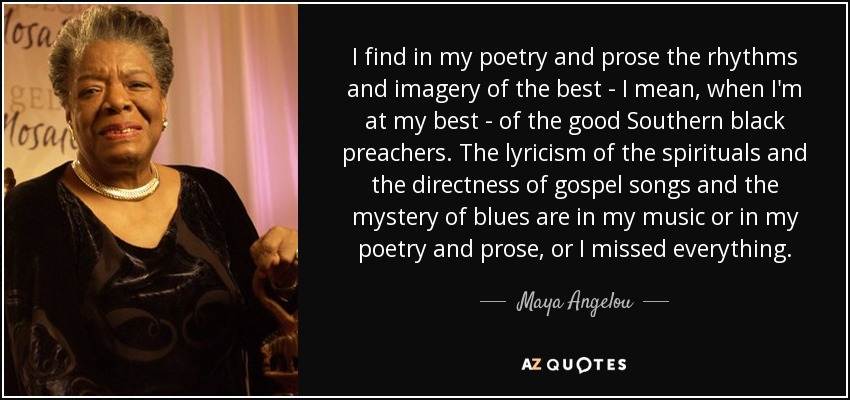
I find in my poetry and prose the rhythms and imagery of the best - I mean, when I'm at my best - of the good Southern black preachers. The lyricism of the spirituals and the directness of gospel songs and the mystery of blues are in my music or in my poetry and prose, or I missed everything.
Neither is there figurative and non-figurative art. All things appear to us in the shape of forms. Even in metaphysics ideas are expressed by forms. Well then, think how absurd it would be to think of painting without the imagery of forms. A figure, an object, a circle, are forms; they affect us more or less intensely.
The ultimate politeness in art consists of speaking only to those who are able to uncover and measure its relationships. Anything else is symbolic, and symbolism is merely transcendental imagery.
What I like about baroque is the reemergence of pre-Christian religion. The art of baroque mixes ancient pre-Christian myths with Christian imagery and each reflects upon the other.
It was as if he (Sigmar Polke) painted his imagery in a highly wrought way, instead of a calculatedly dumb way, or mechanical way, by silk-screening or by tracing from epidiascope projections, and so on.
I don't feel that I decided deliberately I'm going to write something and have it stand alone. Somewhere by the end I think it would probably revert to imagery.
Why did Ted Geisel end up writing and illustrating for young minds? He has specific imagery in the book, and we never would have moved beyond the discussion phase, if we couldn't have found an expression for The Lorax, dimensionally, that was true to the soul of what comes through in his simple line drawings, on the page.
David Bowie really played with ideas, and iconography and imagery. He's brilliant man. And a gentleman, too.
I enjoyed learning something and, uh, so I think like with anything in life, in the schoolroom in an artistic endeavor, if you have just a really good teacher, it's inspiring. I certainly use, in my work, I mean, I used to rely heavily on imagery. I was obsessed with this photograph that was in the NY Times of a fish engulfing a smaller fish and this smaller fish had this look in its eyes; it knew what was about to happen and, I don't know how they ever captured such an image, but I've used that for a play I (did). It's called "Saved."
If there's no magic of cinema, you only have the plain imagery of television. We are moving more and more towards a world devoid of meaningful experiences. We're going to the surface.
What I try to do is reinvigorate strategies and clichés I find in Hollywood movies. At a certain point I had these huge folders, each one classified according to subject matter or genre: people with guns, people kissing, Indians and cowboys falling off horses, getting shot, getting shot with arrows - almost every plot device. Then I cropped the cheap, recycled imagery to give exhausted images new meaning, or at least something other than their original meaning. I'm basically reassembling atoms to give them a meaning that's more au courant.
The question at hand is the danger posed to truth by computer-manipulated photographic imagery. How do we approach this question in a period in which the veracity of even the straight, unmanipulated photograph has been under attack for a couple of decades.
Documentary is a little like horror movies, putting a face on fear and transforming threat into fantasy, into imagery. One can handle imagery by leaving it behind. (It is them, not us.)
Now, there's just so much imagery. Imagine what our grandkids are going to be able to see of us?
When I was in my early 20s, I was quite into Japanese animation. It's like the same thing that I end up always saying which is, imagery based stuff is the thing that really gets me.
I do have a lot of sexual imagery in my performance. But I don't think it's ever encouraging anyone to have sex. I think I just show my own sexuality, but I don't think I've ever really written about having sex or anything like that.
Anything can be misinterpreted. People can look at Christ on a cross and think, This is an image of murder, this is violent, this has sexual imagery in it. And it just - I think it's my job as an artist to be out there pushing people's buttons and making them question everything.
We live in a world ruled by fictions of every kind - mass merchandising, advertising, politics conducted as a branch of advertising, the instant translation of science and technology into popular imagery, the increasing blurring and intermingling of identities within the realm of consumer goods, the preempting of any free or original imaginative response to experience by the television screen. We live inside an enormous novel.
Left-wing movements have tended to be unisex, and asexual in their imagery. Right-wing movements, however puritanical and repressive the realities they usher in, have an erotic surface. Certainly Nazism is "sexier" than communism.
That way of inspiration is always open, and open to everyone; it acts as go-between, interpreter, it explains symbols of the past in to-day's imagery.
I feel like we are so used to CGI [computer-generated imagery] and thank god because it is a wonderful tool, but there is an element of everything you are looking at has been created in the comfort of a studio. I want to return to a world where I can celebrate when you are really interacting with the world.
Imagery is the most important to me when singing stories. I try to paint pictures with the words and decorate with little to no singing....let the song do the work.
Films about the English monarchy, they tend to have a lavishness, sumptuous imagery, it's all very posh and rich.
I like visual imagery in my head.
I have a hard time with extreme imagery. Like I can't watch horror movies or anything like that.
Follow AzQuotes on Facebook, Twitter and Google+. Every day we present the best quotes! Improve yourself, find your inspiration, share with friends
or simply: