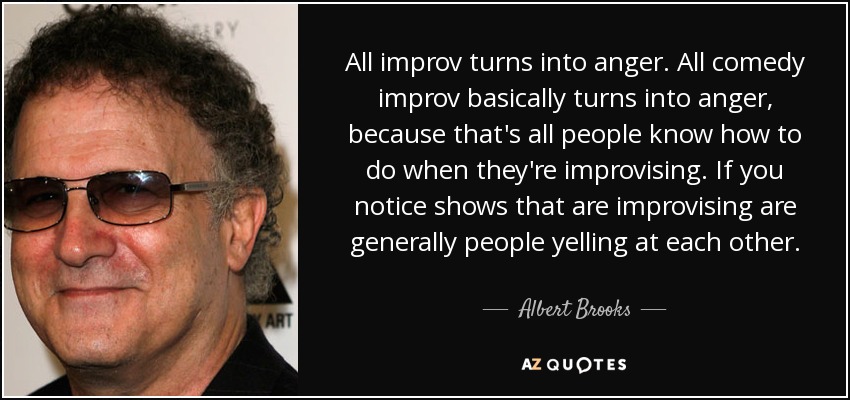
All improv turns into anger. All comedy improv basically turns into anger, because that's all people know how to do when they're improvising. If you notice shows that are improvising are generally people yelling at each other.
No hawk swooping down upon his prey, no stag improvising new detours by which to trick the huntsman, no dog scenting game from afar is comparable in speed to the celerity of a salesman when he gets wind a deal, to his skill in tripping up or forestalling a rival, and to the art with which he sniffs out and discovers a possible sale.
Sometimes you have to kind of keep proving that you're improvising. That's the game, or the goal, of long-form TV improv, is that you have to kind of keep reminding and showing people that you're improvising, because they won't believe you really.
When Indian musicians play a raga it's very restrictive. But, in a way these restraints are essential to liberate yourself through them, if that makes sense. I'm very much of this school of rhythm, it's the direction I'm drawn in when I'm writing and improvising.
If you do improvising, it can sometimes end up being a waste of time. And if you do that, it's more or less based on a writing process.
Remembering that life can be full of surprises is useful in any part of your life. You can try a new way of singing a song you’ve performed for years, a new way of showing your family your love for them, or a new recipe. Don’t just play the licks you know. We’re all improvising all the time — it’s good to recognize that and embrace it.
I've always loved improvising. That's how I write songs. Creativity has an improvised element to it.
I enjoy the challenge of taking something which was not meant for the piano, distilling its essence and writing or improvising it for/at the piano, but having the listener forget that he or she is listening to a piano.
Normally when I'm writing, in the beginning I don't think of lyrics at all. I'm just improvising.
Although arguably, it's my job to dig deep whether I'm improvising or not. It's just their style. That's the way they feel like they get what they want. I mean, they're really good storytellers, so I love being in their hands.
I find myself improvising a lot. But, sometimes I'll come us with a chorus or just one line and it will sort of hang out for a long time before it get's flushed out into a real living song.
I end up improvising in almost everything to some degree, 'cause it's often necessary on movies. The script is one thing, and it's this kind of theory of what you're going to do, and then you get there on the day and you realize, "Oh, the script is not appropriate to this room, the door's over here."
There's something very edgy about Bill Murray out there improvising.
I write and rewrite and memorize, and then inject my performance with improvising and spontaneity, because if something feels too rehearsed, it's not going to be fun.
You have to be loose enough so that when you listen to what's coming, you can follow it. In that sense I am improvising, but I don't think I'm experimenting. I have a problem with the whole term "experimental music."
I don't want to see an experiment. Experiment at home - when you show up on stage, I want to see a result. I think a lot of improvisers, you'll see them some nights and they just stink, and they go, "Well, we're just improvising." Like that's a license to have a shitty night!
When I joined the band I was coming largely from an improvising background, and the idea of a fluid rhythm that was really coherent attracted me.
First of all, you're improvising through a puppet, so you're not always yourself: you're a cow or you're a pig or you're an old woman, you know, whatever puppet you pick, or you're a demon, you know, whatever you pick up, that's what you get to be in the scene.
In many ways, I think it's easier in some ways, or it's more entertaining or more guaranteed to be entertaining than traditional improvising. Again, because you're not just you in your body.
A puppet that starts to improvise badly is almost funnier than the puppet that's improvising well. So the show gets better when the improvising is really good, but also the show can also sometimes get better when the improvising sort of goes a little wrong and that's sort of a blessing to improvising with puppets.
I think initially it's terrifying because going into a show where, you know, "Oh, I'm going to be on stage for two hours, I have no lines to memorize, I have nothing really prepared," and actually I say that, the show is not all improvising.
The show is probably 60 percent improvising and 40 percent not. So there's quite a bit of it that we do have prepared and that part of it, you have memorized and you've rehearsed and you're prepared, just like any show.
When I did The X-Files, there was certainly less of that because the script was as it was and it was such a wonderful script and it was quite complex and there wasn't a hell of a lot of improvising I could do to bring to the table, but I guess what I did bring was a sense of self and that the reason I was cast was because I did come across as someone who possibly was only human for a short time.
A lot of people love the idea of improvising but are terrified of it, so I tried to make a book that was not a chef's book about improvising but a real home cook's book with a real home cook's pantry, supermarket ingredients, that sort of thing.
I haven't written a novel or something that long, because I really am improvising all along and the story is growing new limbs to do what it needs to do. So there's very little planning. There's a little planning where I say, "Well, it looks like I'm going in this direction, ok, good." But there's very little forethought or intellectual justification: "Oh, look, I'm putting in a theme park because that represents dystopian America!"
Follow AzQuotes on Facebook, Twitter and Google+. Every day we present the best quotes! Improve yourself, find your inspiration, share with friends
or simply: