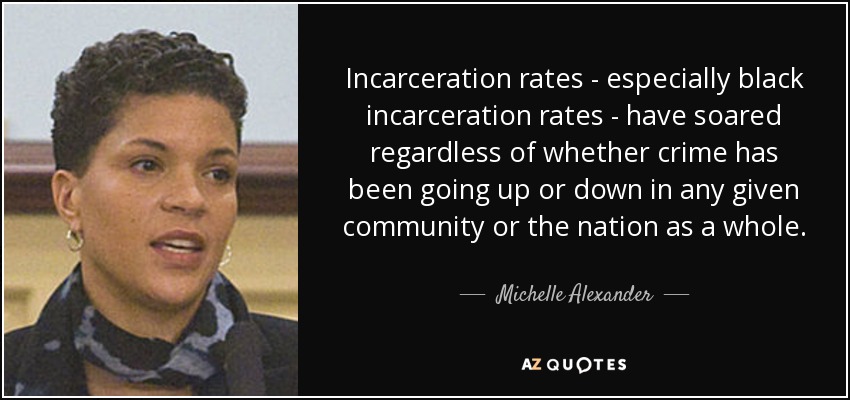
Incarceration rates - especially black incarceration rates - have soared regardless of whether crime has been going up or down in any given community or the nation as a whole.
I think it's critically important for people to understand that this system of mass incarceration governs not just those who find themselves in prison on any given day, but also all those who are in jail, on probation or parole, as well as all those who are just months away from being locked up again because they are unable to find work or housing due to their criminal record.
The war on drugs has been the engine of mass incarceration. Drug convictions alone constituted about two-thirds of the increase in the federal prison population and more than half of the increase in the state prison population between 1985 and 2000, the period of our prison system's most dramatic expansion.
We forget the conditions - not only in slavery - but after slavery, when there was this purposeful locking out of African Americans from economic opportunity. Or we forget today's incarceration rates, and educational and housing discrimination; all of these things. We pretend that everything that has happened happened long ago, and then we act as if we all now just treat each other equally, everything will be fine.
An environment-based education movement--at all levels of education--will help students realize that school isn't supposed to be a polite form of incarceration, but a portal to the wider world.
We live in a country that talks about being the home of the brave and the land of the free, and we have the highest incarceration rate in the world.
Over the last few years a lot of people have become aware of the inequities in the criminal justice system, right now, with our overall crime rate and incarceration rate both falling, we're at a moment when some good people in both parties, Republicans and Democrats and folks all across the country, are coming up with ideas to make the system work smarter and better.
But for poor black people and working-class black people, it is a much more difficult way to go. The over-incarceration of black people is just intolerable. When you look at the disparity in terms of education and access to fair schooling, it is horrible. If this would happen to white people in this country, it would not be tolerated.
That it is not same-gender relationships that are destroying marriage. What is actually destroying marriage is high unemployment, incarceration, a lack of education and ministers living in contradiction where they speak about holiness on one side but yet are living in adultery on the other.
Incarceration didnt change me. In many ways, incarceration galvanized me. The totality of the experience helped me.
I think this mythology - that we're all beyond race, of course our police officers aren't racist, of course our politicians don't mean any harm to people of color - this idea that we're beyond all that (so it must be something else) makes it difficult for young people as well as the grown-ups to be able to see clearly and honestly the truth of what's going on. It makes it difficult to see that the backlash against the Civil Rights Movement manifested itself in the form of mass incarceration, in the form of defunding and devaluing schools serving kids of color and all the rest.
In my view, the critical questions in this era of mass incarceration are: What disturbs us? What seems contrary to expectation? Who do we really care about?
For those interested in learning more about corporations and private individuals profiting from the caging of human beings, I highly recommend the book "Prison Profiteers: Who Makes Money From Mass Incarceration."
Our system of mass incarceration is better understood as a system of racial and social control than a system of crime prevention or control.
Junior was eleven. The statement is significant. There are a few peevish people in the world who believe that all eleven-year-old boys ought to be hung. Others, less irritable, think that gently chloroforming them would seem more humane. A great many good-natured folks contend that incarceration for a couple of years would prove the best way to dispose of them.
I really think we were charting a course to having a more sane response to mass incarceration, to drug use, and to understanding that the war on drugs has resulted only in the empowerment of vast criminal enterprises and the destruction of democracies around the world. And all that is coming to a miserable, horrific halt.
Just providing information about how bad things are, or the statistics and data on incarceration by themselves, does lead to more depression and resignation and is not empowering. The information has to be presented in a way that's linked to the piece about encouraging students to think critically and creatively about how they might respond to injustice, and how young people have responded to injustice in the past.
There is a tremendous amount of confusion and denial that exists about mass incarceration today, and that is the biggest barrier to movement building. As long as we remain in denial about this system, movement building will be impossible. Exposing youth in classrooms to the truth about this system and developing their critical capacities will, I believe, open the door to meaningful engagement and collective, inspired action.
Most criminologists today will acknowledge that crime rates and incarceration rates in the United States have had relatively little to do with each other.
When you talk about "white privilege", you're talking about something systemic. When you're talking about "black privilege" it's something spiritual because we as black people tap into a divine system that a lot of other cultures and races can't tap into and that system allows us to prosper in spite of everything that's been thrown our way from slavery to segregation to mass incarceration. We have a privilege pre-ordained by God that nothing and no one can stop.
I think it's critically important that the people who have been most harmed by mass incarceration, by mass deportation, by neoliberalism, by all of it, not only have a voice in crafting these platforms but emerge and are supported as real leaders in these movements.
The land of the free - we've got an army marching around the world under the banner of freedom, and yet, we are the most un-free society, in terms of institutions of the deprivation of liberty, of incarceration. The incidents of incarceration is higher in the United States than elsewhere in the world.
Various "wars on drugs" throughout history have killed millions, enslaved millions more, destroyed families, are usually just thin pretenses for mass incarceration, mass surveillance, ethnic cleansing, population control.
Barack Obama's understanding of what the drug war had cost the country was meaningful. And very quietly in his second term, he and Eric Holder did make some adjustments in terms of the use of the Department of Justice, on the federal level. You saw ratcheting back of drug prohibition, and mass incarceration. You also saw, on the part of some certain states, a realization that they followed the war on drugs to a useless place, that they were only doing damage to communities, and bankrupting budgets with prison construction.
Furthermore, the financial and social investment in prisons means that black and brown youth become, essentially, fodder for the machinery of capitalized incarceration. The steady supply of guns in the U.S. makes an already untenable situation even more dangerous, and all of us must raise our voices, write to Congress, hit the streets in protest, attend budget meetings of local municipalities - all to state our opposition to such criminal procedures and practices for our youth.
Follow AzQuotes on Facebook, Twitter and Google+. Every day we present the best quotes! Improve yourself, find your inspiration, share with friends
or simply: