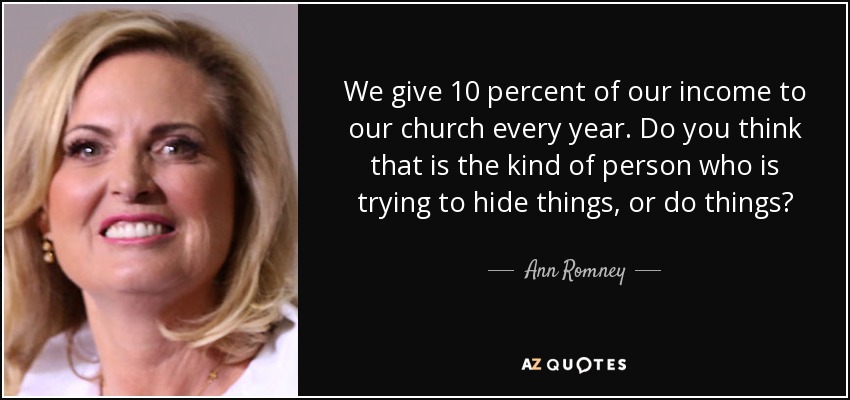
We give 10 percent of our income to our church every year. Do you think that is the kind of person who is trying to hide things, or do things?
They were not easy years. You have to understand, I was raised in a lovely neighborhood, as was Mitt, and at BYU, we moved into a $62-a-month basement apartment with a cement floor and lived there two years as students with no income... Neither one of us had a job, because Mitt had enough of an investment from stock that we could sell off a little at a time.
My mission is to raise incomes for hard working middle class families. If you work hard and do your part you should be able to get ahead and stay ahead.
There are skeptics who do not come to their view because they have a source of income from carbon polluters. I don't mean to imply that they're all in that category at all. There are also those who are also not motivated by ideological resistance for any role of government. But I don't know of any arguments or any presenters of arguments that overturn the consensus that I think have gained any legitimacy.
Giving is a universal opportunity. Regardless of your age, profession, religion, income bracket, and background, you have the capacity to create change.
Growth can also involve producing services instead of goods. In particular, a major expansion of public and caring services (like child care, education, elder care, and other life-affirming programs) would generate huge increases in GDP and incomes, with virtually no impact on the environment.
The cartooning was always just an abstraction. It was an income. It was making me famous. It was allowing me to go and do other things that I'd wanted to do.
Our Income Tax System is a disgrace to the human race.
I mean I don't think it got me interested in acting. I think it might be what makes it so that I can have the idea of the variety of people in the world, different incomes. That helps. When you're going to play someone it's interesting and nice to see experiences that aren't like yours. But there's always the remarkable similarity of all people.
An across-the-board, top-to-bottom cut in personal and corporate income taxes ... to expand the incentives and opportunities of private expenditures.
Democracy is mob rule with income taxes.
Below an income of ... $60,000 a year, people are unhappy, and they get progressively unhappier the poorer they get. Above that, we get an absolutely flat line. ... Money does not buy you experiential happiness, but lack of money certainly buys you misery.
The average well-being of our societies is not dependent any longer on national income and economic growth. ... But the differences between us and where we are in relation to each other now matter very much.
The American business man cannot consider his work done when he views the income balance in black at the end of an accounting period. It is necessary for him to trace the social incidence of the figures that appear in his statement and prove to the general public that his management has not only been profitable in the accounting sense but salutary in terms of popular benefits.
So many low income people have seen so many failed promises broken and seen so many quacks and sporadic medicines offered to them that building trust takes a lot of time, takes a lot of patience.
The power to gossip is more democratically distributed than power, property, and income, and, certainly, than the freedom to speak openly.
A useful analogy is to see traditional societies as relying on instantaneous (or minimally delayed) and constantly replenished solar income, while modern civilization is withdrawing accumulated solar capital at rates that will exhaust it in a tiny fraction of the time that was needed to create it.
Liberty is not about class war, income war, race war, national war, a war between the sexes, or any other conflict apart from the core conflict between individuals and those who would seek power and control over the human spirit. Liberty is the dream that we can all work together, in ways of our choosing and of our own human volition, to realize a better life.
I have never been afraid to tackle tough or controversial issues, but I have always done it with the intent to do what I was elected to do, and that is represent the interests of my constituents, the working people of Hawaii. I feel that we are facing some of the most difficult issues in recent history with regard to food security, a widening income gap, and the rapidly increasing rise of the cost of living in our State. I know that the office of Lieutenant Governor can do more to address these issues.
High tax rates in the upper income brackets allow politicians to win votes with class warfare rhetoric, painting their opponents as defenders of the rich. Meanwhile, the same politicians can win donations from the rich by creating tax loopholes that can keep the rich from actually paying those higher tax rates - or perhaps any taxes at all. What is worse than class warfare is phony class warfare. Slippery talk about 'fairness' is at the heart of this fraud by politicians seeking to squander more of the nation's resources.
In today's world, the elites are growing even more comfortable with one another across national lines, yet at the same time, less comfortable with low-income people who share their nationality. How we create those bonds of community that are truly global as well as national is one of our generation's great challenges.
In a world where inequality of ability is inevitable, anarchists do not sanction any attempt to produce equality by artificial or authoritarian means. The only equality they posit and will strive their utmost to defend is the equality of opportunity. This necessitates the maximum amount of freedom for each individual. This will not necessarily result in equality of incomes or wealth but will result in returns proportionate to service rendered.
Investing solely for 'income,' investing merely 'to keep capital employed,' and investing simply 'to hedge against inflation' are all entirely out of the question.
It seems to me that it's better to allow people to have more spendable income.That helps 'LO stimulate the economy and create more jobs.
Unequal funding resources also results in unequal educational opportunity when you consider studies that show that one half of low income students who are qualified to attend college do not attend because they can't afford to.
Follow AzQuotes on Facebook, Twitter and Google+. Every day we present the best quotes! Improve yourself, find your inspiration, share with friends
or simply: