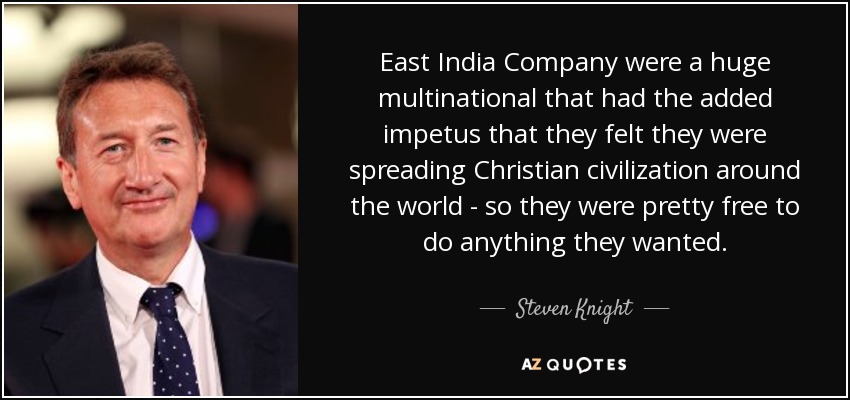
East India Company were a huge multinational that had the added impetus that they felt they were spreading Christian civilization around the world - so they were pretty free to do anything they wanted.
In a country like India, we don't want to put everyone in one big mixture. We have a different language, culture and cuisine for each region, even though we are united in the larger context. We are more like a fruit salad, where each ingredient has its own specialty, each fruit its distinct flavor, and together, the salad makes a tasty dish, without losing the individuality of each constituent.
If God were like a Star Wars Force linking all consciousness, I supposed I could maybe believe that. But let's just say I'm not going to be running off to India to join an ashram anytime soon.
Today, of course, the world's perception of India has changed tremendously. People understand its role in world affairs; they understand that India is not some backward nation. In fact, it is the fastest growing free-market democracy in the world today, and that says it all.
I think the East India Company represents what we would think of as a very modern approach to the world where everything was counted, every penny was counted.
I'm interested in mythology generally, but India has no special place in my heart - although Hindu gods seem a lot more fun.
"Moksha" is really a satire of myself. I've always been interested in Eastern spirituality. I'm particularly interested in enlightenment and the spiritual pursuit to liberate ourselves (I'm a Buddhist at heart). During my teenage years, I imagined I'd end up going to India to become a yogi; study with the last living saints in a cave; give up all my worldly possessions; learn to levitate. And there's still part of me that can see myself "disappearing" for some years at an ashram somewhere.
Some of the most dramatic consequences of the Kosovo war are linked to the resumption of the arms race and the suicidal political and economic policies of countries like India and Pakistan where tons of money are currently being spent on atomic weaponry. This is abhorrent!
I always had a hard time with Nashville. I reluctantly live there. I've mellowed, and it's improved some, in the fact it has more immigrants. There's some real Mexicans there, some folks from India, some of this and that. I'm not satisfied at all with living there. It's a dilemma for me.
Countries and world leaders have changed their perspective towards India. This is the biggest benefit.
Although many swamis and yogis had come from India to the West, Prabhupada was the only one with the purity and devotion to establish India's ancient Krishna conscious philosophy around the world on its own terms-not watered down, but as it is.
There are still some places I'd love to visit - Africa, China, Brazil, India. I want to travel the world and experience other cultures and peoples.
We are in the process of negotiating an agreement with the United States. We will be negotiating agreements with India and China. We are in the process of negotiating an agreement with Mercosur, South America. So there are a number of these trade agreements in the major markets of the world.
The biggest threat, when it comes to climate change and pollution, isn't going to come from us because we only have 300 million people. It's going to come from China with over 1 billion people and India with over 1 billion people.
I would especially like to appeal to my country's media that we should stop looking at everything in India from the prism of Pakistan. India is an independent country. It is a country of 125 crore people. Whenever it approaches any country, it will only be concerned about its own interests. It has been our biggest shortcoming and mistake that we have been tagging ourselves with another country and trying to do things.
India doesn't have one problem with China, we have a whole lot of problems pending with China.
Now it's time for India to steer ourselves, ride the waves and decide on our direction, destination and speed.
Earlier the world was bi polar. Foreign policy would be centered around two super powers. India was a little late in realizing that this bi polar situation was for namesake. Now the entire world, in changed circumstances, especially in 21st century, it is more interdependent and inter connected, earlier, the foreign policy was possible between governments, but today it is not possible just between governments. Government relations are important but increasing people to people contact is equally important. There's been a shift in paradigm.
Oh my God! Why did I leave India? I fell in love with a white man. That's what it was. It was the most boring, predictable reason in the world. I met him in India, we fell in love, and we got married. And then, we got divorced. Sorry about that.
Having come from the U.S. and observed the way the health care system works there, we definitely felt that we could do something in India.
Falling prices are driving renewable energy investment in India, which rose 13 per cent last year and is expected to surpass 10 billion dollars in 2015. Adoption of increasingly cost-effective renewables holds the genuine promise of a new age of socio-economic development, powered by clean, increasingly decentralised, and sustainable energy. The opportunity for India is tremendous.
I will win a Grammy for India.
Our supreme objective is peace. Our supreme objective is to protect India's interests. We keep making effort toward that objective and sometimes our efforts are successful.
India seeks friendly relations but without compromising on its interests.
Today the world has to accept what India has been saying about terrorism. India's dialogue on terrorism, the losses India has suffered due to terrorism, the losses suffered by humanity, the world is now acknowledging that.
Follow AzQuotes on Facebook, Twitter and Google+. Every day we present the best quotes! Improve yourself, find your inspiration, share with friends
or simply: