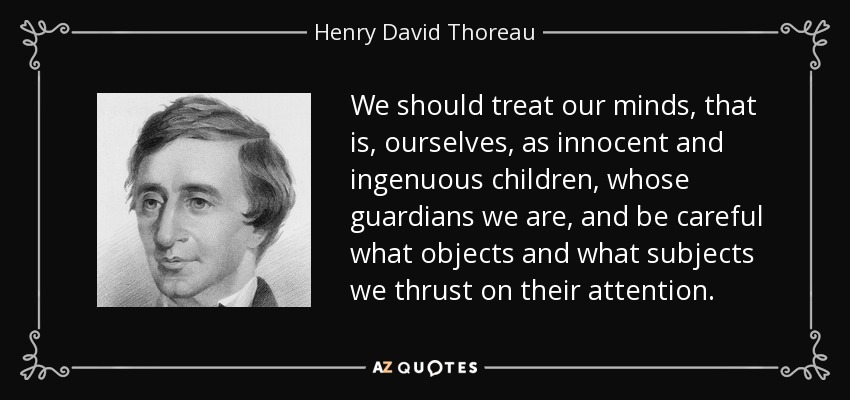
We should treat our minds, that is, ourselves, as innocent and ingenuous children, whose guardians we are, and be careful what objects and what subjects we thrust on their attention.
The English Writers of Tragedy are possessed with a Notion, that when they represent a virtuous or innocent Person in Distress, they ought not to leave him till they have delivered him out of his Troubles, or made him triumph over his Enemies.
By directing our sentiments, passions, and reason toward the common human plight, imagination grants us the advantages of a moralexistence. What we surrender of innocent love of self is exchanged for the safeties and pleasures of belonging to a larger whole. We are born dependent, but only imagination can bind our passions to other human beings.
The traditional educational theory is to the effect that the way to bring up children is to keep them innocent (i.e., believing in biological, political, and socioeconomic fairy tales) as long as possible ... that students should be given the best possible maps of the territories of experience in order that they may be prepared for life, is not as popular as might be assumed.
Writing tends to cheer me; it always soothes my spirit and blesses me with the gift of an innocent, tender, childlike day. It is the sensation of having spent a few hours in my homeland, with my customs, free whims, my total freedom.
At any innocent tea-table we may easily hear a man say, "Life is not worth living." We regard it as we regard the statement that it is a fine day; nobody thinks that it can possibly have any serious effect on the man or on the world. And yet if that utterance were really believed, the world would stand on its head.
All fables, indeed, have their morals; but the innocent enjoy the story.
Children are always looking at the world as if it was for the first time in their lives. So, we should always look to the world with the eyes of a child. I am not saying be naive, I am saying be innocent in the sense of discovering things.
Knowing what [Christ] knew , knowing all about mankind--ah! who would have thought that the crime is not so much to make others die, but to die oneself--confronted day and night with his innocent crime, it became too difficult to go on. It was better to get it over with, to not defend himself, to die, in order not to be the only one to have survived, and to go elsewhere, where, perhaps, he would be supported.
If pimps and thieves everywhere were always punished, honest people would all believe themselves always to be innocent.
But who would dare condemn me in this world with no judges, where no one is innocent!
I think whenever you go through something of that nature, you get to see who's really on your side and who's really there for you. That happened in my case. And it really let me understand that no matter how small of a decision you make, it's going to have a subsequent action or reaction, and something that started out very innocent turned into the tragedy that it was.
[O]ften art has judged the judges, pleaded revenge to the innocent and shown to the future what the past suffered, so that it has never been forgotten. . . .
Everything depends on the value we give to things. We are the ones who make morality and virtue. The cannibal who eats his neighbor is as innocent as the child who sucks his barley-sugar.
There is no ethnic cleansing in Bahrain, no mass genocide, no policy of killing innocent people.
The conduct of a man, who studies philosophy in this careless manner, is more truly sceptical than that of any one, who feeling inhimself an inclination to it, is yet so over-whelm'd with doubts and scruples, as totally to reject it. A true sceptic will be diffident of his philosophical doubts, as well as of his philosophical conviction; and will never refuse any innocent satisfaction, which offers itself, upon account of either of them.
It may be romantic to search for the salves of society's ills in slow-moving rustic surroundings, or among innocent, unspoiled provincials, if such exist, but it is a waste of time.
Till now, society has protected the adult and blamed the victim. It has been abetted in its blindness by theories, still in keeping with the pedagogical principles of our great- grandparents, according to which children are viewed as crafty creatures, dominated by wicked drives, who invent stories and attack their innocent parents or desire them sexually. In reality, children tend to blame themselves for their parents' cruelty and to absolve the parents, whom they invariably love, of all responsibility.
His system of morality was the most benevolent and sublime probably that has been ever taught, and consequently more perfect than those of any of the ancient philosophers... He was the most innocent, the most benevolent, the most eloquent and sublime character that ever has been exhibited to man.
Be thorough in all you do; and remember that although ignorance often may be innocent, pretension is always despicable.
Modern children were considerably less innocent than parents and the larger society supposed, and postmodern children are less competent than their parents and the society as a whole would like to believe. . . . The perception of childhood competence has shifted much of the responsibility for child protection and security from parents and society to children themselves.
To the innocent there are neither cherubim nor angels.
I have been threatened occasionally. But that happens to everybody who is writing this kind of things. Threats will come without fail. It might happen to the most 'innocent' texts. If it gets too much we call the police.
As in my other works of fiction: All persons living and dead are purely coincidental, and should not be construed. No names have been changed to protect the innocent. Angels protect the innocent as a matter of Heavenly routine.
There is no doubt, that man is not built to be a carnivorous animal. What a sweet, pleasing and innocent sight is the spectacle of a table served that way and what a difference to a make up of fuming animal meat, slaughtered and dead! Man in no way has the constitution of a carnivorous being. Hunt and voracity are unnatural to him. Man has neither the sharp pointed teeth or claws to slaughter his prey. On the contrary his hands are made to pick fruits, berries and vegetables and teeth appropriate to chew them.
Follow AzQuotes on Facebook, Twitter and Google+. Every day we present the best quotes! Improve yourself, find your inspiration, share with friends
or simply: