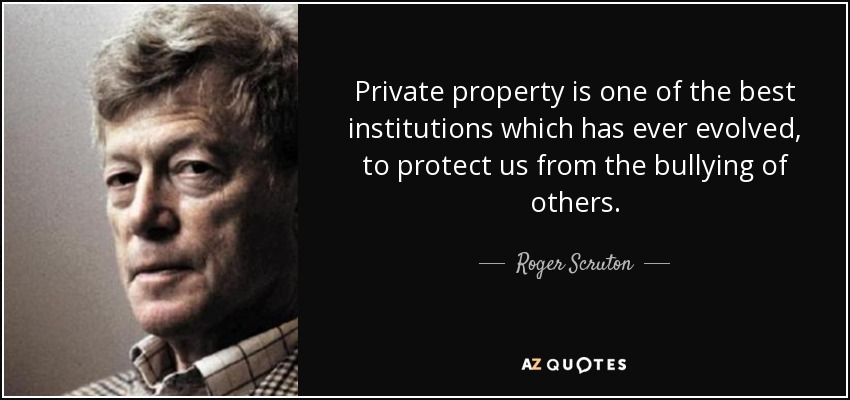
Private property is one of the best institutions which has ever evolved, to protect us from the bullying of others.
It is impossible! It has never happened - it cannot happen in the very nature of things. Marriage is something against nature. Marriage is an imposition, an invention of man - certainly out of necessity, but now even that necessity is out of date. It was a necessary evil in the past, but now it can be dropped. And it should be dropped: man has suffered enough for it, more than enough. It is an ugly institution for the simple reason that love cannot be legalized. Love and law are contradictory phenomena.
Marriage is a plastic flower - marriage is an institution. And who wants to live in an institution?
The evolution of government from its medieval, Mafia-like character to that embodying modern legal institutions and instruments is a major part of the history of freedom. It is a part that tends to be obscured or ignored because of the myopic vision of many economists, who persist in modeling government as nothing more than a gigantic form of theft and income redistribution.
Society thrives on trade simply because trade makes specialization possible, and specialization increases output, and increased output reduces the cost in toil for the satisfactions men live by. That being so, the market place is a most humane institution.
The rich man is always sold to the institution which makes him rich. Absolutely speaking, the more money, the less virtue.
Liberals don't care. Their approach is to rip out society's foundations without asking if they serve any purpose. Why do we have immigration laws? What's with these borders? Why do we have the institution of marriage, anyway? What do we need standardized tests for? Hey, I like Keith Richards - why not make heroin legal? Let's take a sledgehammer to all these load-bearing walls and just see what happens!
The working of great institutions is mainly the result of a vast mass of routine, petty malice, self interest, carelessness and sheer mistake. Only a residual fraction is thought.
Exclusion of just one class of citizens from receiving a marriage license based upon the perceived 'threat' they pose to the marital institution is, at bottom, an arbitrary exclusion based upon the majority's disapproval of the defined class. It is also insulting to same-sex couples, who are human beings capable of forming loving, committed, enduring relationships.
The gay movement is an evil institution that's goal is to defeat the marriage-based society and replace it with a culture of sexual promiscuity in which there's no restrictions on sexual conduct except the principle of mutual choice.
A middle ground might be to fight for same-sex marriage and its benefits and then, once granted, redefine the institution of marriage completely, to demand the right to marry not as a way of adhering to society's moral codes but rather to debunk a myth and radically alter an archaic institution. [Legalizing "same-sex marriage"] is also a chance to wholly transform the definition of family in American culture.
The institution of sexual intercourse is anti-feminist
Like the vast majority of Americans, I've opposed same-sex marriage, but I've also opposed unjust discrimination against anyone, for racial or religious reasons, or for sexual preference. Americans are a tolerant, generous, and kind people. We all oppose bigotry and disparagement. But the debate over same-sex marriage is not a debate over tolerance. It is a debate about the purpose of the institution of marriage and it is a debate about activist judges who make up the law rather than interpret the law.
We also know that the various faith-based institutions provide about 50 per cent of the health and education services in the poor communities; we also know that they have a large constituency including women and youth; they have outreach and networks and they are credible to their people. If we want to achieve the Millennium Development Foals by scaling up the responses of all the communities, do we ignore this large investment in people? Or do we engage in dialogue and in action?
I support this proposal and agree with this great and important initiative to abolish militarism and war. I will continue to speak out for an end to the institution of militarism and war and for institutions built on international law and human rights and nonviolent conflict resolution.
For most of history, war has been a more or less functional institution, providing benefits for those societies that were good at it, although the cost in money, in lives, and in suffering was always significant. Only in the past century have large numbers of people begun to question the basic assumption of civilized societies that war is inevitable and often useful.
Today the children of our public schools are taught more of the history, heroes, legends, and sagas of the old world than of the land of their birth, while they are furnished with little material on the people and institutions that are truly American.
Even with all its problems, I will support marriage as an institution until something better comes along.
Each individual has a universal responsibility to shape institutions to serve human needs.
Today's water institutions-the policies and laws, government agencies and planning and engineering practices that shape patterns of water use-are steeped in a supply-side management philosophy no longer appropriate to solving today's water problems.
Perhaps the only institution more puffed-up and self-important than academia is government.
The new racism: Racism without 'racists.' Today, racial segregation and division often result from habits, policies, and institutions that are not explicitly designed to discriminate. Contrary to popular belief, discrimination or segregation do not require animus. They thrive even in the absence of prejudice or ill will. It's common to have racism without racists.
If there is no transformation inside of us, all the structural change in the world will have no impact on our institutions.
In a small Swiss city sits an international organization so obscure and secretive... Control of the institution, the Bank for International Settlements, lies with some of the world's most powerful and least visible men: the heads of 32 central banks, officials able to shift billions of dollars and alter the course of economies at the stroke of a pen.
Government is an inherently inflationary institution and will ever remain so until it is dispossessed of its monopoly of the supply of money.
Follow AzQuotes on Facebook, Twitter and Google+. Every day we present the best quotes! Improve yourself, find your inspiration, share with friends
or simply: