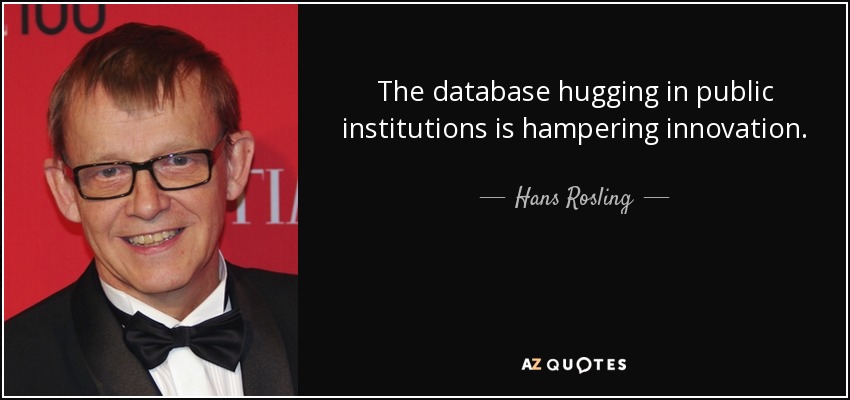
The database hugging in public institutions is hampering innovation.
If we believe in the rebirth of our civilization... then clearly this renaissance must begin in the chambers of our own hearts... We cannot wait for society to change, or for our institutions to be renewed. We, as individuals, must assume responsibility for our own personal transformation.
Far too long, historians have accepted the claim that the conversion of the Emperor Constantine (ca. 285-337) caused the triumph of Christianity. To the contrary, he destroyed its most attractive and dynamic aspects, turning a high-intensity, grassroots movement into an arrogant institution controlled by an elite who often managed to be both brutal and lax.
I cannot define for you what God is. I can only say that my work has proved empirically that the pattern of God exists in every man and that this pattern has at its disposal the greatest of all his energies for transformation and transfiguration of his natural being. Not only the meaning of his life but his renewal and his institutions depend on his conscious relationship with this pattern of his collective unconscious.
And of course most non-Catholics imagine that the Church is immensely rich, and that all Catholic institutions make money hand over fist, and that all the money is stored away somewhere to buy gold and silver dishes for the Pope and cigars for the College of Cardinals.
Common sense, alas in spite of our educational institutions, is a rare commodity.
As I write in 2012 we certainly do not believe that it is over yet, and the worst may be yet to come. Efforts by governments to solve the underlying problems responsible for the crisis have still not gotten very far, and the 'stress tests' that governments have used to encourage optimism about our financial institutions were of questionable thoroughness.
The manager is a servant. His master is the institution he manages and his first responsibility must therefore be to it.
Putting a rheumatologist at the head of a committee that arguably was going to have more influence over brain research than any particular institution in the country at the time, I think a lot of people found surprising.
The commune movement is part of a reawakening of belief in the possibilities for utopia that existed in the nineteenth century and exist again today, a belief that by creating the right social institution, human satisfaction and growth can be achieved.
The Tao can't be perceived. Smaller than an electron, it contains uncountable galaxies. If powerful men and women could remain centered in the Tao, all things would be in harmony. The world would become a paradise. All people would be at peace, and the law would be written in their hearts. When you have names and forms, know that they are provisional. When you have institutions, know where their functions should end. Knowing when to stop, you can avoid any danger. All things end in the Tao as rivers flow into the sea.
The faults of advertising are only those common to all human institutions. If advertising speaks to a thousand in order to influence one, so does the church. And if it encourages people to live beyond their means, so does matrimony. Good times, bad times, there will always be advertising. In good times, people want to advertise; in bad times they have to.
Love is never abstract. It does not adhere to the universe or the planet or the nation or the institution or the profession, but to the singular sparrows of the street, the lilies of the field, "to the least of these my brethren." Love is not, by its own desire, heroic. It is heroic only when compelled to be. It exists by its willingness to be anonymous, humble, and unrewarded.
Freemasonry is an institution calculated to benefit mankind.
Freemasonry is an institution founded on eternal reason and truth; whose deep basis is the civilization of mankind, and whose everlasting glory it is to have the immovable support of those two mighty pillars, science and morality.
There are great truths at the foundation of Freemasonry, truths which it is its mission to teach and which is constituting the very essence of, that sublime system which gives the venerable institution its peculiar identity as a science of morality, and it behooves every disciple diligently to ponder and inwardly digest.
The role of the press and the protections which we afford it are today more important than ever before, because we dwell in a society where belief in our governments and in the strength of our institutions is declining.
If there is trouble in the country, neither I nor my people made it, and all that we have ever done, after much endurance on our part, is to maintain and uphold the constitution and institutions of our country, and to protect an injured, innocent, and persecuted people against misrule and mob violence.
Creativity can replace conformity as the primary mode of social being. . . . We can cling to that which is passing, or has already passed, or we can remain accessible to-even surrender to-the creative process, without insisting that we know in advance the ultimate outcome for us, our institutions, or our planet. To accept this challenge is to cherish freedom, to embrace life, and to find meaning.
Very few established institutions, governments and constitutions ...are ever destroyed by their enemies until they have been corrupted and weakened by their friends.
This understanding, underlying constitutional interpretation since the New Deal, reflects the Constitution's demands for structural flexibility sufficient to adapt substantive laws and institutions to rapidly changing social, economic, and technological conditions.
Good and wise men, in all ages, have embraced a very dissimilar theory. They have supposed that the deity, from the relations we stand in to himself and to each other, has constituted an eternal and immutable law, which is indispensably obligatory upon all mankind, prior to any human institution whatever. This is what is called the law of nature....Upon this law depend the natural rights of mankind.
To their duty to God, youth should realize their duty to our country. They should love and honor the Constitution of the United States, the basic concepts and principles upon which this nation has been established. Yes, they need to develop a love for our free institutions.
The Bible is the best of books, and I wish it were in the hands of every one. It is indispensable to the safety and permanence of our institutions. A free government can not exist without religion and morals, and there cannot be morals without religion. Especially should the Bible be placed in the hands of the young. It is the best school book in the world. I would that all our people were brought up under the influence of that holy book.
Anarchism, in my view, is an expression of the idea that the burden of proof is always on those who argue that authority and domination are necessary. They have to demonstrate, with powerful argument, that that conclusion is correct. If they cannot, then the institutions they defend should be considered illegitimate. How one should react to illegitimate authority depends on circumstances and conditions: there are no formulas.
Follow AzQuotes on Facebook, Twitter and Google+. Every day we present the best quotes! Improve yourself, find your inspiration, share with friends
or simply: