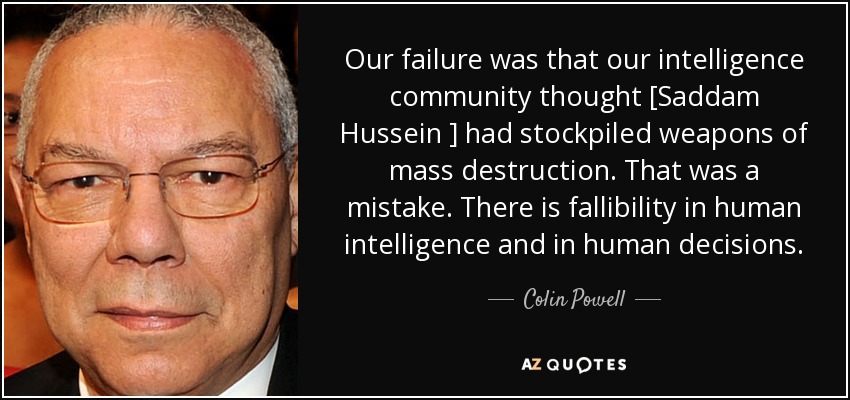
Our failure was that our intelligence community thought [Saddam Hussein ] had stockpiled weapons of mass destruction. That was a mistake. There is fallibility in human intelligence and in human decisions.
I'm the chairman of the intelligence committee. We don't only get formal briefings, but we collect our information from the intelligence community in a variety of ways.
ISIL presents a growing threat not only in Syria and Iraq, but throughout the Middle East, North Africa, Europe, and now in the United States as well. Terrorists and their enablers will continue to receive the unwavering attention of law enforcement and the intelligence community.
This self-reflection, this willingness to examine ourselves, to make corrections, to do better, that's part of what makes us Americans. It's part of what sets us apart from other nations, the United States is the most professional, most capable, most cutting-edge intelligence community in the world.
I don't want to talk about intelligence matters. I will say, however, that intelligence-community estimates should not become public in the way of this city and in the way of Congress.
No one from the intelligence community, anyplace else ever came in and said, ‘What if Saddam is doing all this deception because he actually got rid of the WMD and he doesn't want the Iranians to know?' Now somebody should have asked that question. I should have asked that question. Nobody did. Turns out that was the most important question in terms of the intelligence failure that never got asked.
Terrorists continue to exploit divisions between law enforcement and the intelligence communities that limit the sharing of vital counterterrorism information.
The intelligence community's 2002 National Intelligence Estimate (NIE) stated, in a formal presentation to President Bush and to Congress, its view that Saddam had weapons of mass destruction - a belief in which the NIE said it held a 90% level of confidence. That is about as certain as the intelligence community gets on any subject.
I believe that reforming our intelligence community is one of the most important things that we can do in order to ensure that our country is in fact safer, stronger and wiser.
One of the great intellectual failures of the American intelligence community, and especially the counterterrorism community, is to assume if someone hasn't attacked us, it's because he can't or because we've defeated him.
The intelligence community was absolutely uniform and uniformly wrong about the existence of weapons of mass destruction (in Iraq).
We believe, from everything we have been told by the intelligence community, by 12 years of history with Iraq, by the experience of the U.N. inspectors and by other intelligence agencies in other countries that Saddam Hussein had the intention to develop weapons of mass destruction and to have such weapons, and that was a sound judgment which I still believe to this day because he had had them in the past, he'd used them in the past.
Thinklogical's systems play a key role in the delivery and visualization of mission critical data used every day by military and intelligence communities worldwide.
The way the United States intelligence community operates is it doesn't limit itself to the protection of the homeland. It doesn't limit itself to countering terrorist threats, countering nuclear proliferation. It's also used for economic espionage, for political spying to gain some knowledge of what other countries are doing.
There are lots of examples of routine, middle-skilled jobs that involve relatively structured tasks, and those are the jobs that are being eliminated the fastest. Those kinds of jobs are easier for our friends in the artificial intelligence community to design robots to handle them. They could be software robots; they could be physical robots.
The challenges posed by threats like terrorism, proliferation, and cyber attacks are not going away any time soon, and for our intelligence community to be effective over the long haul, we must maintain the trust of the American people and people around the world.
Congress must go further to protect the right to privacy, to end the NSA's dragnet surveillance of ordinary Americans, to make the intelligence community more transparent and accountable.
When it comes to telephone calls, nobody is listening to your telephone calls. That's not what this program is about. ... What the intelligence community is doing is looking at phone numbers, and durations of calls; they are not looking at people's names and they're not looking at content. ... If the intelligence committee actually wants to listen to a phone call they have to go back to a federal judge, just like they would in a criminal investigation.
We must remain mindful of the potential impact of over-correcting the authorizations of the intelligence community.
All officers of the Intelligence Community, and especially its most senior officer, must conduct themselves in a manner that earns and retains the public trust. The American people are uncomfortable with government activities that do not take place in the open, subject to public scrutiny and review.
By tearing down the wall between law enforcement and the intelligence community, we have been able to share information in a way that was virtually impossible before the Patriot Act.
The U.S. intelligence community is palsied by lawyers. When we were going to capture Osama bin Laden, for example, the lawyers were more concerned with bin Laden's safety and his comfort than they were with the officers charged with capturing him. We had to build an ergonomically designed chair to put him in, special comfort in terms of how he was shackled into the chair. They even worried about what kind of tape to gag him with so it wouldn't irritate his beard. The lawyers are the bane of the intelligence community.
If you look back today over the last 25 years, it is a fact that we have had a progressive degeneration of our intelligence community in general; in particular in the field of human intelligence.
When I talked to [Donald Trump] about - our intelligence agencies, what I've said to him is - is that there are gonna be times where you've got raw intelligence that comes in and in my experience, over eight years, the intelligence community is pretty good about saying, "Look, we can't say for certain what this means." But there are gonna be times where the only way you can make a good decision is if you have confidence that the process is working, and the people that you put in charge are giving you their very best assessments.
A political decision has been made not to irritate the intelligence community. The spy agencies are really embarrassed, they're really sore - the revelations really hurt their mystique. The last ten years, they were getting the Zero Dark Thirty treatment - they're the heroes. The surveillance revelations bring them back to Big Brother kind of narratives, and they don't like that at all.
Follow AzQuotes on Facebook, Twitter and Google+. Every day we present the best quotes! Improve yourself, find your inspiration, share with friends
or simply: