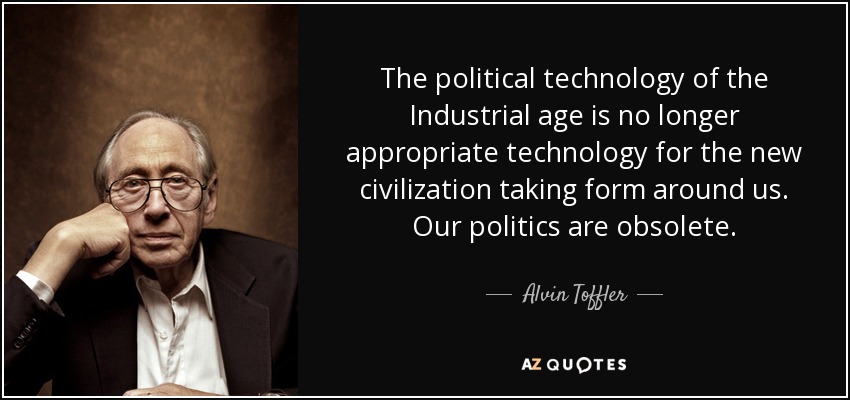
The political technology of the Industrial age is no longer appropriate technology for the new civilization taking form around us. Our politics are obsolete.
In the ever accelerating world of the Internet, e-campaigning has gone from a novelty to a necessity in less than a year. With increasing sophistication and urgency, campaigns are using the Web as a bulletin board, advertising medium and organizing tool.
Unless the digital divide is narrowed soon, the United States may be headed to the class warfare of a century ago, the last time the economy changed so fundamentally. It won't be pleasant.
Comics are reflective of what's going on in larger culture. Wonder Woman came to be in her position when women were first entering the workplace in numbers during the war. Then Wonder Woman had another rise in the '70s when Gloria Steinem latched on to her as an icon for the [feminist] movement. I think we're seeing another wave of feminism today, a fourth wave characterized by intersectionality and the internet. And I think it falls right in line that we would see another wave of superheroines coming to the fore.
The diversity of web browsers tomorrow will match the diversity of ink browsers (aka paper) today
Pay per click was just the beginning. The real evolution is pay per action.
The net is more than an organizing tool - it has become an organizing model, a blueprint for decentralized but cooperative decision-making. It facilitates the process of information sharing to such an extent that many groups can work in concert with one another without the need to achieve monolithic consensus.
I was raised on the internet.
The Web took off in all its glory because it was a royalty-free infrastructure . . . When I invented the Web, I didn't have to ask anyone's permission. Now, hundreds of millions of people are using it freely. I am worried that that is going to end in the U.S.A. If we had a situation in which the U.S. had serious flaws in its Net Neutrality, and Europe did have Net Neutrality, and I were trying to start a company, then I would be very tempted to move.
The poster child of Web 2.0 is Flickr.com. Personalization is a key piece of Web 2.0.
Web applications will become more and more ubiquitous throughout our human environment, with walls, automobile dashboards, refrigerator doors all serving as displays giving us a window onto the Web.
There are converging web-related issues cropping up, like privacy and security, that we currently have no way of thinking about. Nobody has thought to look at how people and the web combine as a whole - until now.
We are creating a world where anyone, anywhere may express his or her beliefs, no matter how singular, without fear of being coerced into silence or conformity.
The first serious infowar is now engaged. The field of battle is WikiLeaks. You are the troops.
The Web is a vast collection of completely uncontrolled heterogeneous documents.
The name was supposed to be 'Googol,' which is the mathematical term for a 1 followed by 100 zeroes. It was before the Google spellchecker existed.
The prime reason the Google homepage is so bare is due to the fact that the founders didn't know HTML and just wanted a quick interface. In fact, it was noted that the SUBMIT button was a long time coming and hitting the RETURN key was the only way to burst Google into life.
Hypertext, as Nelson [Ted Nelson] originally wrote, is interlinked reading and writing. Links make hypertext.
Hypertext is an idea. The Internet is a medium. They grow up beside each other, they influence each other, and their evolving relationship will probably provide a great story for future biographers.
This is the most important principle of reading on the Internet: You must determine for yourself whether or not something is true.
SEO expertise is a core need for today's online businesses.
Today, only about 1% of the World Wide Web is written in Arabic.
Note that the #1 Top Reviewer at Amazon (4550 book reviews) is Harriet Klausner, formerly an acquisitions librarian in Pennsylvania. This just goes to show that librarians were destined to rule the Web.
The lesson of the Internet is that no audience is too small.
Rumors are nearly as old as human history, but with the rise of the Internet, they have become ubiquitous. In fact we are now awash in them. False rumors are especially troublesome; they impose real damage on individuals and institutions, and they often resist correction. They can threaten careers, policies, public officials, and sometimes even democracy itself.
Follow AzQuotes on Facebook, Twitter and Google+. Every day we present the best quotes! Improve yourself, find your inspiration, share with friends
or simply: