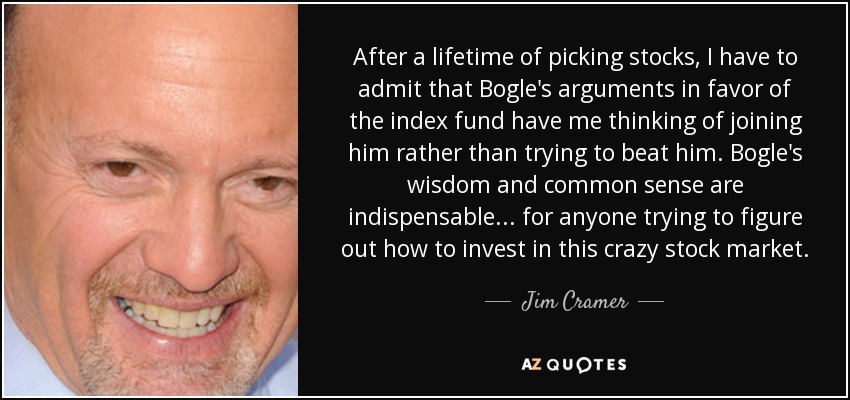
After a lifetime of picking stocks, I have to admit that Bogle's arguments in favor of the index fund have me thinking of joining him rather than trying to beat him. Bogle's wisdom and common sense are indispensable... for anyone trying to figure out how to invest in this crazy stock market.
First, those who disagree with market efficiency simply assert that it stands to common sense that greater effort to get facts and greater acumen in analyzing those facts will pay off in better performance somehow measured. (By this logic, cure for cancer must have been found by 1955).
Risk comes from not knowing what you are doing so wide diversification is only required when investors are ignorant. You only have to do a very few things in your life so long as you don't do too many things wrong.
Investment based on genuine long-term expectations is so difficult today as to be scarcely practicable.
Confidence in a forecast rises with the amount of information that goes into it. But the accuracy of the forecast stays the same.
My main life lesson from investing: self-interest is the most powerful force on earth, and can get people to embrace and defend almost anything.
Berkshire was built on the eternal verities: basic mathematics, basic horse sense, basic fear, and basic diagnosis of human nature to make predictions regarding human behavior. We stuck to the basics with a certain amount of discipline and it has worked out quite well.
Most people might just as well buy a share of the whole market, which pools all the information, than delude themselves into thinking they know something the market doesn't.
We have not known a single person who has consistently or lastingly make money by thus "following the market". We do not hesitate to declare this approach is as fallacious as it is popular.
For 99 issues out of 100 we could say that at some price they are cheap enough to buy and at some price they would be so dear that they would be sold.
If you roll dice, you know that the odds are one in six that the dice will come up on a particular side. So you can calculate the risk. But, in the stock market, such computations are bull - you don't even know how many sides the dice have!
History doesn't crawl; it leaps.
Charlie and I have a number of filters that things have to get through before we'll think about them.
To enjoy a reasonable chance for continued better than average results, the investor must follow policies which are (1) inherently sound and promising, and (2) not popular on Wall Street.
You never know what the American public is going to do, but you know that they will do it all at once.
Calculate a stock's price/earnings ratio yourself, using Graham's formula of current price divided by average earnings over the past three years.
It is our argument that a sufficiently low price can turn a security of mediocre quality into a sound investment opportunity - provided that the buyer is informed and experienced and he practices adequate diversification. For, if the price is low enough to create a substantial margin of safety, the security thereby meets our criterion of investment.
The margin of safety is always dependent on the price paid. It will be large at one price, small at some higher price, nonexistent at some still higher price.
It's nonsensical to derive a price/earnings ratio by dividing the known current price by unknown future earnings.
The considerations upon which expectations of prospective yields are based are partly existing facts which we can assume to be known more or less for certain, and partly future events which can only be forecasted with more or less confidence.
If Bill Gates woke up with Oprah's money he'd jump out the window.
Surprise! The returns reported by mutual funds aren't actually earned by mutual fund investors.
You've got to have models in your head and you've got to array you experience - both vicarious and direct - onto this latticework of mental models.
A few major opportunities, clearly recognizable as such, will usually come to one who continuously searches and waits, with a curious mind, loving diagnosis involving multiple variables. And then all that is required is a willingness to bet heavily when the odds are extremely favorable, using resources available as a result of prudence and patience in the past.
I think I've been in the top 5% of my age cohort all my life in understanding the power of incentives, and all my life I've underestimated it.
Follow AzQuotes on Facebook, Twitter and Google+. Every day we present the best quotes! Improve yourself, find your inspiration, share with friends
or simply: