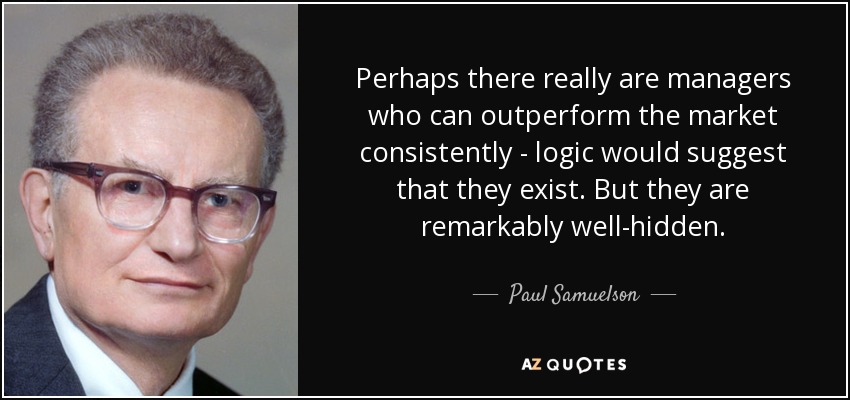
Perhaps there really are managers who can outperform the market consistently - logic would suggest that they exist. But they are remarkably well-hidden.
Most of the mutual fund investments I have are index funds, approximately 75%.
It's human nature to find patterns where there are none and to find skill where luck is a more likely explanation (particularly if you're the lucky manager).
Second, they [those who disagree with market efficiency] always claim they know a man, a bank, or a fund that does do better. Alas, anecdotes are not science. And once Wharton School dissertations seek to quantify the performers, these have a tendency to evaporate into the air - or, at least, into statistically insignificant t-statistics.
99% of fund managers demonstrate no evidence of skill whatsoever.
We next consider the rule that the investor does or should consider expected return a desirable thing and variance of return an undesirable thing.
Many of us economists who believe in efficiency do so because we view markets as amazingly successful devices for reflecting new information rapidly and, for the most part, accurately.
Anything can happen anytime in markets. And no advisor, economist, or TV commentator-and definitely not Charlie nor I-can tell you when chaos will occur. Market forecasters will fill your ear but will never fill your wallet.
In any bureaucratic organization there will be two kinds of people: those who work to further the actual goals of the organization, and those who work for the organization itself. Examples in education would be teachers who work and sacrifice to teach children, vs. union representative who work to protect any teacher including the most incompetent. The Iron Law states that in all cases, the second type of person will always gain control of the organization, and will always write the rules under which the organization functions.
There are a few investment managers, of course, who are very good - though in the short run, it's difficult to determine whether a great record is due to luck or talent. Most advisors, however, are far better at generating high fees than they are at generating high returns. In truth, their core competence is salesmanship. Rather than listen to their siren songs, investors - large and small - should instead read Jack Bogle's The Little Book of Common Sense Investing.
Unless an investor has access to “incredibly high-qualified professionals,” they “should be 100 percent passive - that includes almost all individual investors and most institutional investors.
Even fans of actively managed funds often concede that most other investors would be better off in index funds. But buoyed by abundant self-confidence, these folks aren't about to give up on actively managed funds themselves. A tad delusional? I think so. Picking the best-performing funds is 'like trying to predict the dice before you roll them down the craps table,' says an investment adviser in Boca Raton, FL. 'I can't do it. The public can't do it.'
The simple index fund solution has been adopted as a cornerstone of investment strategy for many of the nation's pension plans operated by our giant corporations and state and local governments. Indexing is also the predominant strategy for the largest of them all, the retirement plan for federal government employees, the Federal Thrift Savings Plan (TSP). The plan has been a remarkable success, and now holds some $173 billion of assets for the benefit of our public servants and members of armed services.
A minuscule 4 percent of funds produce market-beating after-tax results with a scant 0.6 percent (annual) margin of gain. The 96 percent of funds that fail to meet or beat the Vanguard 500 Index Fund lose by a wealth-destroying margin of 4.8 percent per annum.
There is no other proposition in economics that has more solid empirical evidence supporting it than the Efficient Market Hypothesis... In the literature of finance, accounting, and the economics of uncertainty, the EMH is accepted as a fact of life.
In an economy, an act, a habit, an institution, or a law, gives birth not only to an effect, but to a series of effects. Of these effects, the first only is immediate; it manifests itself simultaneously with its cause - it is seen. The others unfold in succession - they are not seen. Now this difference is enormous, for it is often true that when the immediate consequence is favorable, the ultimate consequences are fatal, and the converse.
Nothing highlights better the continuing gap between rhetoric and substance in British financial services than the failure of providers here to emulate Jack Bogle's index fund success in the United States. Every professional in the City knows that index funds should be core building blocks in any long-term investor's portfolio. Since 1976, the Vanguard index funds has produced a compound annual return of 12 percent, better than three-quarters of its peer group.
Risk comes from not knowing what you are doing so wide diversification is only required when investors are ignorant. You only have to do a very few things in your life so long as you don't do too many things wrong.
Surprise! The returns reported by mutual funds aren't actually earned by mutual fund investors.
I don't try to be clever at all. The idea that I could see what no one else can is an illusion.
A vast industry of stockbrokers, financial planners, and investment advisers skims a fortune for themselves off the top in exchange for passing their clients' money on to people who, as a whole, cannot possibly outperform the market.
Markets are efficient, but there are different dimensions of risk and those lead to different dimensions of expected returns. That's what people should be concerned with in their investment decisions and not with whether they can pick stocks, pick winners and losers among the various managers delivering basically the same product.
History has shown that in every age and in every field of human knowledge, many of the views which almost everyone accepted as true and never bothered to think about further, were in time proven completely wrong.
An intelligent investor gets satisfaction from the thought that his operations are exactly opposite to those of the crowd.
When the brothel burns down, even the pretty girls have to run out.
Follow AzQuotes on Facebook, Twitter and Google+. Every day we present the best quotes! Improve yourself, find your inspiration, share with friends
or simply: