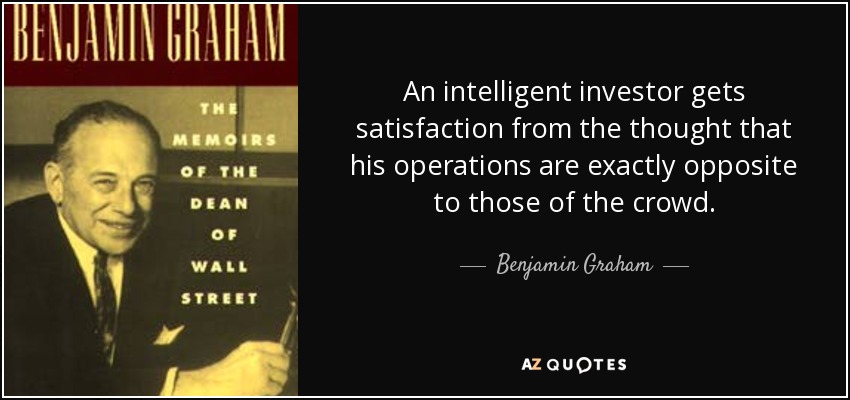
An intelligent investor gets satisfaction from the thought that his operations are exactly opposite to those of the crowd.
The premise of this book is that it is easier to recognize other people's mistakes than your own.
Confidence in a forecast rises with the amount of information that goes into it. But the accuracy of the forecast stays the same.
You never know what the American public is going to do, but you know that they will do it all at once.
History doesn't crawl; it leaps.
If you roll dice, you know that the odds are one in six that the dice will come up on a particular side. So you can calculate the risk. But, in the stock market, such computations are bull - you don't even know how many sides the dice have!
No matter how careful you are, the one risk no investor can ever eliminate is the risk of being wrong. Only by insisting on what Graham called the "margin of safety" - never overpaying, no matter how exciting an investment seems to be - can you minimize your odds of error.
The purpose of this book is to supply, in the form suitable for laymen, guidance in the adoption and execution of an investment policy.
We have not known a single person who has consistently or lastingly make money by thus "following the market". We do not hesitate to declare this approach is as fallacious as it is popular.
The determining trait of the enterprising (or active, or aggressive) investor is his willingness to devote time and care to the selection of securities that are both sound and more attractive than the average.
To enjoy a reasonable chance for continued better than average results, the investor must follow policies which are (1) inherently sound and promising, and (2) not popular on Wall Street.
It's nonsensical to derive a price/earnings ratio by dividing the known current price by unknown future earnings.
Calculate a stock's price/earnings ratio yourself, using Graham's formula of current price divided by average earnings over the past three years.
The margin of safety is always dependent on the price paid. It will be large at one price, small at some higher price, nonexistent at some still higher price.
There is a close logical connection between the concept of a safety margin and the principle of diversification.
Losing some money is an inevitable part of investing, and there's nothing you can do to prevent it. But to be an intelligent investor, you must take responsibility for ensuring that you never lose most or all of your money.
By refusing to pay too much for an investment, you minimize the chances that your wealth will ever disappear or suddenly be destroyed.
The safe time to invest is when there is blood in the streets.
Even with a margin of safety in the investor's favor, an individual security may work out badly. For the margin guarantees only that he has a better chance for profit than for loss - not that loss is impossible. But as the number of such commitments is increased the more certain does it become that the aggregate of the profits will exceed the aggregate of the losses.
And, partly, I had found that theory-structure was a superpower in helping one get what one wanted. As I had early discovered in school wherein I had excelled without labor, guided by theory, while many others, without mastery of theory failed despite monstrous effort. Better theory I thought had always worked for me and, if now available could make me acquire capital and independence faster and better assist everything I loved.
Charlie and I have a number of filters that things have to get through before we'll think about them.
The considerations upon which expectations of prospective yields are based are partly existing facts which we can assume to be known more or less for certain, and partly future events which can only be forecasted with more or less confidence.
A few major opportunities, clearly recognizable as such, will usually come to one who continuously searches and waits, with a curious mind, loving diagnosis involving multiple variables. And then all that is required is a willingness to bet heavily when the odds are extremely favorable, using resources available as a result of prudence and patience in the past.
Here's one truth that perhaps your typical investment counselor would disagree with: if you're comfortably rich and someone else is getting richer faster than you by, for example, investing in risky stocks, so what?! Someone will always be getting richer faster than you. This is not a tragedy.
Hard work, honesty, if you keep at it, will get you almost anything.
Follow AzQuotes on Facebook, Twitter and Google+. Every day we present the best quotes! Improve yourself, find your inspiration, share with friends
or simply: