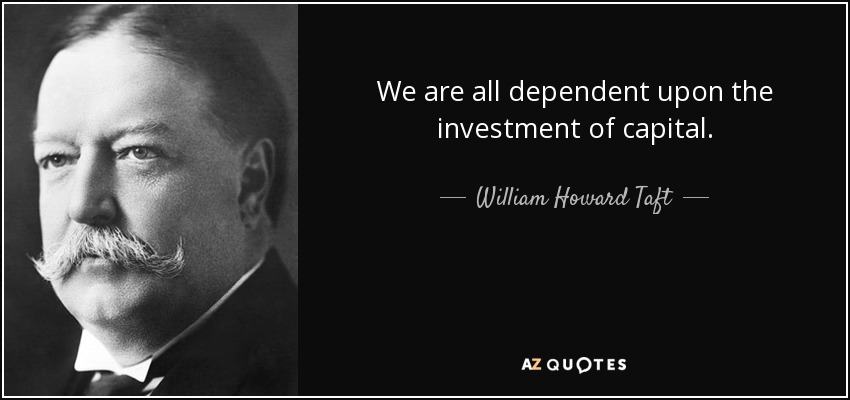
We are all dependent upon the investment of capital.
... Any pension fund manager who doesn't have the vast majority-and I mean 70% or 80% of his or her portfolio-in passive investments is guilty of malfeasance, nonfeasance or some other kind of bad feasance!
The debate can be put in the form of the question: Resolved, that the best of money managers cannot be demonstrated to be able to deliver the goods of superior portfolio-selection performance. Any jury that reviews the evidence, and there is a great deal of relevant evidence, must at least come out with the Scottish verdict: Superior investment performance is unproved.
The purpose of this book is to supply, in the form suitable for laymen, guidance in the adoption and execution of an investment policy.
No matter how careful you are, the one risk no investor can ever eliminate is the risk of being wrong. Only by insisting on what Graham called the "margin of safety" - never overpaying, no matter how exciting an investment seems to be - can you minimize your odds of error.
Experience conclusively shows that index-fund buyers are likely to obtain results exceeding those of the typical fund manager, whose large advisory fees and substantial portfolio turnover tend to reduce investment yields. Many people will find the guarantee of playing the stock-market game at par every round a very attractive one. The index fund is a sensible, serviceable method for obtaining the market's rate of return with absolutely no effort and minimal expense.
The general systems of money management today require people to pretend to do something they can't do and like something they don't. It's a funny business because on a net basis, the whole investment management business together gives no value added to all buyers combined. That's the way it has to work. Mutual funds charge two percent per year and then brokers switch people between funds, costing another three to four percentage points. The poor guy in the general public is getting a terrible product from the professionals.
Never mingle your speculative and investment operations in the same account nor in any part of your thinking.
If your broker or investment advisor is not familiar with the concept of standard deviation of returns, get a new one.
Some investments do have higher expected returns than others. Which ones? Well, by and large they're the ones that will do the worst in bad times.
There are a few investment managers, of course, who are very good - though in the short run, it's difficult to determine whether a great record is due to luck or talent. Most advisors, however, are far better at generating high fees than they are at generating high returns. In truth, their core competence is salesmanship. Rather than listen to their siren songs, investors - large and small - should instead read Jack Bogle's The Little Book of Common Sense Investing.
Without investment there will not be growth, and without growth there will not be employment.
Confusing speculation with investment is always a mistake.
The result of neo-colonialism is that foreign capital is used for the exploitation rather than for the development of the less developed parts of the world. Investment under neo-colonialism increases rather than decreases the gap between the rich and poor countries of the world.
No one wants to pursue anything creative anymore, because that's too risky. They may not get the kind of return on the financial investment they've made in their education that they think they should.
Government investment unlocks a huge amount of private sector activity, but the basic research that we put into IT work that led to the Internet and lots of great companies and jobs, the basic work we put into the health care sector, where it's over $30 billion a year in R&D that led the biotech and pharma jobs. And it creates jobs and it creates new technologies that will be productized. But the government has to prime the pump here. The basic ideas, as in those other industries, start with government investment.
The value of market esoterica to the consumer of investment advice is a different story. In my opinion, investment success will not be produced by arcane formulae, computer programs or signals flashed by the price behavior of stocks and markets. Rather an investor will succeed by coupling good business judgment with an ability to insulate his thoughts and behavior from the super-contagious emotions that swirl about the marketplace.
What is most disturbing today is that we use rational methods to cultivate the tastes and values of the young in all kinds of educational, religious, and cultural institutions that are predicated on corporate practices and goals. Everything we do to, with, and for our children is influenced by capitalist market conditions and the hegemonic interests of ruling corporate elites. In simple terms, we calculate what is best for our children by regarding them as investments and turning them into commodities.
There is order in the universe, even though it looks like chaos. We separate the world into categories: this is good and this is bad. But life is set up to trick us. It's a series of illusions we invest in. And ultimately those investments don't serve our understanding, because physicality is always going to let you down, because physicality doesn't last.
Many financial advisors recommend that you diversify for your own protection. What they fail to tell you is that it is also for their protection. Since most financial advisors cannot tell you exactly which stock or mutual fund is a great investment, they tell you to buy a bunch of them.
Hollywood is a small, familial place. Everyone does business with everybody else. The same complications occur in investment banking.
Research suggests that investment bankers are more prone to commit fraud when they feel the competitor at their heels.
Private sector development and the creation of small businesses spur investment, jobs, opportunity, and hope. It empowers the market to meet local needs, whether for food, basic goods, or services.
I know how to make stuff happen, how to create wealth, create jobs, create investment.
Most business schools are geared toward churning out investment bankers and management consultants.
Follow AzQuotes on Facebook, Twitter and Google+. Every day we present the best quotes! Improve yourself, find your inspiration, share with friends
or simply: