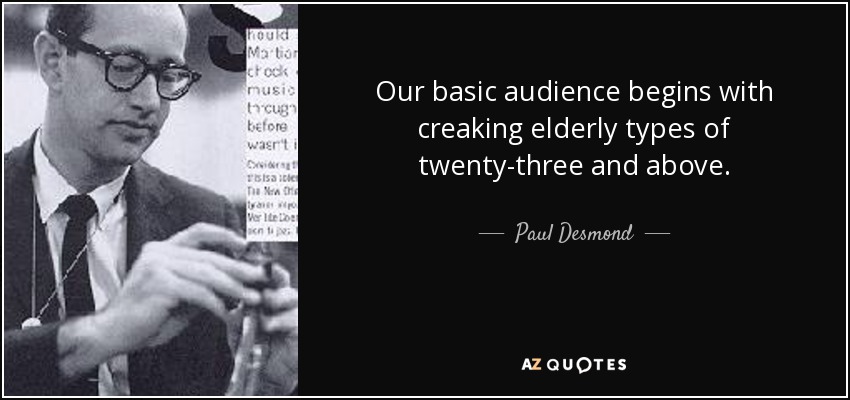
Our basic audience begins with creaking elderly types of twenty-three and above.
I'd listened to [Ornette Coleman] all kinds of ways. I listened to him high and I listened to him cold sober. I even played with him. I think he's jiving baby.
I resolved to play my trumpet like a sax.
I can play, and I know it; I'm not looking for any pats on the back. I don't have to be endorsed by anybody. I make enough to live and eat, and I'm happy with my music-and that's all I need.
For some reason that only a sociologist might be able to accurately explain, the Brazilian Press was extremely unkind to me, reporting only selective derogatory untruthful rumors (some of which are still around), harsh criticism, and unwarranted sarcasm. I was very hurt by this. It was such great disappointment... When I came back from Brazil at that time, I made a promise to myself that I would never, ever again sing in Brazil. So far [as of 2002], I have kept this promise, having declined each and every invitation or proposals to perform in Brazil. Once was enough!
Miles got a mystique about him-plus he's at the top of his profession. And he's got way, way, way more money.
Jazz to me is a living music. It's a music that since its beginning has expressed the feelings, the dreams, hopes, of the people.
What I'm doing, I prefer to call that jazz, because it is a beautiful word - I love it.
Personally, I can't see how anyone can produce any beautiful music out of being angry.
At this stage of my life, I've dedicated myself to playing what I want to play, how I want to play it for the rest of my time. Regardless of whether one might like it or one might not like it, this is where I am.
The type of band that I have now, the type of music that we're playing you either like it or you dislike it. If you dislike it, you probably don't know why. By the same token, you can't even really say why you like it.
There was a lot that was tricky about playing with [Thelonious Monk]. It's a musical language where there's really no lyrics. It's something you feel and you're hearing. It's like an ongoing conversation. You really had to listen to this guy. Cause he could play the strangest tempos, and they could be very in-between tempos on some of those compositions. You really had to listen to his arrangements and the way he would play them. On his solos, you'd really have to listen good in there. You'd have to concentrate on what you were doing as well.
The people in Japan know more about the history of jazz and the musicians than the people in the United States do.
I was talented but crazy, semi-autistic and eccentric.
I'm trying to make music a sensual expression, not an academic experiment.
I finally realized that my relaxation is practicing the piano and writing. I've tried to do other things, but I've learned through the decades, that this is what I enjoy, practicing music and writing.
These magic moments when rhythms and harmonies extend themselves and jell together and the people become another instrument. These things are priceless and they can't be learned; they can only be felt.
The whole basis of my singing is feeling. Unless I feel something, I can't sing.
[Lee Morgan] was the only young cat that scared me when he played. He had so much fire and natural feeling. I had more technique, but he had that feeling. People seemed to like him more than they like me at the beginning.
Don't make the mistakes I made of not taking care of myself. Please, keeps your chops cool and don't overblow. If you are going to play hard, be sure to warm up. I'd get carried away trying to stay right with the momentum [of Art Blakey and the Jazz Messengers]. I used to try and play like Coltrane and solo for 30 or 40 choruses. It all caught up with me.
I used to try to play like [Miles Davis], and Miles caught me copying him one night at Birdland. He said, 'Hey man, why don't you play some of your own stuff.' So, I finally did, because I had copied all his solos.
When I was studying at Berklee, I got the feeling I couldn't play the [guitar] at all, because I could not use my own things as they didn't fit any set pattern. When I joined [Chico Hamilton], he helped me immensely to develop my own style. He never forced me in any set way. At all times, he encouraged me to be myself on the instrument.
Many jazz musicians affect a misunderstood-genius air when they play, which alienates the audience and breaks down the communications of the music. A musician's responsibility is to get as much of his art across as possible. Musicians used to be kept when only the rich could afford art, but now practically everyone can afford radios, stereo equipment, concert tickets, etc. A musician must learn to communicate to survive.
My dream is to do whatever I want without any interference from the record company.
Judy Garland was the singer I most wanted to sound like then, not to copy, but to get some of her soul and purity. A wonderful young voice.
Follow AzQuotes on Facebook, Twitter and Google+. Every day we present the best quotes! Improve yourself, find your inspiration, share with friends
or simply: