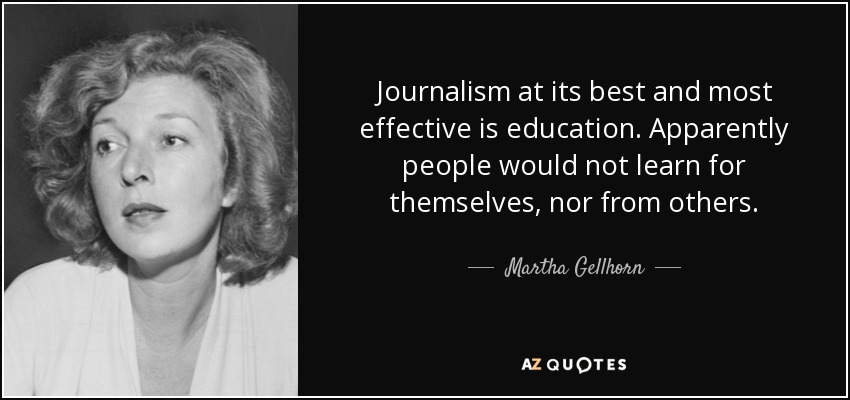
Journalism at its best and most effective is education. Apparently people would not learn for themselves, nor from others.
[On the press:] I love working with children, and I have learned to be very patient with them.
Truth is the hardest substance in the world to pin down. But the one certainty is the awesome penalty exacted sooner or later from a society whose reporters stop trying.
I learned early in life not to judge others. We outcasts are very happy and content to leave that job to our social superiors.
writing had to take the form of journalism. Not for me the Shangri-la of fiction. The rewards, if any, would have been too little and too late, the bailiffs were at the door. ... Two large bailiffs, they were, who visited frequently and smiled like grand pianos, the only really reliable men in my life. They told me what they were going to do and if they did it, woe was me.
[On journalists:] ... however lyingly libellous they may be: nobody can seriously hurt the reputation of a Great person. If he is hurt: he is not Great. They can but scratch at his skin with their mice nails.
Newspapers today have almost replaced the Bible, the Koran, the Gita and other religious scriptures.
Without a serious study of journalism, there can be no understanding of citizenship, democracy, or community.
As a cub reporter, I devoured books about journalism.
While the web is very much the first draft of history, a rough-cut, it still has to be good journalism, well-sourced, reliable. Clearly, the printed form is going to have more effort put into it, going to be more reflective and relevant.
The newspapers, I perceive, devote some of their columns specially to politics or government without charge; and this, one would say, is all that saves it; but as I love literature and to some extent the truth also, I never read those columns at any rate. I do not wish to blunt my sense of right so much.
Journalism only tells us what men are doing; it is fiction that tells us what they are thinking, and still more what they are feeling. If a new scientific theory finds the soul of a man in his dreams, at least it ought not to leave out his day-dreams. And all fiction is only a diary of day-dreams instead of days. And this profound preoccupation of men's minds with certain things always eventually has an effect even on the external expression of the age.
The only thing which can keep journalism alive - journalism, which is born of the moment, serves the moment, and, as a rule, dies with the moment - is - again the Stevensonian secret! - charm.
If I wrote at all, I must throw myself headlong into the great political maelstrom, and would of course be swallowed up like a fishing-boat in the great Norway horror which decorated our school geographies; for no woman had ever done such a thing, and I could never again hold up my head under the burden of shame and disgrace which would be heaped upon me. But what matter? I had no children to dishonor; all save one who had ever loved me were dead, and she no longer needed me, and if the Lord wanted some one to throw into that gulf, no one could be better spared than I.
No reporter of my generation, whatever his genius, ever really rated spats and a walking stick until he had covered both a lynching and a revolution.
I well recall my horror when I heard for the first time, of a journalist who had laid in a pair of what were then called bicycle pants and taken to golf; it was as if I had encountered a studhorse with his hair done up in frizzes, and pink bowknots peeking out of them. It seemed, in some vague way, ignominious, and even a bit indelicate.
In my day a reporter who took an assignment was wholly on his own until he got back to the office, and even then he was little molested until his copy was turned in at the desk; today he tends to become only a homunculus at the end of a telephone wire, and the reduction of his observations to prose is commonly farmed out to literary castrati who never leave the office, and hence never feel the wind of the world in their faces or see anything with their own eyes.
Drill in exact translation is an excellent way of disposing the mind against that looseness and exaggeration with which the sensationalists have corrupted our world. If schools of journalism knew their business, they would graduate no one who could not render the Greek poets.
Perhaps anxious politicians may prove that only seventeen white men and five negroes were concerned in the late enterprise; but their very anxiety to prove this might suggest to themselves that all is not told. Why do they still dodge the truth? They are so anxious because of a dim consciousness of the fact, which they do not distinctly face, that at least a million of the free inhabitants of the United States would have rejoiced if it had succeeded. They at most only criticise the tactics.
Reform keeps many scores of newspapers in its service, but not one man.
I find it so difficult to dispose of the few facts which to me are significant, that I hesitate to burden my attention with thosewhich are insignificant, which only a divine mind could illustrate. Such is, for the most part, the news in newspapers and conversation.
Do not suffer your life to be taken by newspapers.
All reporters have a stripe of irreverence in their mental makeup. It usually keeps them from turning into toadies, a danger for those who associate, even in an adversarial way, with the rich and powerful.
Never awake me when you have good news to announce, because with good news nothing presses; but when you have bad news, arouse me immediately, for then there is not an instant to be lost.
Language, journalism, food, sex. All is politics. Even innocent love stories are politics. ... There is no such thing as neutrality.
Follow AzQuotes on Facebook, Twitter and Google+. Every day we present the best quotes! Improve yourself, find your inspiration, share with friends
or simply: