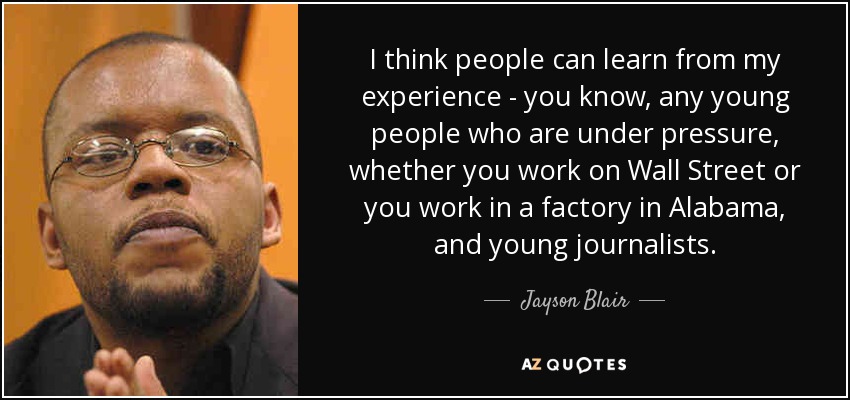
I think people can learn from my experience - you know, any young people who are under pressure, whether you work on Wall Street or you work in a factory in Alabama, and young journalists.
The impulse of the journalist is to be novel, yet to relate his curiosities to the urgencies of the moment; the philosopher seeks what he conceives to be true, regardless of the moment.
I think if there's some kind of crisis in news journalism... a crisis of credibility, then it's been created by journalists. I'm empathetic, I understand it and I see it, but I'm not sympathetic about it. If you want people to think of journalism with higher regard then do better work.
Something we do know is that review coverage does go to male authors more than women authors. That's a fact. I think it's one of those examples of unconscious bias: If you hire a lot of male journalists, they're more likely to pick up the latest Ian McEwan novel than the latest A.S. Byatt novel.
There's several ways to be a journalist. One way is to be combative and take the person to task and what you have is a portrait of somebody defending themselves, which is interesting. The other thing is to slip into their world and really be a representative for all the people that love the experience of that artist, and have them get so comfortable that you become invisible and they're themselves.
I know some really outstanding Turkish journalists, and have been pleased and honored to be able to join with them a few times in their courageous protests against state terror and repression.
It does not help that some politicians and journalists assume the public is interested only in those aspects of science that promise immediate practical applications to technology or medicine.
I feel like a lot of people involved with celebrity journalism have interesting ideas about the people they want to write about going into the interview. Then as soon as they actually sit down with that person, they basically ask the questions they think journalists are supposed to ask, and they start viewing themselves almost as a peer of the subject. Like they're going to become friends. That's why most celebrity journalism is so terrible.
You have to develop a conscience and if on top of that you have talent so much the better. But if you have talent without conscience, you are just one of many thousand journalists.
With two children of my own, I know what it means to balance the demands of family and career - and let's not even talk about finding a date for myself. Rabbi Shmuley keeps telling me he'll find me the perfect woman. My response is, 'As long as she's not a journalist'.
Comedians, such as yourself, Jon Stewart and others, are a valuable supplement, and here's why: Good journalism at its best frequently speaks truth to power. What's happened with journalists - again, I don't except myself from this criticism - in some ways we've lost our guts. We need a spine transplant. What's happened is comedians, in their own way, speak truth to power and fill that vacuum that we in journalism have too often left, particularly post 9/11.
Being a journalist got me to meet with children who had witnessed all their beliefs, all their faith in the world collapse.
I'm just a journalist. I shine a mirror to the culture. I give the cop-out answer.
In any kind of conflict, you have a certain dehumanization that comes along with it. And it's important as a reporter, a writer, a journalist, to try to restore humanity.
Because I would never work for a niche publication or a niche program on television and because I am a journalist and not an opinion person, my job is to try to see how many different points of view I can represent or how. It's not even a question of who you don't offend because you are always going to offend somebody. The question is how can you get people to listen to the information you have to present.
The responsibility of the scientist or journalist is to convey the context. If you're talking about the Arctic Sea ice, you have to embrace the reality that there's a huge number of other things that influence that on a year-to-year basis.
There is no journalist without opinions, and there's no real objectivity, but we can strive toward it.
It amazes me to witness the masochism with which some journalists characterize their industry as a dying species. The future belongs to citizen journalism and blogs.
I think that some of the greatest muckrakers and some of the greatest investigative journalists of all time had strong feelings about civil rights. There is a role for the journalist-advocate. And as long as you play your cards on the table, I think thats a role that we should allow.
If I am traitor, who did I betray? I gave all my information to the American public, to American journalists who are reporting on American issues. If they see that as treason, I think people really need to consider who they think they're working for. The public is supposed to be their boss, not their enemy.
The problem of journalism is simple. Journalists are rarely in a position to establish the truth of an issue themselves, since they didn't' witness it personally. They are entirely dependent on self-interested sources to supply their facts. Every part of the news-making process is defined by this relationship; everything is colored by this reality.
I think the reporter or journalist is well served by having a responsibility to the powerless, to use a much-abused cliché. The voice of the powerless is in some danger of not being heard in the elite discourses we now have in the mainstream media.
Under Syrian law, a journalist is not allowed to report on military matters. This may be wrong or right, but that's just the way it is.
When interviews are good, the conversation can be amazing. Sometimes I've had conversations with journalists that I've never had with anybody else.
I knew I had to be a journalist because I'm deeply curious about the world.
Follow AzQuotes on Facebook, Twitter and Google+. Every day we present the best quotes! Improve yourself, find your inspiration, share with friends
or simply: