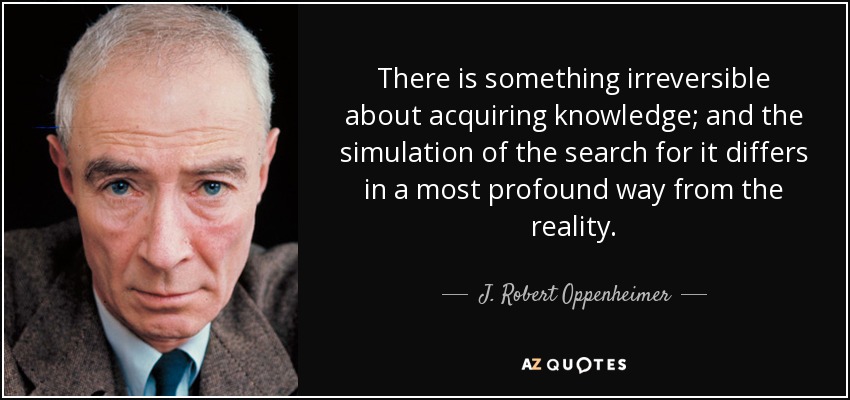
There is something irreversible about acquiring knowledge; and the simulation of the search for it differs in a most profound way from the reality.
To demonstrate experimentally that a microscopic organism actually is the cause of a disease and the agent of contagion, I know no other way, in the present state of Science, than to subject the microbe (the new and happy term introduced by M. Sédillot) to the method of cultivation out of the body.
To inquisitive minds like yours and mine the reflection that the quantity of human knowledge bears no proportion to the quantity of human ignorance must be in one view rather pleasing, viz., that though we are to live forever we may be continually amused and delighted with learning something new.
Books have always a secret influence on the understanding; we cannot at pleasure obliterate ideas; he that reads books of science, thogh without any fixed desire of improvement, will grow more knowing.
But science is the great instrument of social change, all the greater because its object is not change but knowledge, and its silent appropriation of this dominant function, amid the din of political and religious strife, is the most vital of all the revolutions which have marked the development of modern civilisation.
But the greatest error of all the rest is the mistaking or misplacing of the last or farthest end of knowledge: for men have entered into a desire of learning and knowledge, sometimes upon a natural curiosity and inquisitive appetite; sometimes to entertain their minds with variety and delight; sometimes for ornament and reputation; and sometimes to enable them to victory of wit and contradiction; and most times for lucre and profession; and seldom sincerely to give a true account of their gift of reason, to the benefit and use of men.
By profession a biologist, [Thomas Henry Huxley] covered in fact the whole field of the exact sciences, and then bulged through its four fences. Absolutely nothing was uninteresting to him. His curiosity ranged from music to theology and from philosophy to history. He didn't simply know something about everything; he knew a great deal about everything.
By this we may understand, there be two sorts of knowledge, whereof the one is nothing else but sense, or knowledge original (as I have said at the beginning of the second chapter), and remembrance of the same; the other is called science or knowledge of the truth of propositions, and how things are called, and is derived from understanding.
Criticism, though dignified from the earliest ages by the labours of men eminent for knowledge and sagacity, has not yet attained the certainty and stability of science.
Do you realize we've got 250 million years of coal? But coal has got environmental hazards to it, but there's-I'm convinced, and I know that we-technology can be developed so we can have zero-emissions coal-fired electricity plants.
During the century after Newton, it was still possible for a man of unusual attainments to master all fields of scientific knowledge. But by 1800, this had become entirely impracticable.
Even the facts of science may dust the mind by their dryness, unless they are ... rendered fertile by the dews of fresh and living truth. Knowledge does not come to us by details, but in flashes of light from heaven.
Even those to whom Providence has allotted greater strength of understanding, can expect only to improve a single science. In every other part of learning, they must be content to follow opinions, which they are not able to examine; and, even in that which they claim as peculiarly their own, can seldom add more than some small particle of knowledge, to the hereditary stock devolved to them from ancient times, the collective labour of a thousand intellects.
Every student who enters upon a scientific pursuit, especially if at a somewhat advanced period of life, will find not only that he has much to learn, but much also to unlearn.
Exact knowledge is the enemy of vitalism.
Experimentation is the least arrogant method of gaining knowledge. The experimenter humbly asks a question of nature.
Facts, and facts alone, are the foundation of science... When one devotes oneself to experimental research it is in order to augment the sum of known facts, or to discover their mutual relations.
First, In showing in how to avoid attempting impossibilities. Second, In securing us from important mistakes in attempting what is, in itself possible, by means either inadequate or actually opposed to the end in view. Thirdly, In enabling us to accomplish our ends in the easiest, shortest, most economical, and most effectual manner. Fourth, In inducing us to attempt, and enabling us to accomplish, object which, but for such knowledge, we should never have thought of understanding. On the ways that a knowledge of the order of nature can be of use.
For [Richard] Feynman, the essence of the scientific imagination was a powerful and almost painful rule. What scientists create must match reality. It must match what is already known. Scientific creativity is imagination in a straitjacket.
From the freedom to explore comes the joy of learning. From knowledge acquired by personal initiative arises the desire for more knowledge. And from mastery of the novel and beautiful world awaiting every child comes self-confidence.
Great healers, people of divine realization, do not cure by chance but by exact knowledge.
Groups do not have experiences except insofar as all their members do. And there are no experiences... that all the members of a scientific community must share in the course of a [scientific] revolution. Revolutions should be described not in terms of group experience but in terms of the varied experiences of individual group members. Indeed, that variety itself turns out to play an essential role in the evolution of scientific knowledge.
He that in ye mine of knowledge deepest diggeth, hath, like every other miner, ye least breathing time, and must sometimes at least come to terr. alt. for air.
His [Thomas Edison] method was inefficient in the extreme, for an immense ground had to be covered to get anything at all unless blind chance intervened and, at first, I was almost a sorry witness of his doings, knowing that just a little theory and calculation would have saved him 90 per cent of the labor. But he had a veritable contempt for book learning and mathematical knowledge, trusting himself entirely to his inventor's instinct and practical American sense. In view of this, the truly prodigious amount of his actual accomplishments is little short of a miracle.
Human knowledge and human power meet in one; for where the cause is not known the effect cannot be produced. Nature to be commanded must be obeyed; and that which in contemplation is as the cause is in operation as the rule.
Follow AzQuotes on Facebook, Twitter and Google+. Every day we present the best quotes! Improve yourself, find your inspiration, share with friends
or simply: