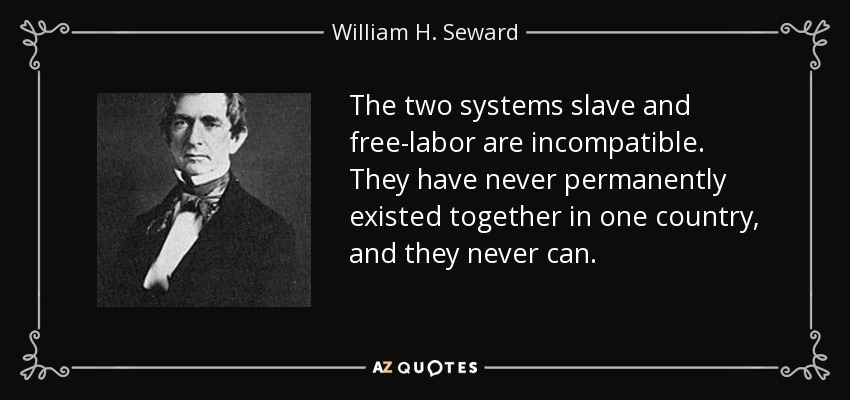
The two systems slave and free-labor are incompatible. They have never permanently existed together in one country, and they never can.
There is very little moral mixture in the 'Antislavery' feeling of this country. A great deal is abstract philanthropy; part is hatred of slaveholders; a great part is jealousy for white labor, very little is consciousness of wrong done and the wish to right it.
We all declare for liberty; but in using the same word we do not all mean the same thing. With some the word liberty may mean for each man to do as he pleases with himself, and the product of his labor; while with others, the same word many mean for some men to do as they please with other men, and the product of other men's labor. Here are two, not only different, but incompatible things, called by the same name - liberty. And it follows that each of the things is, by the respective parties, called by two different and incompatible names - liberty and tyranny.
The South was at the point where the scale was tipping against slavery. It was slowly dawning on the plantation owners that slave labor was not economic, besides being morally wrong. Slavery was destined to be abolished, whether for economic reasons or moral reasons matters not, but the international intriguers were not going to wait for voluntary abolition to rob them of their trump card.
The abstractionist and the materialist thus mutually exasperating each other, and the scoffer expressing the worst of materialism, there arises a third party to occupy the middle ground between these two, the skeptic, namely. He finds both wrong by being in extremes. He labors to plant his feet, to be the beam of the balance.
Marking dynamos for repair $10,000.00-2 hours labor $10.00; knowing where to mark $9,990.00.
The free mind, unafraid of labor, presses on to attain the good.
By these pleasures it is permitted to relax the mind with play, in turmoils of the mind, or when our labors are light, or in great tension, or as a method of passing the time. A reliable witness is Cicero, when he says (De Oratore, 2): 'men who are accustomed to hard daily toil, when by reason of the weather they are kept from their work, betake themselves to playing with a ball, or with knucklebones or with dice, or they may also contrive for themselves some new game at their leisure.'
The history of work has been, in part, the history of the worker's body. Production depended on what the body could accomplish with strength and skill. Techniques that improve output have been driven by a general desire to decrease the pain of labor as well as by employers' intentions to escape dependency upon that knowledge which only the sentient laboring body could provide.
Now I find that in a state of pure obedience the mind learns contentment in appearing weak and foolish to that wisdom which is of the world; and in these lowly labors, they who stand in a low place and are rightly exercised under the cross will find nourishment.
In praise of Thy goodness I must confess that Thou didst try with all Thy means to draw me to Thee. Sometimes it pleased Thee to let me feel the heavy hand of Thy displeasure and to humiliate my proud heart by manifold castigations. Sickness and misfortune didst Thou send upon me to turn my thoughts to my errantries.-One thing, only, O Father, do I ask: cease not to labor for my betterment. In whatsoever manner it be, let me turn to Thee and become fruitful in good works.
I carry my thoughts about with me for a long time... before writing them down... once I have grasped a theme. I shall not forget it even years later. I change many things, discard others, and try again and again until I am satisfied; then, in my head... [the work] rises, it grows, I hear and see the image n front of me from every angle... and only the labor of writing it down remains... I turn my ideas into tones that resound, roar, and rage until at last they stand before me in the form of notes.
I have a feeling-as compelling as a religious conviction-that if industry will constantly pass on to the worker and the customer all the savings of labor-saving machinery and invention, rather than siphon them off into the pools of watered securities, it will by that process keep distribution and production in balance and go as far toward Utopia as our poor human natures will go or be driven.
Any labor which competes with slave labor must accept the economic conditions of slave labor.
Our modern economy privileges pure profit, momentary transactions and rapid fluidity. Part of craft’s anchoring role is that it helps to objectify experience and also to slow down labor. It is not about quick transactions or easy victories. That slow tempo of craftwork, of taking the time you need to do something well, is profoundly stabilizing to individuals.
The Christian life is very much like climbing a hill of ice. You cannot slide up, nay, you have to cut every step with an ice axe; only with incessant labor in cutting and chipping can you make any progress... If you want to know how to backslide, leave off going forward. Cease going upward and you will go downward of necessity. You can never stand still.
Not the labors of my hands Can fulfill thy Law's demands: Could my zeal no respite know, Could my tears forever flow, All for Sin could not atone: Thou must save, and Thou alone!
For the masses who do the city's labor also keep the city's heart.
In todays economy, the most important resource is no longer labor, capital or land; it is knowledge
When it comes to labor and politics, I am inclined to be sympathetic to the left, but when it comes to the Catholic Church, then I am far to the right.
Our food and our rest, our trades and our labors, are to be attended to, and all the offices of humanity performed in obedience to the will of God, for the glory of Christ.
It is a sign of our times, conspicuous to the coarsest observer, that many intelligent and religious persons withdraw themselves from the common labors and competitions of the market and the caucus, and betake themselves to a certain solitary and critical way of living, from which no solid fruit has yet appeared to justify their separation.
Labor came to humanity with the fall from grace and was at best a penitential sacrifice enabling purity through humiliation. Laborwas toil, distress, trouble, fatigue--an exertion both painful and compulsory. Labor was our animal condition, struggling to survive in dirt and darkness.
How we shall earn our bread is a grave question; yet it is a sweet and inviting question. Let us not shirk it, as is usually done.It is the most important and practical question which is put to man. Let us not answer it hastily. Let us not be content to get our bread in some gross, careless, and hasty manner. Some men go a-hunting, some a-fishing, some a-gaming, some to war; but none have so pleasant a time as they who in earnest seek to earn their bread.
Gascoigne, Ben Jonson, Greville, Raleigh, Donne, Poets who wrote great poems, one by one, And spaced by many years, each line an act Through which few labor, which no men retract. This passion is the scholar's heritage
Follow AzQuotes on Facebook, Twitter and Google+. Every day we present the best quotes! Improve yourself, find your inspiration, share with friends
or simply: