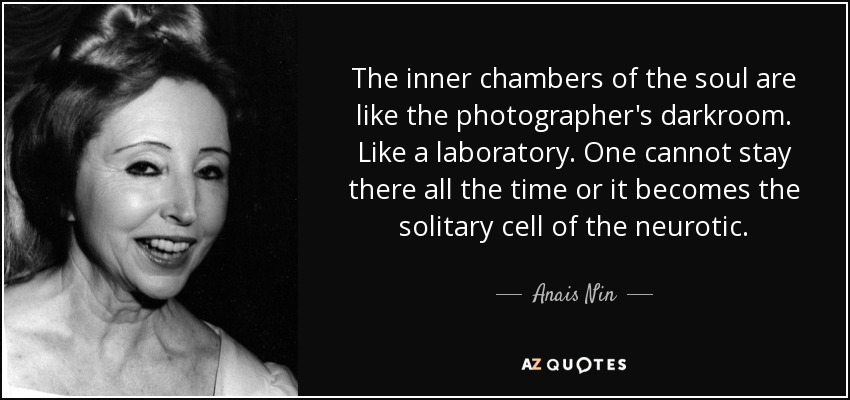
The inner chambers of the soul are like the photographer's darkroom. Like a laboratory. One cannot stay there all the time or it becomes the solitary cell of the neurotic.
Cities are an immense laboratory of trial and error, failure and success, in city building and city design.
It is as dangerous for people unaccustomed to handling words and unacquainted with their technique to tinker about with these heavily-charged nuclei of emotional power as it would be for me to burst into a laboratory and play about with a powerful electromagnet or other machine highly charged with electrical force.
From laboratories employing complex apparatus, poetry often emerges into the outside world after a long lapse of time, just as some scientific discoveries become common property only after they have entered the blood stream of the generations.
The subconscious is like having a laboratory assistant who pretends to love you and help you, but after you go home to go to sleep it goes back into the lab and starts fumbling with the data and destroying it. It's a very tricky thing. People think our minds are us, but that's not true at all. The mind is not us.
The stage is like a laboratory where you can run theatrical experiments, imposing interesting conditions on the cast or story and seeing how they pan out. Each new play is like creating a tiny virtual universe enclosed by the confines of the stage.
I never took banned substances, but I have been courted by doctors who wanted to improve my blood in the laboratory. My mother always put them on a flight.
If I had done everything I'm credited with, I'd be speaking to you from a laboratory jar at Harvard.
In my own field, x-ray crystallography, we used to work out the structure of minerals by various dodges which we never bothered to write down, we just used them. Then Linus Pauling came along to the laboratory, saw what we were doing and wrote out what we now call Pauling's Rules. We had all been using Pauling's Rules for about three or four years before Pauling told us what the rules were.
How ignorant we are! How ignorant everyone is! We can cut across only a small area of the appallingly expanding fields of knowledge. No human being can know more than a tiny fraction of the whole. It must have been satisfactory in ancient times when one's own land seemed to be the universe; when research studies, pamphlets, books did not issue in endless flow; when laboratories and scientists were not so rapidly pushing back frontiers of knowledge that the process of unlearning the old left you gasping for breath.
In truth, the laboratory is the forecourt of the temple of philosophy, and whoso has not offered sacrifices and undergone purification there has little chance of admission into the sanctuary.
In all cultures, the family imprints its members with selfhood. Human experience of identity has two elements; a sense of belonging and a sense of being separate. The laboratory in which these ingredients are mixed and dispensed is the family, the matrix of identity.
From him [Wilard Bennett] I learned how different a working laboratory is from a student laboratory. The answers are not known! [While an undergraduate, doing experimental measurements in the laboratory of his professor, at Ohio State University.]
In the laboratory, we call this the six-degrees-of-separation-from-cancer rule: you can ask any biological question, no matter how seemingly distant-what makes the heart fail, or why worms age, or even how birds learn songs-and you will end up, in fewer than six genetic steps, connecting with a proto-oncogene or tumor suppressor.
The AMA virtually stopped the Rife treatment in 1939, first by threatening the physicians using Rife's instrument, then by forcing Rife into court....During the period 1935 to early 1939, the leading laboratory for electronic or energy medicine in the USA, in New Jersy, was independently verifying Rife's discoveries...(this) laboratory was "mysteriously" burned to the ground.....Rife's treatment was ruthlessly suppressed by the AMA's Morris Fishbein.
The more we learn of the true nature of non-human animals, especially those with complex brains and corresponding complex social behavior, the more ethical concerns are raised regarding their use in the service of man - whether this be in entertainment, as "pets," for food, in research laboratories, or any of the other uses to which we subject them.
It would be great if all the fast-food outlets, slaughterhouses, these laboratories and the banks who fund them exploded tomorrow.
We think we learn from teachers, and we sometimes do. But the teachers are not always to be found in school or in great laboratories. Sometimes what we learn depends upon our own powers of insight.
Is it necessary to practice all these asanas, further and further? Is it necessary to develop scientific researches further and further? To a yogi, the body is a laboratory, a field of experiments and perpetual researches.
Nationalism is blamed for this century's wars, but nationalism need not mean militarism. And the nation-state has been the laboratory of liberty.
Finally, as the digestive canal is a complex system, a series of separate chemical laboratories, I cut the connections between them in order to investigate the course of phenomena in each particular laboratory; thus I resolved the digestive canal into several separate parts.
He [Louis Brandais] did believe in the states famously as laboratories of democracy, to use that resonant phrase that Tea Party and conservative libertarians have embraced today because he loves state experimentation.
We enslave, torture and then slaughter animals to eat them, then when we eventually become sick from that we enslave, torture and kill more animals in laboratories in the hopes of creating drugs to enable us to continue with our animal-abusive lifestyle! Few of us look to the future (i.e., to our parents and grandparents), see the effects of an omnivorous lifestyle, and opt out of it before it makes us sick.
In fact, numerous scientific laboratory tests and field observations have led to the conclusion that animals are conscious, intelligent, emotional beings. They are not machines and truly feel physical pain when it is inflicted upon them. They are capable of experiencing a wide range of emotions, including loneliness, embarrassment, sadness, longing, depression, anxiety, panic, and fear, as well as joy, relief, surprise, happiness, contentment, and peace.
I think that the marriage of academic medical centers and academicians with the private sector is a very, is a marriage made in heaven because it's the best way to get basic discoveries from the laboratory into new therapeutics for our patients.
Follow AzQuotes on Facebook, Twitter and Google+. Every day we present the best quotes! Improve yourself, find your inspiration, share with friends
or simply: