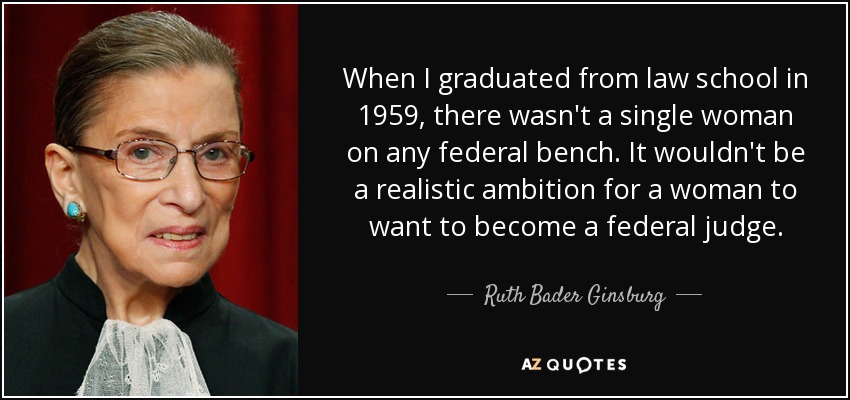
When I graduated from law school in 1959, there wasn't a single woman on any federal bench. It wouldn't be a realistic ambition for a woman to want to become a federal judge.
I grew up in the '50s and '60s when Jack Kennedy was president. We would watch him on television. And our teachers always talked about the good things public servants could do. I thought maybe that's something I should do. So when I got out of law school, my wife, Jane, and I became precinct captains.
I enjoyed [playing lawyer in From The Hip] as an ode to my dad. My dad went to Harvard and Harvard Law School, so he had some friends that practiced in Boston. So, there was a big law firm that he hooked me up with the senior partner, then the senior partner hooked me up with a young lawyer who worked in the firm. And the young lawyer was married to a public defender. So I would hang out with them, and I could see both sides of it, those that are corporate attorneys and those that help the poor and the disenfranchised.
I went right to Chicago to do improv [after law school], but I wish I had gone, "Let me just bypass this law thing." I mean, sure, it helps you read a contract, but I can read a contract regardless. It's just common sense, contracts.
There's a strange myth of Anglo-Saxonism. When the University of Virginia was founded by Thomas Jefferson, for example, its law school offered the study of "Anglo-Saxon Law." And that myth of Anglo-Saxonism carries right over into the early twentieth century.
Ken Heitz got drafted by the Bucks the same year I did. He went to their camp just for the experience, then dropped out to attend Harvard Law School. I always admired his combination of athleticism and brains.
In law school they teach you that everything is a contract; well, in poetry everything is a narrative.
When you're embarking on a piece of writing, the anxiety is just too much, especially when you're young and you're trying to figure out if this is your thing or not. You feel like, "if I don't write a good story, I gotta get going to law school!"
When I left law school, I wanted to go into the government, into the tax policy area. I got the job that I wanted in the International Tax Council's office in Treasury. I arrived determined to change the world. But I discovered very quickly that the world couldn't care less. And I couldn't stomach the lying and stealing that I witnessed. I realized that the only difference between my mother's family and the senators and administrators that I was working with was that the latter wore suits and ties.
Let Girls Learn issue has always been personal for me. I grew up in a working-class neighborhood on the South Side of Chicago where most folks, including my parents, didn't have college degrees. But with a lot of hard work - and a lot of financial aid - I had the chance to attend Princeton and Harvard Law School, and that gave me the confidence to pursue my ambitions.
When I went to Harvard Law School I became interested in the connection between legal standards for safety and automobile engineering design. At that time, it was all blamed on a "nut behind the wheel," so-called, the driver. But I knew that the vehicle had a great deal to do with that because I had come across some Air Force-sponsored studies at medical schools. The Air Force found they were losing more men on the highways than in the Korean War.
I have all of Elizabeth Lowell's first editions. I love these books. They are among my most treasured possessions. I have carried them in boxes through college, law school, apartments and then houses. They have seen me through my darkest moments and inspired me to my greatest joys. I sometimes get scared thinking what would have happened to me if I hadn't started writing. I literally cannot imagine another life. And Elizabeth Lowell played a huge part in getting me on the right path.
After I got out of law school and worked in a big law firm, I thought, there are so many kids like me, in my neighborhood, that could be here if they had more support from their families, better financial aid. But the gap is so wide once you miss that opportunity. So I was always interested in figuring out, How do you bridge that? I felt, as a lawyer, when I was mentoring and working with kids, that I gained a level of groundedness that I just couldn't get sitting on the forty-seventh floor of a fancy firm.
I love being a woman. I never wanted to be a man or needed to prove I was just like them. I graduated law school at USC, won moot court honors, and finished high in my graduating class, so I knew who I was. I knew I was intelligent and educated and strong. Being a woman has always helped me in many ways.
I had no choice but to make me as a comedian, because I am not particularly gifted with a lot of marketable skills. Unless I really want to spend the rest of my life temping, or teaching drama to third-graders, I don't have a lot of other options - which is freeing, in a way. I never have to say, "Well, I could always go back to law school."
I feel for young people today. When I came out of law school, yes, we were broke, we had kids, we had problems. But it was straightforward. I didn't have to say, "My God, I am $80,000 in debt, I have to get a job, I have to pay it back, my life is ruined otherwise." We were able to go forward and work toward building something new, and that's what we did. Today many lawyers are unable to feel free to be advocates.
I think my parents wanted me to do something very normal, have a normal person job and not be confronted by the instability of an artistic pursuit, but there wasn't really a lot they could do to stop me. I was, at one point, going to go to law school when I finished high school, but the next day I got accepted into acting school and there was no real question in my mind of what I was going to do.
Even after I'd published three books and had been writing full-time for twenty years, my father continued to urge me to go to law school.
Was it the act of giving birth that made you a mother? Did you lose that label when you relinquished your child? If people were measured by their deeds, on the one hand, I had a woman who had chosen to give me up; on the other, I had a woman who'd sat up with me at night when I was sick as a child, who'd cried with me over boyfriends, who'd clapped fiercely at my law school graduation. Which acts made you more of a mother? Both, I realized. Being a parent wasn't just about bearing a child. It was about bearing witness to its life.
The conventional explanation for Jewish success, of course, is that Jews come from a literate, intellectual culture. They are famously "the people of the book." There is surely something to that. But it wasn't just the children of rabbis who went to law school. It was the children of garment workers. And their critical advantage in climbing the professional ladder wasn't the intellectual rigor you get from studying the Talmud. It was the practical intelligence and savvy you get from watching your father sell aprons on Hester Street.
The study of law can be disappointing at times, a matter of applying narrow rules and arcane procedure to an uncooperative reality; a sort of glorified accounting that serves to regulate the affairs of those who have power--and that all too often seeks to explain, to those who do not, the ultimate wisdom and justness of their condition. But that's not all the law is. The law is also memory; the law also records a long-running conversation, a nation arguing with its conscience.
I tried not to think about my life. I did not have any good solid plans for it long-term - no bad plans either, no plans at all - and the lostness of that, compared with the clear ambitions of my friends (marriage, children, law school), sometimes shamed me. Other times in my mind I defended such a condition as morally and intellectually superior - my life was open and ready and free - but that did not make it less lonely.
I've often thought that when something is hard for you, whether it's going to law school or anything else that challenges you, that's probably what you should do.
One of the things I was taught in law school is that I'd never be able to think the same again - that being a lawyer is something that's part of who I am as an individual now.
I never overestimate the audience, nor do I underestimate them. I just have a very rational idea as to who we’re dealing with, and that we’re not making a picture for Harvard Law School, we’re making a picture for middle-class people, the people that you see on the subway, or the people that you see in a restaurant. Just normal people.
Follow AzQuotes on Facebook, Twitter and Google+. Every day we present the best quotes! Improve yourself, find your inspiration, share with friends
or simply: