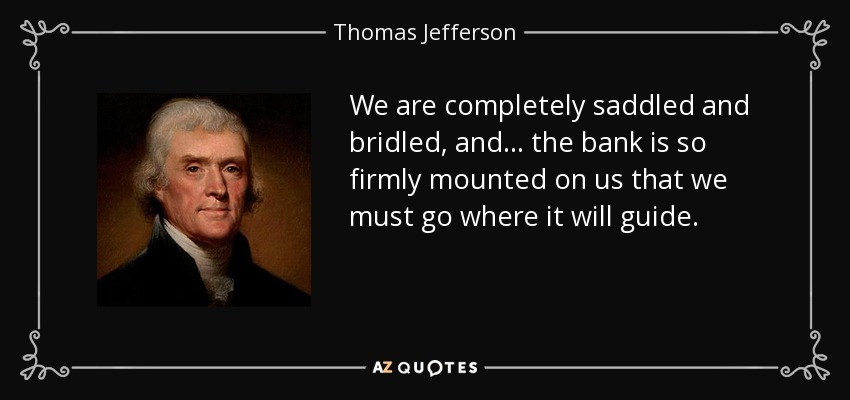
We are completely saddled and bridled, and... the bank is so firmly mounted on us that we must go where it will guide.
We are overdone with banking institutions, which have banished the precious metals, and substituted a more fluctuating and unsafe medium... These have withdrawn capital from useful improvements and employments to nourish idleness... These are evils more easily to be deplored than remedied.
We shall all consider ourselves unauthorized to saddle posterity with our debts, and morally bound to pay them ourselves; and consequently within what may be deemed the period of a generation, or the life of the majority.
Democracy has two excesses to avoid: the spirit of inequality, which leads to an aristocracy, or to the government of a single individual; and the spirit of extreme equality, which conducts it to despotism, as the despotism of a single individual finishes by conquest.
God forbid we should ever be twenty years without such a rebellion... We have had thirteen States independent for eleven years. There has been one rebellion. That comes to one rebellion in a century and a half, for each State. What country before ever existed a century and a half without a rebellion.
We ought to be very cautious and circumspect in the prosecution of magic and heresy. The attempt to put down these two crimes may be extremely perilous to liberty.
The tumults in America I expected would have produced in Europe an unfavorable opinion of our political state. But it has not. On the contrary, the small effect of these tumults seems to have given more confidence in the firmness of our governments. The interposition of the people themselves on the side of government has had a great effect on the opinion here in Europe.
Republics come to an end by luxurious habits; monarchies by poverty.
In our time, in particular, there exists another form of ownership which is becoming no less important than land: the possession of know-how, technology and skill. The wealth of the industrialized nations is based much more on this kind of ownership than on natural resources.
Economic activity, especially the activity of a market economy, cannot be conducted in an institutional, juridical or political vacuum. On the contrary, it presupposes sure guarantees of individual freedom and private property, as well as a stable currency and efficient public services.
Also, the Federal Advisory Committee should be enlarged and reorganized. Members should be chosen for the broadest possible representation of the public interest, their main qualification: ability.
It may seem strange, but Congress has never developed a set of goals for guiding Federal Reserve policy. In founding the System, Congress spoke about the country's need for "an elastic currency." Since then, Congress has passed the Full Employment Act, declaring its general intention to promote "maximum employment, production, and purchasing power." But it has never directly counseled the Federal Reserve.
There have been times when the Federal Reserve has restricted the money supply and raised interest rates to gain an end, which had much better been left to another Government agency or the Congress to attain. The country could have had lower interest rates without sacrificing anything else.
There are many reasons why the general public doesn't really understand our monetary system. In the first place, money is something that people tend to get emotional about. After all, money involves, and always has involved, something closely akin to faith-which probably explains why in many past societies the money system has been in the hands of a priesthood, the subject of magical rites, and the ceremonial services of the tribe's medicine man.
In a democracy the responsibility for the Government's economic policies, which so affect the economy, normally rests with the elected representative of the people: in our case, with the President and the Congress. If these two follow economic policies inimical to the general welfare, they are accountable to the people for their actions on election day. With Federal Reserve independence, however, a body of men exist who control one of the most powerful levers moving the economy and who are responsible to no one.
If the Federal Reserve pursues a policy which Congress or the President believes not to be in the public interest, there is nothing Congress can do to reverse the policy. Nor is there anything the people can do. Such bastions of unaccountable power are undemocratic. The Federal Reserve System must be reformed, so that it is answerable to the elected representatives of the people.
The Federal Reserve is the overlord of the money supply. If these two are not steering in the same direction, they can either neutralize each other or have the economy lurching in all directions. This is not a rational system for setting economic policy. It has given us trouble in the past, as the text will establish, and will inevitably in the future.
If the world is made to furnish each individual with the means of livelihood and the instruments for his growth and progress, each man has therefore the right to find in the world what is necessary for himself. The recent Council reminded us of this: "God intended the earth and all that it contains for the use of every human being and people. Thus, as all men follow justice and unite in charity, created goods should abound for them on a reasonable basis."
It is not the ownership of the instruments of production which it is important for the State to assume. If the State is able to determine the aggregate amount of resources devoted to augmenting the instruments and the basic rate of reward to those who own them, it will have accomplished all that is necessary. Moreover, the necessary measures of socialization can be introduced gradually and without a break in the general traditions of society.
The immense accumulations of fixed capital which, to the great benefit of mankind, were built up during the half century before the war, could never have come about in a Society where wealth was divided equitably.
When incentive to acquire and obtain property is gone, people no longer make efforts to acquire any... Those who infringe upon property rights commit an injustice... If this occurs repeatedly, all incentives to cultural enterprise are destroyed and they cease utterly to make an effort. This leads to destruction and ruin of civilization.
"Freedom" in capitalist countries exists only for those who possess money and who consequently hold power.
Louis Kelso's formula sounds like Lydia Pinkham's Vegetable Compound. The whole theory sounds crazy. But, then, one may recall, they said all that of Copernicus too.
Man is not made for the state; the state is made for man. To deprive man of freedom is to relegate him to the status of a thing, rather than elevate him to the status of a person. Man must never be treated as a means to the end of the state, but always as an end within himself.
A heavy progressive or graduated income tax.
Follow AzQuotes on Facebook, Twitter and Google+. Every day we present the best quotes! Improve yourself, find your inspiration, share with friends
or simply: