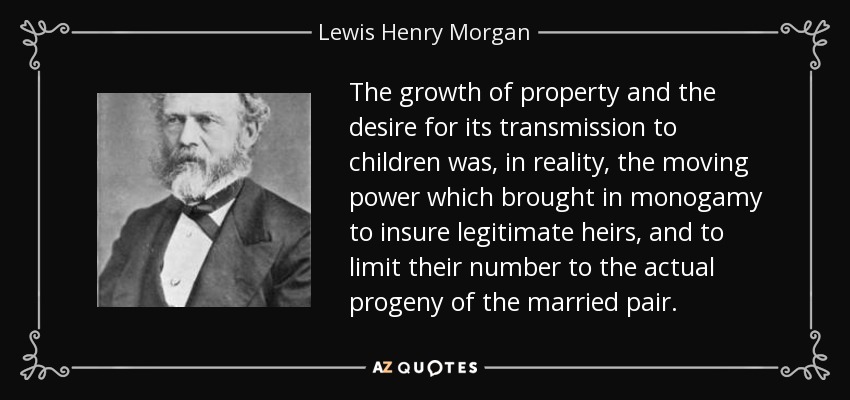
The growth of property and the desire for its transmission to children was, in reality, the moving power which brought in monogamy to insure legitimate heirs, and to limit their number to the actual progeny of the married pair.
The time will come when human intelligence will rise to the mastery of property.
Free enterprise is a natural result of the American form of government, which says in so many words that the more men do for themselves, the less government does for them, the better off we will all be.
Nine-tenths of the people are at present freeholders... The time is not distant when this country will abound with mechanics and manufacturers who will receive their bread from their employers. Will such men be the secure and faithful guardians of liberty? Give the votes to people who have no property, and they will sell them to the rich who will be able to buy them.
One ideological claim is that private property is theft, that the natural product of the existence of property is evil, and that private ownership therefore should not exist... What those who feel this way don't realize is that property is a notion that has to do with control - that property is a system for the disposal of power. The absence of property almost always means the concentration of power in the state.
So many of the new nations which were established as democracies after the second world war, during the decolonizing process, have now changed their system to state-socialism. Small elites run them, and they aren't sharing societies. They aren't even socialist. The power of the state has been merged with business property and you have the greatest concentration of power that's possible.
Man's Chief purpose is the creation and preservation of values; that is what gives meaning to our civilization, and the participation in this is what gives significance, ultimately, to the individual human life.
The gods hate unjust men.
One rule which woe betides the banker who fails to heed it/Never lend any money to anybody unless they don't need it.
Adam Smith's was a real universalism in intent. Laissez Faire was intended to establish a world community as well as a natural harmony of interests within each nation... But the "children of darkness" were able to make good use of his creed. A dogma which was intended to guarantee the economic freedom of the individual became the "ideology" of vast corporate structures of a later period of capitalism, used by them, and still used, to prevent a proper political control of their power.
Marxism was the social creed and the social cry of those classes who knew by their miseries that the creed of the liberal optimists was s snare and a delusion... Liberalism and Marxism share a common illusion of the "children of light." Neither understands property as a form of power which can be used in either its individual or its social form as an instrument of particular interest against the general interest.
Government has the responsibility to provide the climate in which Americans, all Americans, have an opportunity for good jobs; and not only for good jobs, but an opportunity if they have the ability and the desire, to be owners and managers, to have a piece of the action, because if they have a piece of the action, then they believe in the system rather than fighting against it.
It's long been common practice among many to draw a distinction between "human rights" and "property rights," suggesting that the two are separate and unequal - with "property rights" second to "human rights."
We must adopt reforms which will expand the range of opportunities for all Americans. We can fulfill the American dream only when each person has a fair chance to fulfill his own dreams. This means equal voting rights, equal employment opportunity and new opportunities for expanded ownership, because in order to be secure in their human rights, people need access to property rights.
The market, if it can be kept honest and competitive, does provide very strong incentives for work effort and productive contributions. In their absence, society would thrash about for alternative incentives-some unreliable, like altruism; some perilous like collective loyalty; some intolerable, like coercion or oppression.
How right the working classes are in their "materialism." How right they are to realize that the belly comes before the soul, not in the scale of values but in point of time!
The people of America are a people of property; almost every man is a freeholder.
Bad as "independence" is, the main fault of the Federal Reserve System - an admirable system if conducted in the public interest - is that too much power and control rests in the hands of people whose private interests are directly affected by the Federal Reserves' actions.
The Open Market Committee, as presently established, is plainly not in the public interest. This committee must be operated by purely public servants, representatives of the people as a whole and not any single interest group. The Open Market Committee should be abolished, and its powers transferred to the Federal Reserve Board - the present public members of the committee, with reasonably short terms of office.
Also, the Federal Advisory Committee should be enlarged and reorganized. Members should be chosen for the broadest possible representation of the public interest, their main qualification: ability.
It may seem strange, but Congress has never developed a set of goals for guiding Federal Reserve policy. In founding the System, Congress spoke about the country's need for "an elastic currency." Since then, Congress has passed the Full Employment Act, declaring its general intention to promote "maximum employment, production, and purchasing power." But it has never directly counseled the Federal Reserve.
There have been times when the Federal Reserve has restricted the money supply and raised interest rates to gain an end, which had much better been left to another Government agency or the Congress to attain. The country could have had lower interest rates without sacrificing anything else.
There are many reasons why the general public doesn't really understand our monetary system. In the first place, money is something that people tend to get emotional about. After all, money involves, and always has involved, something closely akin to faith-which probably explains why in many past societies the money system has been in the hands of a priesthood, the subject of magical rites, and the ceremonial services of the tribe's medicine man.
In a democracy the responsibility for the Government's economic policies, which so affect the economy, normally rests with the elected representative of the people: in our case, with the President and the Congress. If these two follow economic policies inimical to the general welfare, they are accountable to the people for their actions on election day. With Federal Reserve independence, however, a body of men exist who control one of the most powerful levers moving the economy and who are responsible to no one.
If the Federal Reserve pursues a policy which Congress or the President believes not to be in the public interest, there is nothing Congress can do to reverse the policy. Nor is there anything the people can do. Such bastions of unaccountable power are undemocratic. The Federal Reserve System must be reformed, so that it is answerable to the elected representatives of the people.
Follow AzQuotes on Facebook, Twitter and Google+. Every day we present the best quotes! Improve yourself, find your inspiration, share with friends
or simply: