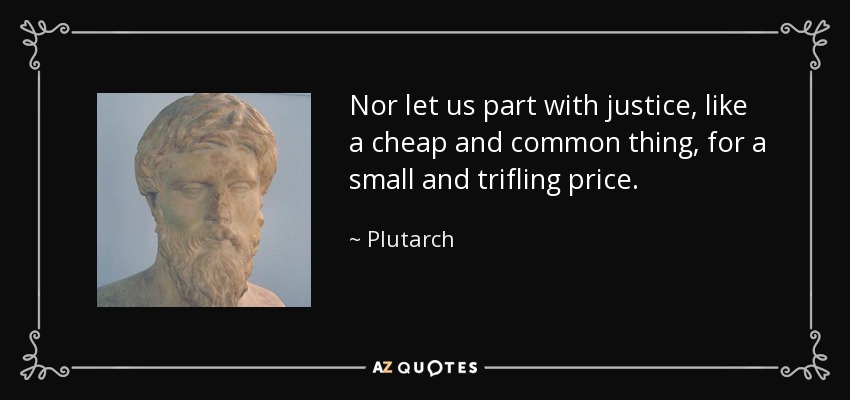
Nor let us part with justice, like a cheap and common thing, for a small and trifling price.
Of the land which the Romans gained by conquest from their neighbours, part they sold publicly, and turned the remainder into common; this common land they assigned to such of the citizens as were poor and indigent, for which they were to pay only a small acknowledgment into the public treasury. But when the wealthy men began to offer larger rents, and drive the poorer people out, it was enacted by law that no person whatever should enjoy more than five hundred acres of ground.
Rome was in the most dangerous inclination to change on account of the unequal distribution of wealth and property, those of highest rank and greatest spirit having impoverished themselves by shows, entertainments, ambition of offices, and sumptuous buildings, and the riches of the city having thus fallen into the hands of mean and low-born persons. So that there wanted but a slight impetus to set all in motion, it being in the power of every daring man to overturn a sickly commonwealth.
It's the nature of government, to build enduring institutions, structures that stay long after their purpose is over. If you pay people to help the poor, you have people who won't be paid if there aren't any poor, so they'll be sure to find some.
We hold that the ownership of private property is the right and privilege of every American citizen and is one of the foundation stones upon which this nation and its free enterprise system has been built and has prospered. We feel that private property rights and human rights are inseparable and indivisible. Only in those nations that guarantee the right of ownership of private property as basic and sacred under their law is there any recognition of human rights.
Over hundred years ago Abraham Lincoln signed the Homestead Act. There was wide distribution of land and they didn't confiscate anyone's privately owned land... We need an industrial Homestead Act.
Could there be a better answer to the stupidity of Karl Marx than millions of workers individually sharing in the ownership of the means of production.
I've long believed one of the mainsprings of our own liberty has been the widespread ownership of property among our people and the expectation that anyone's child, even from the humblest of families, could grow up to own a business or corporation.
Meanwhile, what about the workers in those state monopolies that are being put up for sale? I am reminded of a technique for employee ownership that has worked well for many U.S. companies. It goes by various names, but the best known is "Employee Stock Ownership Program," or ESOP.
Our economic assistance must be carefully targeted, and must make maximum use of the energy and efforts of the private sector... Economic freedom is the world's mightiest engine for abundance and social justice... Developing countries need to be encouraged to experiment with a growing variety of arrangements for profit sharing and expanded capital ownership.
Our Founding Fathers well understood that concentrated power is the enemy of liberty and the rights of man. They knew that the American experiment in individual liberty, free enterprise and republican self-government could succeed only if power were widely distributed. And since in any society social and political power flow from economic power, they saw that wealth and property would have to be widely distributed among the people of the country. The truth of this insight is immediately apparent.
Could there be anything resembling a free enterprise economy, if wealth and property were concentrated in the hands of a few, while the great majority owned little more than the shirts on their backs?
Could there be anything but widespread misery, where a privileged few controlled a nation's wealth, while millions labored for a pittance, and millions more were desperate for want of employment?
It should be clear to everyone that the nation's steadfast policy should afford every American of working age a realistic opportunity to acquire the ownership and control of some meaningful form of property in a growing national economy.
This is not to say that the government should confiscate from the "haves" and bestow upon the "have-nots", beyond the requirements of a compassionate welfare program to provide for those who cannot provide for themselves. Far from it. But it is to say that our duty is to foster a strong, vibrant wealth-producing economy which operates in such a way that new additions to wealth accrue to those who presently have little or no ownership stake in their country.
The people of Central America - and, in a broader sense, the entire developing world - need to know first-hand that freedom and opportunity are not just for the elite, but the birthright of every citizen; that property is not just something enjoyed by a few, but can be owned by any individual who works hard and makes correct decisions.
Today it is difficult to find leaders who are independent of the forces that have brought us our problems: The Congress, the bureaucracy, the lobbyists, big business, and big labor.
Insofar as human beings flower on the ground of freedom, justice guards that ground. Insofar as human beings flower in the soil of community, justice tends that soil. Justice makes possible a social order that people can truly be said to share freely.
We believe this approach (progress sharing) is a rational approach because you cooperate in creating the abundance that makes the progress possible, and then you share that progress after the fact, and not before the fact. Profit sharing would resolve the conflict between management apprehensions and worker expectations on the basis of solid economic facts as they materialize rather than on the basis of speculation as to what the future might hold.
Profit sharing in the form of stock distributions to workers would help to democratize the ownership of America's vast corporate wealth which is today appallingly undemocratic and unhealthy.
Labour, like all other things which are purchased and sold... has its natural and its market price.
The last point for consideration is the supposed disposition of the people to interfere with the rights of property. So essential does it appear to me, to the cause of good government, that the rights of property should be held sacred, that I would agree to deprive those of the elective franchise against whom it could justly be alleged that they considered it their interest to invade them.
Taxation has its limitations as a method of achieving better economic distribution since for this purpose it is essentially remedial. We must also take a positive approach by finding new ways to spread ownership of future capital growth more broadly in our society.
Many of the deficiencies of our economic system could be alleviated if ways were found to broaden the ownership of the means of production... This has happened in some companies through ESOPs. Successful approaches of this sort would pay dividends in terms of employee commitment and morale. And they would not deprive anyone of his present holdings since they are based on future growth.
Let us not confuse objectives with methods. Too many so-called leaders of the nation fail to see the forest because of the trees. Too many of them fail to recognize the vital necessity of planning for definite objectives. True leadership calls for the setting forth of the objectives and the rallying of public opinion in support of these objectives.
Follow AzQuotes on Facebook, Twitter and Google+. Every day we present the best quotes! Improve yourself, find your inspiration, share with friends
or simply: