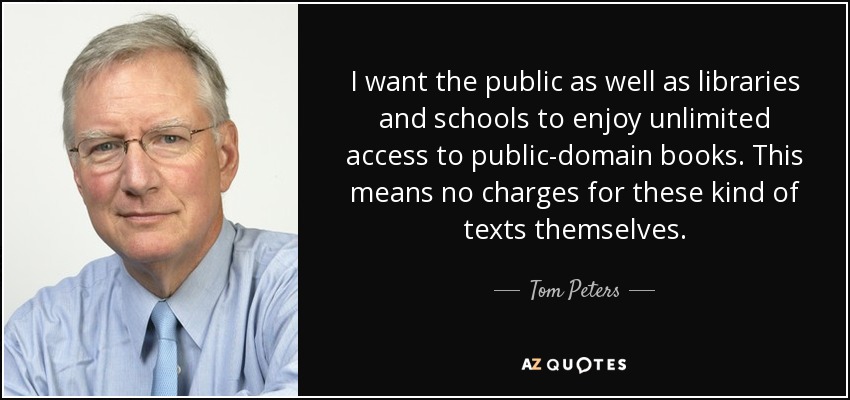
I want the public as well as libraries and schools to enjoy unlimited access to public-domain books. This means no charges for these kind of texts themselves.
Authors and publishers want fair compensation and a means of protecting content through digital rights management. Vendors and technology companies want new markets for e-book reading devices and other hardware. End-users most of all want a wide range and generous amount of high-quality content for free or at reasonable costs. Like end-users, libraries want quality, quantity, economy, and variety as well as flexible business models.
Because nearly all digital libraries are tied to bricks-and-mortar institutions, the funding base tends to be quite localized.
In my school, the library was forbidden. I was accused of turning on the radiator so that the [class]room was uninhabitable and the ceiling came down below; I'm pretty sure I didn't do it. But then we were moved to the library. And there was a really boring history thing, about the Spanish Armada: how could you make that boring?!So I reached my hand out, and slid a book off to read under the desk, and it opened at King Lear Act Four Scene Six. I was astounded. I'd never seen language like it. I was awestruck. I think that may be one reason why I got involved in theatre.
Print-based libraries developed in an age of scarce printed resources.
We all know of the dangers and inequities of the traditional digital divide: People who have good access tocomputer networks have a distinct advantage - in terms of both life opportunities and quality of life, I wouldargue - over the vast majority of the world's population that does not yet have good access to computernetworks. The "other" digital divide points to an increasingly unstable situation that has developed inlibrarianship as digital libraries have evolved and matured.
A completely free library is as rare as a truly free lunch.
If, as I anticipate, a wide array of personal, portable information/communication devices becomes increasingly important and widespread for information-intensive users, it will be a major challenge for libraries to adapt their content and services to such a diverse technological environment.
One time, the Library of Congress was giving books to local libraries around the country on Islam. The library of a guy named Walter Jones, who's a member of Congress from North Carolina, got some books and resource materials, and he got up in the press and said he didn't want any Muslim books in the library. And the people said, "Wait a minute, that's kind of anti-Muslim." He said, "Oh no, Keith Ellison is a friend of mine." And I said, "You know what? We are friends, but you're wrong about this.
To have a great university library near you with plenty of archives of all the journals that you want to research in the twentieth century is a remarkable asset, and I spend a day, maybe two days a week in that library. I just plain love it.
The whole thing that Dante [Alighieri] did was summed up in the medieval world. It's like St. Thomas Aquinas, the Summa Theologica. He didn't invent it, he just put it all in one package. You get twelve fat books there sitting in any library. Whereas... I think if Joshi thinks [H.P.] Lovecraft was doing anything like that, just throwing together all this stuff to form a kind of anti-mythology, that's where I would disagree with him.
I mean, these are really dedicated people [in Lovecraft Society] when it comes to [h.P.] Lovecraft. But in the top floor of the John Hay Library, you have all of Lovecraft's archives. And messing around in there, I noticed, I said, what are these paintings? And the librarian told me, "Well, those are Pickman's paintings." I said, "I thought this was like something he made up, like The Necronomicon, that kind of stuff." And he said no, that the guy actually existed.
People who spend their working hours in a lab or research library or a classroom might be intent primarily on keeping or advancing their elite positions, thereby lending tacit support to power structures. Or they might not be.
Usage tends to be global, while funding tends tobe local. When we allow it to happen, usage of a digital library is remarkably diverse and widespread.
Many flagship state universities have wonderful digital libraries that are accessed by people around the world. In future, if not current, budget crises, trustees, board members, and administrators may wonder why these state institutions - with an articulated primary clientele of students, faculty, and staff members and a secondary clientele of all citizens of the state - should be spending resources on a digital library that is used by many people beyond the primary and secondary service populations.
At the school where I went you were able to check out instruments like you check out a library book, if your parents signed for you and vouched for you. Then after you had it for a little while you could decide if you were interested in taking lessons or you could also get your own gear. Or you could turn that instrument in for another one and try something else. So that's how I got my hands on the guitar.
I went to the library and began to read some stuff on my own. My discovery of James Baldwin was life-changing. I read Go Tell It on the Mountain first, and that was hugely impactful.
I am confident that for the foreseeable future (barring some catastrophic event affecting economic, energy, electrical, and communications systems), many subpopulations that use information intensively (e.g., students, academics, library patrons, white collar workers) will be using some sort of portal information appliance.
I worked the AV counter at the Roland Heights public library in the '80s. My best story from the library was the time a couple asked for a recommendation, and I recommended Raising Arizona and they absolutely hated it. They came back hungry for blood. I was on my lunch break and my boss came out and said, "Hey kid, you need to come talk to these people. They totally hate Arizona." And he said, "Arizona's a dog; nobody gets that movie."
The reality is, if you go to the library and read biographies, thousands of people have changed, radically changed. St. Augustine was one of them. He lived a terrible a life for the first 33 years, and then he radically changed.
[People in 1600s] didn't have many books. They would have been staggered by the personal libraries we have today, because books back then were incredibly expensive.
People of all demographic categories and geographic regions will access a good digital library.
AT first Raoden stayed away from the library, because it reminded him of her. Then he found himself drawn back to it—because it reminded him of her.
The library would've cheered me up, most days. I loved the heavy oaken tables, the high walls stacked with books to the ceiling, the musty smell of old pages and the heavy brass fixtures that had gone dark with age and wear.
I didn't want to be on screen not nailing an American accent. It's an insult to an American! There are plenty of great American actors who can already do an American accent, so me, coming in and stealing their roles, the one thing I have to perfect is the accent. So for years I practiced. And we're lucky because the whole world is raised on a library of American movies. I would pretend to be Jim Carrey, and, I say Robin Williams now because he's in my mind, but those actors really inspired us to be crazy and be theatrical.
Follow AzQuotes on Facebook, Twitter and Google+. Every day we present the best quotes! Improve yourself, find your inspiration, share with friends
or simply: