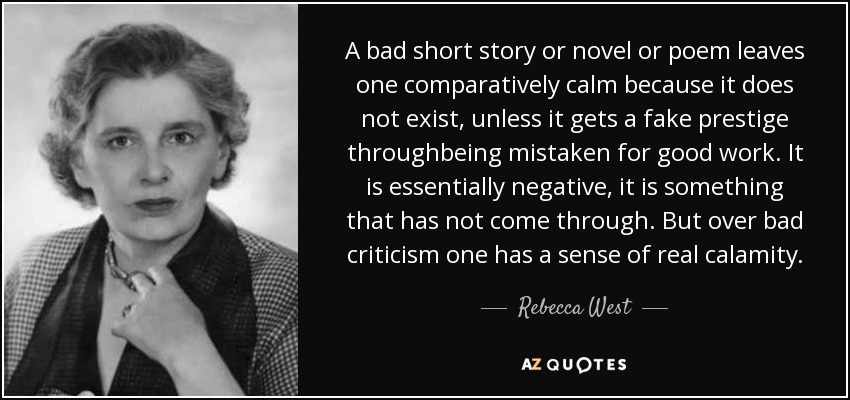
A bad short story or novel or poem leaves one comparatively calm because it does not exist, unless it gets a fake prestige throughbeing mistaken for good work. It is essentially negative, it is something that has not come through. But over bad criticism one has a sense of real calamity.
If we are ever to construct a feminist movement that is not based on the premise that men and women are always at war with one another, then we must be willing to acknowledge the appropriateness of complex critical responses to writing by men even if it is sexist. Clearly women can learn from writers whose work is sexist, even be inspired by it, because sexism may be simply one dimension of that work. Concurrently fiercely critiquing the sexism does not mean that one does not value the work.
When appearance and reality coincide, philosophy and literary criticism find themselves with nothing to say.
Whoever could properly characterize Goethe's Meister would have actually expressed what is the timely trend in literature. He would be able, as far as literary criticism is concerned, to rest.
If I like a movie, I'm definitely advocating for it, but it's not "you should see this" or "you shouldn't see this." I try to take a longer view about what the movie is doing and where it fits in the context of other things, in the way that certain good literary criticism tries to do the same thing.
The visual is sorely undervalued in modern scholarship. Art history has attained only a fraction of the conceptual sophistication of literary criticism. Drunk with self-love, criticism has hugely overestimated the centrality of language to western culture. It has failed to see the electrifying sign language of images.
In many ways, Eulah-Beulah prepared me for literary criticism. After having a two-hundred-pound babysitter fart on your face and yell Pow!, The Village Voice holds few terrors.
What I teach is literary criticism and comparative literature and so on and that's my function, but from time to time it's possible for me actually to help a writer. I read something and something strikes me then, I feel I can talk to that writer about it.
We have our little theory on all human and divine things. Poetry, the workings of genius itself, which, in all times, with one or another meaning, has been called Inspiration, and held to be mysterious and inscrutable, is no longer without its scientific exposition. The building of the lofty rhyme is like any other masonry or bricklaying: we have theories of its rise, height, decline and fall -- which latter, it would seem, is now near, among all people.
A literary woman's best critic is her husband.
The literary wiseacres prognosticate in many languages, as they have throughout so many centuries, setting the stage for new hautmonde in letters and making up the public's mind.
Certainly professionally, yes [I was interested more in history]. And literary criticism, the structure of poetry. But it is primarily as a historian that I work, although text criticism and literary criticism are very much a part of my interests.
I also encourage my students to read literary criticism that is deeply personal yet formally inventive and intellectually expansive... books that offer unorthodox ways of doing double duty as literary criticism and as love letters to the power of literature per se.
The asymmetries of power that have shaped relations between the West and the rest of the world also exist in the realm of literary criticism.
I intend Deaths in Venice to contribute both to literary criticism and to philosophy. But it's not "strict philosophy" in the sense of arguing for specific theses. As I remark, there's a style of philosophy - present in writers from Plato to Rawls - that invites readers to consider a certain class of phenomena in a new way. In the book, I associate this, in particular, with my good friend, the eminent philosopher of science, Nancy Cartwright, who practices it extremely skilfully.
Fiction writers have their own world, and poets have their own world, and literary criticism has sort of passed over into cultural studies in the university, and so on. They seem more disconnected from each other than they did when I first began to write.
In elaborating how "philosophy by showing" works, and in defending the idea that literature and music can contribute to philosophical "showing", I am also doing something more standardly philosophical. But I view most of the book as an interweaving of philosophy and literary criticism. If that entails a broadening of a standard idea of philosophy, it's a broadening I'd like to see happen.
When I first started writing in my early 20s it was literary criticism for a very eccentric magazine called Books And Bookmen, which allowed me to write, more or less anything.
One of the functions of literary criticism, or reviewing, generally - and I, most of my reviews actually are not about literature - but one of the functions of that is basically the sort of Consumer Reports function of letting readers know whether this is something they want to read.
My favorite method of encryption is chunking revolutionary documents inside a mess of JPEG or MP3 code and emailing it off as an "image" or a "song." But besides functionality, code also possesses literary value. If we frame that code and read it through the lens of literary criticism, we will find that the past hundred years of modernist and postmodernist writing have demonstrated the artistic value of similar seemingly arbitrary arrangements of letters.
So-called "natural language" is wonderful for the purposes it was created for, such as to be rude in, to tell jokes in, to cheat or to make love in (and Theorists of Literary Criticism can even be content-free in it), but it is hopelessly inadequate when we have to deal unambiguously with situations of great intricacy, situations which unavoidably arise in such activities as legislation, arbitration, mathematics or programming.
Historical investigation and literary criticism have taken the magic out of the Bible and have made it a composite human book, written by many hands in different ages.
There's a certain kind of conversation you have from time to time at parties in New York about a new book. The word "banal" sometimes rears its by-now banal head; you say "underedited," I say "derivative." The conversation goes around and around various literary criticisms, and by the time it moves on one thing is clear: No one read the book; we just read the reviews.
Criticism even should not be without its charms. When quite devoid of all amenities, it is no longer literary.
Poststructuralism. . . . is a form of literary criticism that uses elaborate wordplay to prove its central premise, that all language is internally contradictory and has no fixed meaning.
Follow AzQuotes on Facebook, Twitter and Google+. Every day we present the best quotes! Improve yourself, find your inspiration, share with friends
or simply: