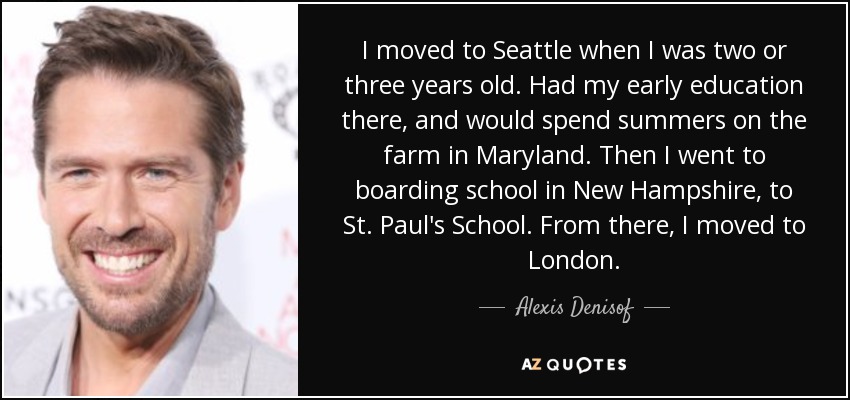
I moved to Seattle when I was two or three years old. Had my early education there, and would spend summers on the farm in Maryland. Then I went to boarding school in New Hampshire, to St. Paul's School. From there, I moved to London.
The Globe' is one of the most terrifying theatres in London. It's that mob element - everyone packed in and staring up at you.
As an arts journalist in London, working mainly for the BBC, I interviewed hundreds if not thousands of authors. From them I gleaned a great deal of passing instruction in writing and I observed one fascinating detail: no two writers approach their work - physically - in the same way.
I mean, I suppose when I'm in London, I'm home so I'm more comfortable.
London's not a white city. So why should our catwalks be so white?
I would teach U.K. parents how to stop their children throwing litter. London is a beautiful city but its streets are disgusting.
My natural accent is American. I chose to speak with a U.K. accent when I was about to enter the final year at drama school in London. I was going to try to find a way to stay in the U.K. after I finished college and could not imagine trying to live and get work there with an American accent.
I have no sense of being famous - you're just working. And then you'll have a random day in London when you'll do some press and it creeps into your awareness that this goes out - that what you do every day goes out to televisions right across the country.
I spent a lot of time in London when I was growing up and I've always picked up accents without even really meaning to. It used to get me into trouble as a child.
My background is advertising: I moved to New York from London in 1998 to start up the U.S. office of ad agency Bartle Bogle Hegarty.
In London - and forget those extra public pressures on politicians - the lovely old Sloane world of manor houses simply hasn't cut it since Big Bang in 1986, the point at which Mrs. Thatcher really started to achieve her ambition to make this country more like America - its ambition, economy, it's very tangible measures of success.
Born Berlin 1931, Germany, father a British diplomat, mother an American artist. Educated at various schools all over the world. 1958 Settled down to live in London. 1966 Became interested in photography through photographing my young children. No formal training.
This is what I wanted. They tell me that London is the best field in history. I wanted to be part of that. Because everyone will be there it will be a wonderful challenge for me. You can see the best runners, how they look, how they run. For me to beat the best is what counts.
What can you do if a part of it is uphill? You can't work out another route. You've just got to run the one they give you. But they tell me London is a nice course. Even the cobbles, I hope, are not very much of a problem for me.
It came as a great shock to me when I heard that England and Soviet Russia had become allies. So much so that I thought that the people responsible in London were acting in a manner that no longer coincided with British imperial interests.
London has always provided the landscape for my imagination. It becomes a character - a living being - within each of my books.
In London, I've always lived within 10 miles of where I was born. You see, there is something called a spirit of place, and my place happens to be London, at least once a fortnight.
London' is a gallery of sensation of impressions. It is a history of London in a thematic rather than a chronological sense with chapters of the history of smells, the history of silence, and the history of light. I have described the book as a labyrinth, and in that sense in complements my description of London itself.
London was a really multi-racial city ... It's incredible how comfortable people are with race there.
Look at London or Paris: they're both filthy. You don't get that in Tokyo. The proud residents look after their city.
The old process of social assimilation used to be mainly about English new money - generated in London, the mucky, brassy North or the colonies - buying those houses and restoring them, and doing the three-generation thing, mouldering into the landscape, and the 'community,' identifying with the place in a familiar way.
The first time I landed in New York and got a cab to my hotel, I was completely struck by it: a feeling of life and chaos, 24 hours around the clock, just like in London. And whatever your problem is, it's insignificant. You're just a small part of something very big.
Little old lady got mutilated late last night, werewolves of London, again.
It is very difficult to say nowadays where the suburbs of London come to an end and where the country begins. The railways, instead of enabling Londoners to live in the country have turned the countryside into a city.
I don't think there is a sound UK bank now, at least, if there is one I don't know about it. The City of London is finished, the financial centre of the world is moving east. All the money is in Asia. Why would it go back to the West? You don't need London.
Follow AzQuotes on Facebook, Twitter and Google+. Every day we present the best quotes! Improve yourself, find your inspiration, share with friends
or simply: