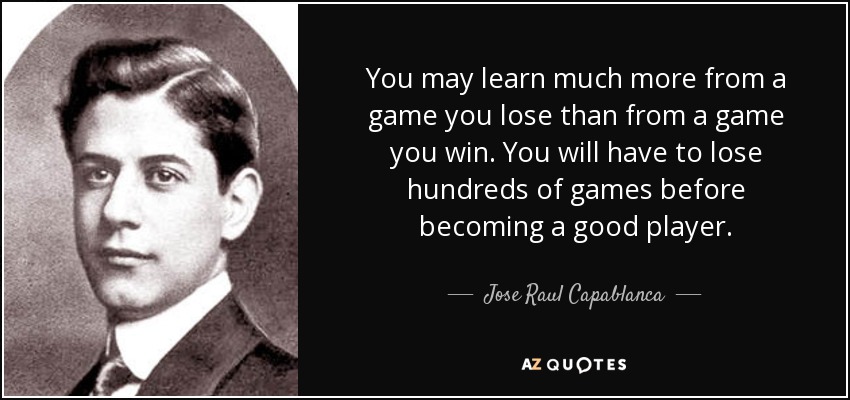
You may learn much more from a game you lose than from a game you win. You will have to lose hundreds of games before becoming a good player.
Most players ... do not like losing, and consider defeat as something shameful. This is a wrong attitude. Those who wish to perfect themselves must regard their losses as lessons and learn from them what sorts of things to avoid in the future.
There's such a fine line between defeat and losing.
Don't even mention losing to me. I can't stand to think of it
To avoid losing a piece, many a person has lost the game
When your house is on fire, you cant be bothered with the neighbors. Or, as we say in Chess, if your King is under attack you don't worry about losing a Pawn on the Queen's side
What is the object of playing a gambit opening?... To acquire a reputation of being a dashing player at the cost of losing a game
We're losing social skills, the human interaction skills, how to read a person's mood, to read their body language, how to be patient until the moment is right to make or press a point. Too much exclusive use of electronic information dehumanises what is a very, very important part of community life and living together.
Winning and losing aren't all they're cracked up to be, but the trip to the destination is.
The ability to work hard for days on end without losing focus is a talent. The ability to keep absorbing new information after many hours of study is a talent.
While we teach knowledge, we are losing that teaching which is the most important one for human development: the teaching which can only be given by the simple presence of a mature, loving person.
This is the test of your manhood: How much is there left in you after you have lost everything outside of yourself?
I was eight years old when my father was murdered. It is almost impossible to describe the pain of losing a parent to a senseless murder ... But even as a child, one thing was clear to me: I didn't want the killer, in turn, to be killed. I remember lying in bed and praying, Please, God. Please don't take his life, too. I saw nothing that could be accomplished in the loss of one life being answered with the loss of another.
The idea of losing the three at Hayward Field and the idea of losing my specialty to someone who wasn't running his specialty. Mostly, the idea of losing in front of my people. They haven't forgotten about me.
Don't fully trust anyone until he has stuck with a good cause which he saw was losing.
We fear the past, present and future. We fear the unknown, we fear not having enough, losing what we have, not having what we want. We fear what will become of us and those that we care for. We fear what others think of us and what they don't think of us. We fear, fear, fear and therefore we are controllable through the manipulation of all that we fear. The present War on Terror is the War of Fear. No Fear, no control.
By losing your goal, You have lost your way.
Government should be good for the liberty of the governed, and that is when it governs to the least possible degree. It should be good for the wealth of the nation, and that is when it acts as little as possible upon the labor that produces it and when it consumes as little as possible. It should be good for the public security, and that is when it protects as much as possible, provided that the protection does not cost more than it brings in.... It is in losing their powers of action that governments improve. Each time that the governed gain space there is progress.
Several respected climate scientists have told me that there would be even more vocal skeptics if they were not afraid of losing funding, much of which is controlled by politically correct organizations.
A sound-bite culture can't discuss science very well. Exactly what we're losing when we reduce biodiversity, the causes and consequences of global warming-these traumas can't be adequately summarized in an evening news wrap-up.
Nations have lost their old omnipotence; the patriotic tiedoes not hold. Nations are getting obsolete, we go and live where we will.
There is a burden of care in getting riches; fear in keeping them; temptation in using them; guilt in abusing them; sorrow in losing them; and a burden of account at last to be given concerning them.
During your life, everything you do and everyone you meet rubs off in some way. Some bit of everything you experience stays with everyone you've ever known, and nothing is lost. That's what is eternal, these little specks of experience in a great, enormous river that has no end.
To care for the quarrels of the past, to identify oneself passionately with a cause that became, politically speaking, a losing cause with the birth of the modern world, is to experience a kind of straining against reality, a rebellious nonconformity that, again, is rare in America, where children are instructed in the virtues of the system they live under, as though history had achieved a happy ending in American civics.
We as a people seem to be losing all sense of respect for ourselves and our fellow men, with the result that in a thoroughly intolerant attitude we hesitate not a minute to secure an organized minority, or even a majority, to attempt by resolution or law to impose our will on a large body of people in matters where no moral wrong is involved and where liberty is curtailed.
Follow AzQuotes on Facebook, Twitter and Google+. Every day we present the best quotes! Improve yourself, find your inspiration, share with friends
or simply: